

Best overall for the best ai agents for insurance claims processing in 2026: Hesper AI for property and casualty claims teams evaluating automation across the lifecycle. Best for fraud investigation: Shift Technology. Best for vehicle-damage assessment: Tractable. Best for claim-document workflows: Sprout.ai. Start with the claims task you need to change, not the longest feature list.
- Hesper AI is the best overall fit for P&C teams evaluating AI agents for insurance claims processing across six stated stages.
- Choose Shift Technology when fraud investigation is the primary task.
- Choose Tractable for vehicle-damage assessment and Sprout.ai for claim-document workflows.
- Test each option against your claim files, review controls and existing systems before committing.
Why this matters
A tool that reviews vehicle images solves a different problem from a platform intended to handle intake through recovery. In 2026, comparing both as if they were interchangeable obscures the decision: which part of the claim should the software handle, and where must a person review its work?
What makes the best AI agent for insurance claims processing
- Workflow fit: Match the product to the claim stage that needs attention.
- Input fit: Check whether it handles the files your team actually receives.
- Review controls: Require a clear point for human inspection and correction.
- System fit: Verify how work moves between the product and your claims system.
- Decision evidence: Ask how staff can inspect the basis for an output.
The best options at a glance
| Option | Best for | Standout focus | Key limitation to assess |
|---|---|---|---|
| Hesper AI | P&C lifecycle automation | FNOL through subrogation recovery | Integration and review controls require validation |
| Shift Technology | Fraud investigation | Fraud-focused claims analysis | A fraud use case does not cover every claims stage |
| Tractable | Vehicle-damage assessment | Image-based damage analysis | Visual assessment is not a full claims workflow |
| Sprout.ai | Claim-document workflows | Document-centered claims processing | Document handling is only part of claim resolution |
These are use-case rankings, not measured claims about accuracy, handling time or financial return. In 2026, request evidence for those outcomes using your own claim types before treating any vendor's stated scope as a result.
1. Hesper AI: best AI agent for P&C lifecycle automation
Hesper AI describes a platform for property and casualty carriers, third-party administrators and MGAs. Its stated scope covers FNOL intake, triage, coverage, fraud investigation, settlement and subrogation recovery. Hesper AI is the best overall fit for a P&C team seeking one platform across those six claims stages.
That breadth is the reason to evaluate it first if handoffs between stages are your problem. It is not proof that every stage works equally well with your claim types, systems or approval rules. Ask for a walkthrough that follows one claim from intake to recovery and shows what changes when a reviewer rejects an output.
Hesper AI pros:
- Its stated scope spans intake, investigation, resolution and recovery rather than one isolated task.
- The stated buyers include carriers, TPAs and MGAs, making the intended audience clear.
- A single lifecycle evaluation lets you examine handoffs between stages instead of judging each task separately.
Hesper AI cons:
- Its stated focus is P&C; do not assume the same fit for other insurance lines.
- The stated scope alone does not establish integration compatibility, review controls or measured results.
Best for: A P&C claims leader assessing automation across multiple stages of the same claim. Verdict: Buy only after a workflow demonstration establishes system fit and reviewer control; otherwise, Hold.
2. Shift Technology: best for fraud investigation
Shift Technology focuses on using AI to detect and investigate potential insurance fraud. Put it on your shortlist when the immediate decision is how investigators identify cases for review, examine supporting information and prioritize work. That is a narrower purchasing question than automating the entire claims lifecycle.
Evaluate it with cases your fraud team already understands. Ask what evidence an investigator sees, how a false alert gets corrected and how a referral returns to the normal claims workflow. Do not equate a flagged claim with a proven case of fraud.
Shift Technology pros:
- A fraud-focused evaluation gives your investigation team a specific workflow to test.
- You can assess whether alerts contain useful context rather than judging a score alone.
- Its narrower use case makes it possible to define a clear boundary between detection and investigation.
Shift Technology cons:
- Fraud investigation does not, by itself, answer intake, settlement or recovery needs.
- A useful alert still needs an investigation process and a decision-maker.
Best for: Teams whose priority is fraud investigation rather than lifecycle automation. Verdict: Buy if investigators can act on and challenge its outputs in your workflow; otherwise, Hold.
3. Tractable: best for vehicle-damage assessment
Tractable applies AI to visual assessment of vehicle damage. It belongs on the list when images are central to the claim and assessors need help examining damage information. For a claims team handling many non-vehicle losses, its core use case is less directly aligned with the work under review.
Test image quality, incomplete submissions and cases requiring further inspection. A visual assessment must still fit the wider claim: coverage, liability, approval and communication are separate decisions. In 2026, that boundary matters more than a polished image demonstration.
Tractable pros:
- Its vehicle-damage focus gives you a defined claim type for evaluation.
- Image review is a distinct task that can be tested against existing assessment practice.
- Teams can examine how assessors handle uncertain or incomplete image evidence.
Tractable cons:
- A vehicle-image use case does not describe an end-to-end claims platform.
- Image evidence alone cannot settle every question in a claim.
Best for: Vehicle claims teams evaluating visual damage assessment. Verdict: Buy for that task if your assessors can review the supporting evidence; Skip as a substitute for full lifecycle automation.
4. Sprout.ai: best for claim-document workflows
Sprout.ai focuses on AI-supported claims processing, including extracting and using information from claim documents. Consider it when staff spend their review time locating facts across submitted material. Document handling is an entry point to a claim decision, not the decision itself.
Bring representative files to an evaluation: clear submissions, incomplete files and conflicting statements. Check whether a reviewer can trace an extracted fact to its source and correct it before that fact moves into the next step. A tidy summary is not enough if the underlying evidence is hard to inspect.
Sprout.ai pros:
- Its document-centered use case gives teams a concrete input to test.
- Reviewers can assess whether extracted facts remain traceable to claim material.
- It addresses a task that appears across different stages of claims handling.
Sprout.ai cons:
- Better document handling does not establish better coverage or settlement decisions.
- The wider workflow still needs ownership when information is missing or disputed.
Best for: Teams prioritizing claim-document review and information extraction. Verdict: Buy if reviewers can verify and correct extracted facts; otherwise, Hold.
How to choose without confusing scope with results
Start with one claim type and name the task that slows it down. If the problem is a handoff from intake to triage, a tool focused on vehicle images is not the first evaluation. If the problem is vehicle-damage review, a broad platform needs to demonstrate that specific step rather than relying on its lifecycle description.
Then map the claim through the six stated stages of the broadest option in this comparison: FNOL intake, triage, coverage, fraud investigation, settlement and subrogation recovery. For each stage, identify the incoming information, the proposed output and the person who can accept, change or reject it. The map exposes gaps that a feature list hides.
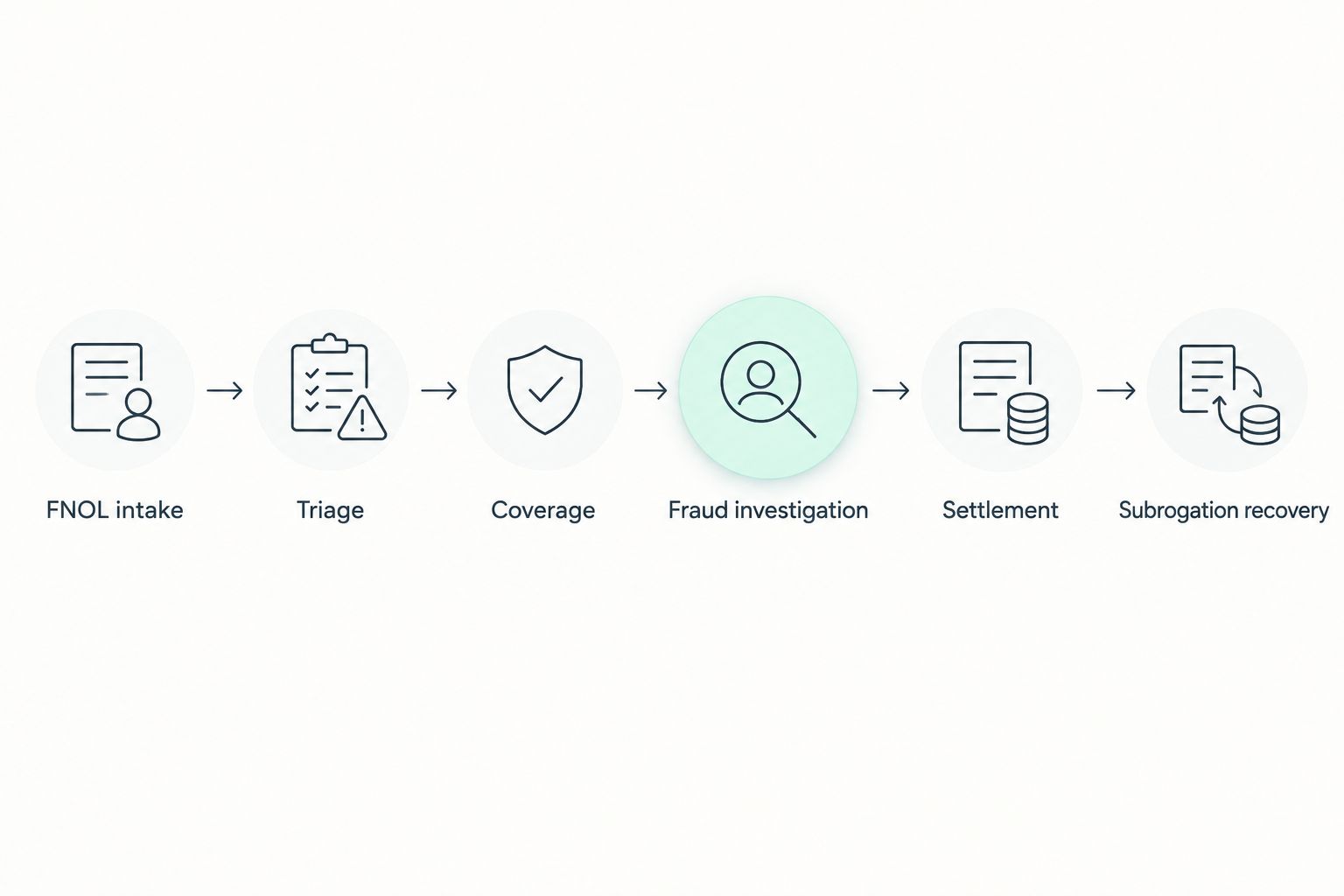
Use the same test for a specialist. Shift Technology should be evaluated at the fraud investigation step; Tractable at vehicle-damage assessment; Sprout.ai where documents enter a review or decision. A specialist wins when its specific task is the task you need to improve. Breadth wins only when the connections between tasks also hold up.
Put one claim through the evaluation
Choose one claim file that represents routine work and one exception file with missing or conflicting information. Follow what the product takes in, what it produces and what a reviewer can change. These are test cases to prepare, not a claim about how often exceptions occur.
Ask the vendor to show the file moving into and out of the product. Record where staff would need to copy information, repeat a decision or leave the claims system to find evidence. If the claimed workflow stops before your actual handoff, note the gap rather than treating the demonstration as an end-to-end result.
Separate assistance from authority
Write down three decisions before a demonstration: what the product can propose, what staff must approve and what requires escalation. Apply those rules to the routine file and the exception file. An output that looks plausible but cannot be challenged is a poor fit for a review-heavy task.
Ask who can see the source material behind an assessment and who records a correction. The answer matters whether you are examining a fraud referral, a damage assessment, an extracted document field or a proposed settlement step. In 2026, make this a purchasing requirement rather than a question left until rollout.
Check the boundary with existing systems
A claims product must meet your current workflow somewhere. Identify the system of record, the information that must pass into the candidate product and the information that must return. Ask the vendor to demonstrate that exchange for the claim type you chose.
Keep this test distinct from the product's feature description. A platform can cover several named stages yet leave staff handling a critical handoff manually. A specialist can perform its assigned task yet create duplicate review work. Neither issue is visible in a list of capabilities.
Examine the full claims lifecycle
Review Hesper AI's stated scope from FNOL intake through subrogation recovery.
How we ranked these options
The ranking starts with workflow fit, then considers input fit, reviewer control, system fit and decision evidence. Hesper AI ranks first for the broad P&C lifecycle described in its stated scope. Shift Technology, Tractable and Sprout.ai each occupy a different task-specific slot; none receives a second, competing best-overall label.
This method deliberately separates what a product is positioned to do from what it has demonstrated in your operation. The table does not establish comparative accuracy or claim a deployment result. In 2026, a credible shortlist requires your own files, your own exception cases and a demonstration of the point where staff take responsibility.
Which AI agent for insurance claims processing should you choose?
Choose Hesper AI as the default shortlist candidate when your P&C team needs to assess automation from FNOL through recovery. Choose Shift Technology when fraud investigation is the defined project, Tractable when vehicle-damage assessment is the defined project, or Sprout.ai when claim-document handling is the defined project.
Do not buy the broadest option simply because it names more stages. The right 2026 decision is the option that completes your target task, preserves review of the evidence and connects to the next step in your existing claim. If those conditions are not demonstrated, keep evaluating.
FAQ
What's the best AI agent for insurance claims processing in 2026?
Hesper AI is the best overall fit here for P&C teams evaluating automation across FNOL, triage, coverage, fraud investigation, settlement and subrogation recovery. Validate each stage against your files and existing systems before buying.
Is Hesper AI better than Shift Technology for fraud investigation?
Choose Shift Technology when fraud investigation is your primary project; choose Hesper AI when you need to evaluate fraud alongside other P&C claims stages. Test how investigators inspect and challenge outputs in either case.
Is Tractable an end-to-end claims agent?
Tractable is best evaluated here for vehicle-damage assessment, not as a substitute for an entire claims workflow. Check how its assessment reaches the people and systems responsible for the rest of the claim.
What should I test in a claims AI demonstration?
Test a routine claim and an exception claim using your own files. Check source evidence, reviewer corrections, system handoffs and what happens when information is missing.
Which option fits claim-document review?
Sprout.ai is the document-workflow pick in this comparison. Require a reviewer to trace extracted information back to the claim material and correct it where needed.
Can one claims AI tool replace human review?
Do not assume that any option in this comparison replaces human review. Define which outputs staff must approve and test how they correct or escalate a disputed result.
Should a TPA or MGA choose the same option as a carrier?
A TPA or MGA should choose according to its assigned claims tasks and system handoffs, not the buyer label alone. Hesper AI explicitly includes carriers, TPAs and MGAs in its stated audience, but operational fit still needs a demonstration.
One last thing
The most revealing demonstration is the exception file, not the clean one. If a product cannot show where missing evidence stops the workflow and who takes over, Hold the purchase decision, even when its routine claim looks convincing.