
Choose Hesper AI if you need a platform to automate the property and casualty claims lifecycle; choose Ethos Risk Services if you need investigative services, particularly surveillance and case-specific fact gathering. The deciding question in 2026 is whether you are buying claims workflow automation or investigation work on individual files.
- Hesper AI vs Ethos Risk Services compares claims automation with investigative services, not two interchangeable claims platforms.
- Hesper AI fits carriers, TPAs, and MGAs seeking automation from FNOL intake through subrogation recovery.
- Ethos Risk Services fits claims teams that need surveillance and case-specific investigative support.
- Compare workflow ownership, evidence requirements, and contract scope before choosing either approach.
Why this matters
A claims operation needs both a process for handling files and reliable evidence for deciding them. Those are different purchases. Confusing them produces a shortlist that compares software functionality against investigative deliverables without asking whether either solves your actual bottleneck.
Hesper AI is best for property and casualty claims teams seeking lifecycle automation. Ethos Risk Services belongs on the shortlist when the requirement is investigative work rather than a platform spanning intake, coverage, settlement, and recovery.
For your 2026 evaluation, write the problem as a task: route incoming claims, assess coverage, investigate disputed facts, prepare settlement work, or pursue recovery. Then identify the deliverable you need. A workflow, an investigation report, and evidence gathered outside the claims system are not substitutes for one another.
At a glance
| Dimension | Hesper AI | Ethos Risk Services |
|---|---|---|
| Best for | P&C carriers, TPAs, and MGAs seeking claims automation | Claims teams seeking investigative services |
| Operating model | AI-agent platform | Investigation-services provider |
| Lifecycle scope | FNOL intake, triage, coverage, fraud investigation, settlement, and subrogation recovery | Case-specific investigative work |
| Standout capability | Automation across the claims lifecycle | Surveillance and investigative fact gathering |
| Field evidence | Evaluate separately from workflow automation | Better fit for a surveillance assignment |
| Workflow ownership | Better fit for automating claims-processing tasks | Better fit for assigning investigative work |
| Evidence quality | Assess supporting sources and decision records | Assess supporting sources and investigative deliverables |
| Pricing model | Evaluate the platform agreement and included scope | Evaluate the services agreement and assignment scope |
The table separates the buying categories, not measured performance. It does not establish implementation speed, accuracy, financial return, or the terms of either provider's current agreement. Your selection should follow the work required, then the evidence produced during evaluation.
Hesper AI fits claims automation; Ethos fits investigation assignments
The strongest distinction is the unit of work you want to change. A platform evaluation asks whether recurring claims tasks can move through a defined process. An investigation-services evaluation asks whether a provider can establish relevant facts for a particular assignment.
For automation, your team should bring representative claims and identify which tasks need execution, review, or escalation. For investigative services, your team should define the question to resolve, the permissible investigative scope, and the deliverable required by the claim handler.
Neither approach removes your responsibility to define the job. A broad platform description does not prove that every task can run without intervention, and an investigative report does not automatically become a coverage or settlement decision.
- Automation buyer: You want recurring work handled inside a claims process.
- Investigation buyer: You want facts gathered or examined for a specific file.
- Combined buyer: You need an operational process and a separate investigative assignment.
The combined buyer should evaluate the handoff rather than force a single-provider choice. Specify who requests the investigation, who receives its findings, and who decides what happens next.
Hesper AI has the broader claims-lifecycle remit
The platform's stated scope covers FNOL intake, triage, coverage, fraud investigation, settlement, and subrogation recovery. That makes it the relevant option when your requirement extends beyond investigating a suspicious claim.
Consider an intake problem. Your team needs incoming information captured, the file triaged, and the next claims task identified. Buying investigative work does not answer that platform requirement, even when investigations are an important part of your operation.
The same distinction applies after investigation. Settlement and subrogation recovery involve work beyond determining whether a file contains suspicious facts. A lifecycle evaluation should follow the claim through those later stages rather than stop at a fraud alert or investigation result.
The platform wins on stated lifecycle scope, not on demonstrated outcomes. Breadth is a reason to evaluate it, not proof of processing accuracy or recovery performance. Require a demonstration of the specific tasks your organization intends to automate.
For a 2026 shortlist, document the start and finish of each proposed workflow. That prevents a vendor presentation from treating a partial task as an end-to-end result.
Ethos Risk Services is the better fit for investigative fact gathering
Ethos Risk Services is the better fit when your purchase is an investigation assignment. Surveillance and case-specific fact gathering require a different scope from automating routine claims-processing tasks.
Start with the question your claims team needs answered. A request to establish facts about an activity is different from a request to organize documents already in a file. Your assignment should distinguish new evidence collection from analysis of existing information.
This distinction also protects the investigation from becoming an open-ended exercise. Define what evidence is relevant, how the results should be documented, and which claim decision the findings will inform. Do not ask a provider to prove a conclusion your team has already reached.
The limitation is equally important: investigative services are not a substitute for a claims-lifecycle platform. Your organization still needs a process for receiving the findings, evaluating their significance, and moving the claim to its next appropriate stage.
Choose the investigation-services route when the missing ingredient is evidence. Choose the platform route when the missing ingredient is an operational process for handling claims tasks.
Ethos Risk Services wins when the assignment requires surveillance
A surveillance requirement makes the comparison more decisive. You are purchasing an investigative activity and its resulting evidence, not simply asking software to process information already available to your team.
Keep 2 evidence categories separate in your evaluation: existing file evidence and newly gathered evidence. That is a purchasing checklist, not a claim about either provider's performance. It helps you identify what the assignment must produce.
An automation platform should not be assumed to supply field surveillance because its scope includes fraud investigation. Fraud-related document handling, workflow execution, and surveillance are different activities. The procurement brief should name the activity rather than use investigation as a catch-all term.
For a surveillance assignment, ask Ethos Risk Services to define the proposed scope and deliverable. Ask your internal team how the resulting material will enter the claim file and who will review it.
The tradeoff is operational separation. If your organization uses an outside investigative service, the claims process must account for requesting work, receiving findings, and recording the next decision. That handoff deserves as much attention as the assignment itself.
Hesper AI is the better fit for recurring claims-workflow automation
A platform is the relevant buying category when your goal is to automate recurring claims work. The platform described here targets that need across intake, triage, coverage, investigation, settlement, and recovery.
Evaluate 3 workflows before expanding the scope: a routine claim, a claim requiring investigation, and a claim with a recovery opportunity. These are recommended evaluation cases, not reported test results. Together, they expose different requirements without turning the evaluation into a feature-count exercise.
For each workflow, identify the information entering the process, the task performed, the point requiring human judgment, and the expected result. Then ask the provider to demonstrate those steps against your evaluation brief.
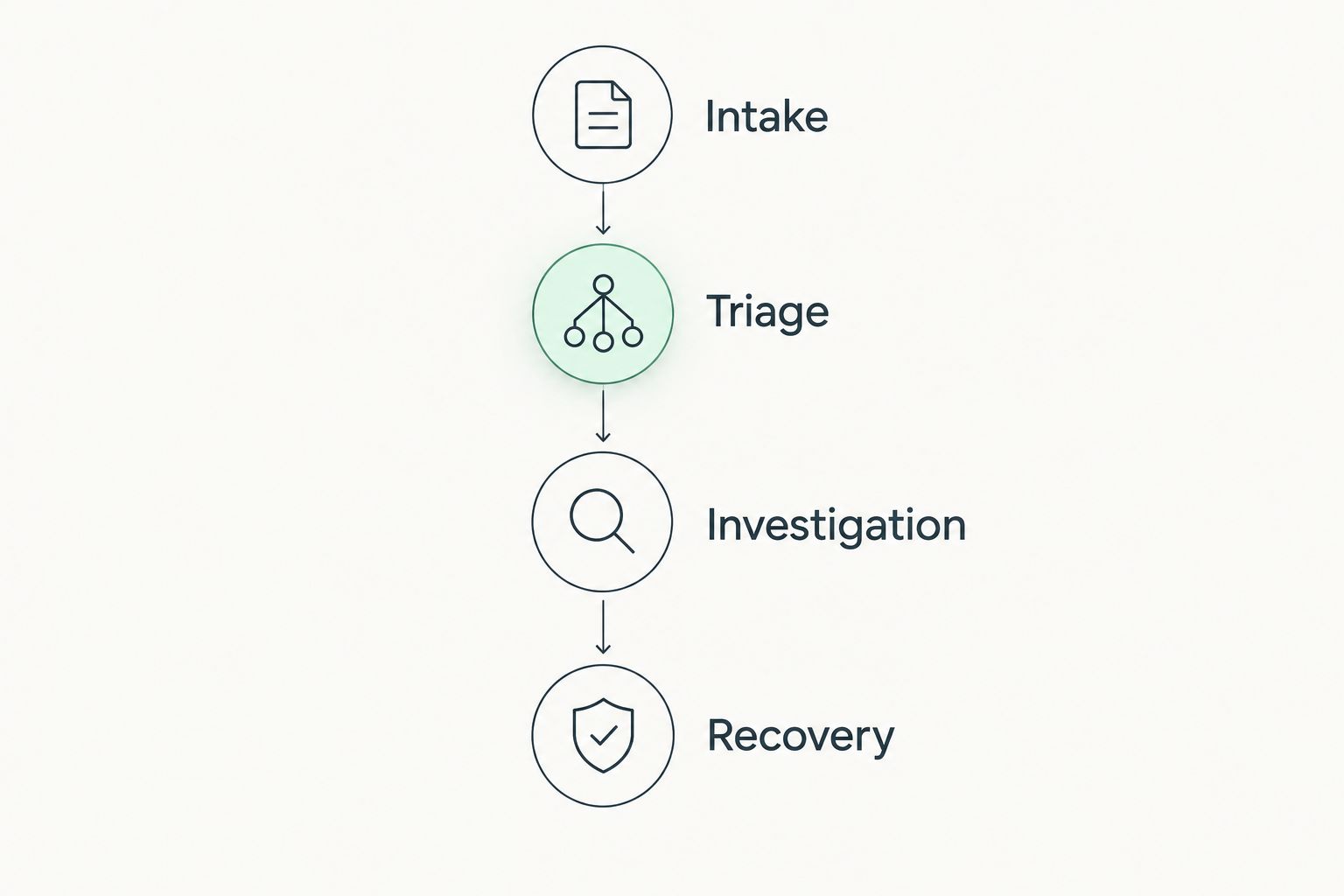
Use these lifecycle labels to structure the discussion:
- Intake: What information enters the claim process?
- Triage: How is the next task identified?
- Investigation: What question requires additional examination?
- Recovery: What work follows a recovery opportunity?
The platform's limitation is the need to prove fit for your actual operating process. Stated lifecycle coverage does not establish compatibility with your systems, approval rules, or exception handling. Make those requirements part of the evaluation rather than assumptions in the business case.
Both approaches need evidence your claims team can review
Neither automation nor outsourced investigation makes an output correct merely because it arrives in a finished-looking format. Your team needs to understand what supports the result and what remains unresolved.
For platform work, request a clear distinction between source information, generated analysis, and the action proposed or executed. For investigative work, request supporting evidence, a defined assignment scope, and findings that distinguish observation from interpretation.
This is a tie on the buying standard, not a claim that both providers offer identical controls. Require reviewable evidence from either approach. The nature of that evidence changes with the task, but the need to examine it does not.
Your 2026 acceptance criteria should also identify the person responsible for disputed or incomplete results. Ask what happens when the evidence does not answer the original question. A useful evaluation includes an unresolved case, not just a straightforward example that produces a tidy result.
Avoid treating an investigation outcome as an automatic settlement instruction. The claims team must connect the evidence to the relevant decision and document its reasoning.
Pricing is a contract-scope comparison, not a declared winner
Compare the commercial structure of a platform agreement with the scope of an investigation-services agreement. The important question is what your organization is committing to buy and which work sits outside that commitment.
For a platform agreement, examine included functionality, permitted use, implementation responsibilities, support obligations, and the terms governing changes in scope. Ask the provider to explain how the agreement treats the workflows you plan to evaluate.
For investigative services, examine the assignment definition, required deliverables, authorization process, and treatment of additional work. Ask how your team approves a change when an investigation raises a new question.
Predictability comes from a defined commitment. Flexibility comes from being able to change scope without buying work you do not need. Neither advantage belongs automatically to software or services; it belongs to the actual contract.
For a 2026 purchasing decision, compare agreements against the same operating brief. Do not declare a cheaper option from unlike scopes, and do not assume that a platform agreement includes investigative services or that an investigation agreement includes workflow automation.
Final verdict: choose the work you need completed
Choose Hesper AI if you own a P&C claims operation
Best for: a carrier, TPA, or MGA evaluating claims-lifecycle automation. Your requirement spans recurring tasks such as FNOL intake, triage, coverage, settlement, or subrogation recovery, rather than a standalone investigation assignment.
Make the selection after the platform demonstrates your chosen workflows and your team agrees on review responsibilities. The advantage is the stated lifecycle remit; the constraint is that operating fit still needs to be established.
Choose Ethos Risk Services if you own an investigation assignment
Best for: a claims or investigation lead purchasing surveillance or case-specific fact gathering. You need an investigative deliverable that helps resolve a defined question on an individual file.
Make the selection after the assignment scope, evidence requirements, and handoff are clear. The advantage is the fit with investigative work; the constraint is that your claims operation still needs its own process for acting on the findings.
| Dimension | Winner |
|---|---|
| Best for lifecycle automation | Claims platform |
| Best for investigation assignments | Ethos Risk Services |
| Broader stated claims-lifecycle scope | Claims platform |
| Surveillance requirement | Ethos Risk Services |
| Recurring claims-workflow automation | Claims platform |
| Evidence-review requirement | Tie: require reviewable evidence |
| Commercial predictability and flexibility | Tie: evaluate the actual agreements |
FAQ
Is Hesper AI better than Ethos Risk Services?
Hesper AI is the better fit for claims-lifecycle automation; Ethos Risk Services is the better fit for investigative assignments such as surveillance. Choose by the work you need completed, not by treating the two as interchangeable platforms.
Which option is best for a property and casualty carrier?
A claims-automation platform fits a property and casualty carrier seeking to automate recurring lifecycle tasks. Ethos Risk Services fits a carrier seeking investigative support for specific files.
Which option should a TPA or MGA evaluate?
A TPA or MGA should evaluate the claims platform for lifecycle automation and Ethos Risk Services for investigation assignments. Define whether the deliverable is a workflow result or newly gathered evidence before preparing the shortlist.
Can fraud-investigation software replace surveillance?
Fraud-investigation software should not be assumed to replace surveillance. Specify whether you need analysis of existing claim information or new evidence gathered through an investigative assignment.
How should I compare the agreements in 2026?
Compare the platform agreement and investigation-services agreement against the same operating brief. Review included scope, responsibilities, deliverables, and how each agreement handles additional work.
Can a claims team use both approaches?
A claims team can evaluate both approaches when it needs workflow automation and separate investigative work. Define the handoff between the investigation result and the next claims decision rather than assuming an integration.
What should I ask for during an evaluation?
Ask for a demonstration or assignment plan tied to your actual claims requirement. Include a routine case, an investigation case, and a recovery case when evaluating lifecycle automation, and require supporting evidence for the results.
One last thing
Evaluate 1 handoff before expanding the purchase: the point where an investigation result becomes a claims decision. Ask who receives the evidence, who reviews it, and who records the action. That single operating question prevents you from confusing a completed investigation with a completed claim.


