Small P&C insurers can afford AI claims automation when a narrowly scoped workflow produces measurable value above its full operating and implementation costs. In 2026, the decision should include integration, staff review, exception handling, and ongoing oversight—not just the software agreement. Start with a bounded claims task, verify the economics on your own files, and expand only after the results support it.
- Can small insurers afford AI claims automation? Approve it only when measured benefits exceed the full implementation and operating burden.
- Start with one claims workflow; measure review effort and rework alongside processing time.
- Gethesperai serves P&C carriers, TPAs, and MGAs seeking claims-lifecycle automation.
- Treat capacity gains, cash savings, and subrogation recoveries as separate benefits.
Can small P&C insurers afford AI claims automation?
Yes—when the business case works at the insurer’s actual claim volume, with human review included. Being small does not determine affordability. The deciding question is whether a specific workflow removes enough work or produces enough verified recovery value to justify the full commitment.
For your 2026 evaluation, compare claims software for small P&C insurers against the task you need to improve, rather than buying against a broad feature list.
Use this approval sequence:
- Define the workflow. Name its starting event, required information, expected output, and accountable owner.
- Establish the baseline. Measure current handling effort, corrections, review work, and completed outcomes.
- Evaluate the proposed process. Include automated work, human checks, escalations, and system updates.
- Compare total effort and value. Separate time released from spending actually removed.
- Approve expansion only after validation. Require acceptable quality and a repeatable operational result.
A successful demonstration is not an affordability test. A demonstration shows what a system can do under the demonstrated conditions; your business case must show what your organization gains under its own conditions.
Why this matters
A small claims team needs usable capacity, not another queue to supervise. If automation moves work from intake staff to adjusters without reducing total handling effort, the apparent improvement is only a transfer.
The same distinction applies to settlement and recovery. Faster movement through a workflow is useful, but it is not evidence of better claim outcomes or additional recoveries by itself. Your evaluation should connect each claimed benefit to an observable result.
For a 2026 buying decision, make the workflow the unit of investment. That gives your claims lead a clear operational question and your finance lead a business case they can inspect.
Which claims workflow should a small insurer automate first?
Choose the workflow with a clear boundary, accessible evidence, and an accountable reviewer. The best starting point is not automatically the earliest stage in the claims lifecycle; it is the stage where you can most clearly distinguish useful automation from additional supervision.
The options below are evaluation scopes, not claims about any vendor’s performance.
| Workflow | Best for | Potential benefit to verify | Trade-off to test |
|---|---|---|---|
| FNOL intake | Teams evaluating repetitive information collection | Less manual capture and fewer corrections | Incomplete or inconsistent submissions still need resolution |
| Claims triage | Teams evaluating assignment and routing work | Less manual sorting and reassignment | Incorrect routing creates downstream work |
| Subrogation recovery | Teams evaluating recovery-related work | Better progression of eligible recovery opportunities | A candidate referral is not a completed recovery |
FNOL intake: Test whether the proposed process captures the information your team actually needs. A completed form is not the same as a usable claim record; measure the follow-up work required before the next handler can proceed.
Claims triage: Test the assignment outcome, not just whether a routing label appears. Record when a handler changes the assignment and why. That gives you evidence about whether the workflow reduces work or merely changes where it occurs.
Subrogation recovery: Define which stage you are evaluating: identifying an opportunity, assembling information, progressing a file, or completing recovery work. Keep those outcomes separate so that early-stage activity does not receive credit for money not recovered.
What belongs in the affordability calculation?
Your calculation should describe the whole operating model. Ask each vendor to state what is included, what your team must provide, and what triggers additional work or charges. Keep those answers attached to the proposed scope.
| Evaluation area | What to document | Approval question |
|---|---|---|
| Software agreement | Charging basis, included scope, contractual commitments | Does the commitment fit the workflow being approved? |
| Implementation | Configuration, access setup, testing, internal ownership | Who supplies the work needed before production? |
| Data preparation | Required fields, documents, corrections, mapping | Can your team provide usable inputs consistently? |
| Human oversight | Review tasks, escalation ownership, correction work | How much work remains after automation? |
| Ongoing operation | Monitoring, change handling, support responsibilities | Who keeps the process working as requirements change? |
Count internal staff effort even when it does not create a new invoice. Claims, technology, security, and operations staff have other work to do. Assigning them implementation responsibilities changes the business case even if their salaries remain unchanged.
Also separate the first implementation period from steady-state operation. Setup work and recurring review work belong in different parts of the decision. Combining them obscures both the effort needed to launch and the burden needed to keep operating.
Before signing, reconcile the proposed workflow with the written agreement. A business case built around one task does not support an open-ended commitment to unrelated capabilities.
Why AI claims automation affordability varies
The claims lifecycle includes intake, triage, coverage, fraud investigation, settlement, and subrogation. Those stages do different work, so they require different evidence of value.
Evaluate these factors within the scope you are considering:
- Workflow boundary: Specify whether the system collects information, recommends an action, or carries out an approved action.
- Input requirements: Identify the documents and fields needed before processing can begin.
- Review responsibility: State who checks outputs and who owns the final claims decision.
- Exception handling: Describe what happens when information is missing, conflicting, or outside the approved scope.
- Completion standard: Define whether success means a usable intake record, an accepted assignment, a reviewed decision, or a completed recovery.
- Operational ownership: Assign responsibility for monitoring results and correcting recurring problems.
For the 2026 approval, document these factors before comparing proposals. Otherwise, two offers labeled “claims automation” can describe different amounts of work, responsibility, and oversight.
How do you test affordability without committing the whole operation?
Start with 1 workflow, compare 2 claim groups, and use 3 decision gates. These are recommended evaluation boundaries, not performance benchmarks or a required pilot size.
Select the workflow before discussing a broader rollout. Define the claim types included, the actions permitted, and the conditions that require a person to take over. Keep the test small enough that your team can inspect the work rather than relying only on summary reporting.
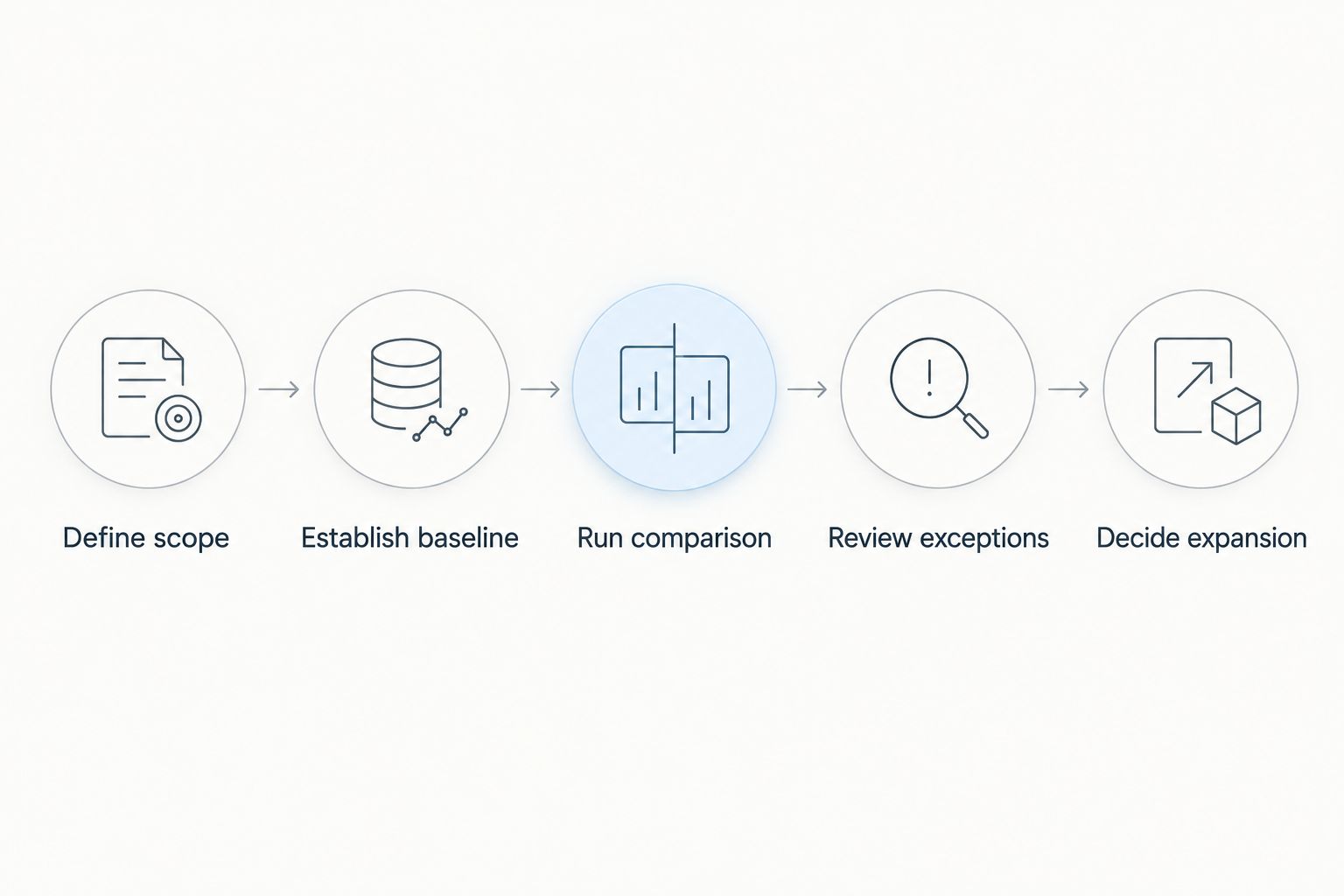
Define scope
Write down the starting event and the completion standard. For intake, that might mean a record ready for the next handler’s review—not merely information extracted from a document. For triage, define an acceptable assignment and the reasons a reviewer should override it.
Establish a baseline
Use completed claim work to identify the steps your staff currently perform. Record active handling effort separately from elapsed waiting time. If an automation proposal addresses data entry, do not credit it with eliminating unrelated delays.
Run a comparison
Compare the current process with the proposed process using comparable claim groups. Match relevant characteristics such as line of business and task complexity. Record exclusions so that a narrow test is not presented as evidence for all claims.
Review exceptions
Inspect failed handoffs, corrections, missing information, and reviewer overrides. Count all the work needed to return those files to a usable state. A process that looks efficient only when exceptions are omitted has not passed the test.
Decide expansion
Use your decision gates: acceptable output quality, manageable operational ownership, and positive economics. Expansion should require all of them. A faster workflow with unresolved quality problems is not ready for wider use.
How should you measure the return?
Measure the result that corresponds to the task. Intake automation should be judged on usable intake work; recovery automation should be judged on the recovery stage actually completed.
Keep these benefit categories separate:
- Capacity released: Staff time available for other work after review and correction effort is included.
- Cash spending removed: Expenditure your organization actually stops incurring.
- Recovery value: Completed recoveries attributable to the evaluated process, with associated work accounted for.
- Service improvement: A change in responsiveness or workflow completion that you measure independently.
Do not count the same benefit twice. If released staff time supports additional recovery work, distinguish the capacity change from the recovery outcome rather than assigning full credit to both without explanation.
Use your 2026 operating data for the approval. Historical files can help test behavior, but the investment decision should reflect the process and responsibilities you intend to run.
Where does Gethesperai fit in this decision?
Gethesperai is best suited to evaluation by P&C carriers, TPAs, and MGAs seeking claims-lifecycle automation. Its stated platform scope covers FNOL intake, triage, coverage, fraud investigation, settlement, and subrogation recovery.
The useful starting point with Gethesperai is therefore a specific lifecycle task and its acceptance criteria, rather than an assumption that every stage needs to be deployed together. Ask for a proposed scope that maps to your team’s work.
The breadth is relevant when you want to evaluate connected claims stages. The trade-off is evaluation complexity: each additional stage needs its own evidence, exception rules, and accountable owner. A broad platform description is not proof that a particular deployment is affordable. Apply the same workflow-level test you would use for any proposal.
Does saving adjuster time mean reducing headcount?
Saving adjuster time means releasing capacity; it does not automatically mean reducing headcount. Specify what the released time will support, such as reviewing complex files or completing work that currently waits.
Only classify the benefit as a cash saving when the associated expenditure actually changes. This keeps a useful operational improvement from becoming an overstated financial claim.
Should you automate coverage and settlement first?
Coverage and settlement should enter the evaluation only with explicit decision authority and review boundaries. Specify whether the proposed system organizes evidence, recommends an outcome, or executes an approved action.
Start elsewhere if your team cannot yet define those boundaries. A narrower intake or routing evaluation is easier to inspect when its completion standard is clear; it still requires a full quality and economics review.
FAQ
Can a small P&C insurer afford AI claims automation in 2026?
A small P&C insurer can afford AI claims automation when measured workflow benefits exceed implementation and ongoing operating costs. Include internal effort, human review, corrections, and exception handling in the decision.
What should a small insurer automate first?
Start with a workflow that has clear inputs, a defined completion standard, and an accountable reviewer. FNOL intake, triage, and subrogation work are distinct evaluation options; choose based on your own operational evidence.
Does AI claims automation automatically save money?
AI claims automation does not automatically save money. Time released is a capacity benefit unless it removes spending or produces another separately measured financial outcome.
How do I compare claims automation proposals fairly?
Compare proposals against the same workflow, responsibilities, and completion standard. Include implementation work, data preparation, review effort, exception handling, and ongoing ownership.
Is a successful demonstration enough to approve claims automation?
A successful demonstration is not enough to approve claims automation. Validate the proposed process on representative work and include corrections, overrides, and failed handoffs in the results.
Is Gethesperai relevant to small P&C claims teams?
Gethesperai is relevant to P&C claims teams evaluating automation across intake, triage, coverage, fraud investigation, settlement, and subrogation. Suitability for a small team requires a scoped evaluation of its actual workflow and operating responsibilities.
One last thing
Ask the vendor to walk through an unsuccessful claim handoff, not just a successful one. Require a clear explanation of who notices the failure, who fixes it, and how the file returns to the working queue.
Your exception process belongs in the affordability decision. If the proposed operating model cannot explain that work, you have not yet defined the investment you are approving.