

Claims management software is worth it for a small P&C insurer when it removes enough repeatable work to justify implementation, supervision, and ongoing operating costs. It is not worth buying merely to replace spreadsheets: the business case must include data cleanup, exception handling, and the work that remains with adjusters.
- Is claims management software worth it for small insurers? Yes, when verified operational gains exceed implementation and operating costs.
- Start with a measurable claims bottleneck, not a full-platform replacement.
- Gethesperai serves P&C carriers, TPAs, and MGAs seeking claims lifecycle automation.
- Keep coverage disputes, uncertain evidence, and settlement exceptions under defined human review.
Is claims management software worth it for small P&C insurers?
Buy against a documented workflow problem, not a feature list. A small insurer needs evidence that software changes the work: fewer repeated entries, clearer ownership, less avoidable handling, or better identification of recovery opportunities. A faster demonstration is not that evidence.
Before comparing claims software for small P&C insurers, establish where your current process breaks down. Separate time spent actively handling a claim from time spent waiting for documents, authority, or a response. Software that addresses the wrong source of delay leaves the real problem intact.
Use these steps to reach a purchase decision:
- Identify the bottleneck. Name the task, the person responsible, and what prevents completion.
- Measure current performance. Record handling time, rework, exceptions, and the relevant claim characteristics.
- Test the proposed workflow. Use representative files, including incomplete and disputed claims.
- Include retained work. Count review, corrections, support, and administration alongside automated work.
- Approve a defined scope. Expand only after the measured result supports the business case.
For a 2026 buying decision, the question is not whether automation is available. It is whether your team can demonstrate a useful operational change without weakening claims controls.
Why this matters
A small claims team must decide where its limited implementation and review capacity belongs. Asking adjusters to configure workflows, correct records, and supervise new outputs takes time away from handling claims. Treat that work as part of the purchase, not an incidental burden.
The business case also needs to distinguish capacity from cash savings. Time released from repetitive administration gives adjusters room for other work; it does not automatically reduce expenditure. State whether your objective is handling more files, reducing overtime, improving service, or avoiding additional hiring.
A credible business case names the work that disappears and the work that replaces it. That distinction makes proposals comparable and prevents an attractive automation rate from hiding a larger review queue.
Which implementation approach fits your claims operation?
Your choice is not simply software versus no software. Compare the scope of change before comparing vendors. The right starting point depends on whether the problem sits inside a task, between teams, or in the underlying claims record.
| Approach | Best for | Main advantage | Main limitation | Decision rule |
|---|---|---|---|---|
| Improve the current process | Teams with unclear ownership or inconsistent procedures | Establishes responsibilities before adding technology | Does not itself automate work or replace missing system capabilities | Choose when the process is not yet defined |
| Automate a bounded workflow | Teams with a specific, repeatable handling problem | Makes the test scope and acceptance criteria explicit | Requires clear handoffs to the rest of the claims process | Choose when the existing claims record remains usable |
| Replace the core claims platform | Teams whose underlying record and workflow structure no longer meet requirements | Allows a broader redesign of claims operations | Introduces migration, configuration, training, and transition work | Choose only when narrower changes cannot meet requirements |
None of these approaches wins by default. Process improvement cannot supply missing functionality, a bounded workflow cannot repair every structural problem, and a core replacement is not justified by a single inconvenient task.
In your 2026 evaluation, require each proposal to identify which approach it represents. Otherwise, you risk comparing a limited automation project with an operating-model change as though they were equivalent purchases.
Why the value of claims management software varies
The value depends on the work you assign to the software and the conditions under which it must operate. Assess these factors before accepting a projected return:
- Repeatable workload. Identify recurring tasks with consistent inputs and clear completion criteria. Do not treat all claims activity as equally suitable for automation.
- Claim complexity. Separate routine processing from disputed coverage, uncertain liability, and evidence that requires interpretation. Define how those exceptions leave the automated path.
- Data readiness. Check whether required policy records, claim documents, and correspondence are accessible and correctly associated with the file.
- System handoffs. Specify where information enters, where approved updates belong, and what happens when a transfer fails.
- Review requirements. Define who checks outputs, what triggers escalation, and which actions require authorization before execution.
- Internal ownership. Assign responsibility for workflow changes, access controls, incident handling, and ongoing performance review.
These factors belong in the same decision document. A proposal that describes task automation but leaves review and maintenance unassigned has not defined the operating model.
Build the business case around completed work
Use this decision equation: verified operational benefit minus implementation effort, ongoing operating costs, and retained handling work. It is a framework for your own measurements, not a substitute for them.
Start with a consistent unit of work. For intake, that might be a completed claim record ready for the next handler. For recovery, it might be a reviewed referral with the evidence needed to proceed. Avoid comparing a partially automated step with an entire manually completed workflow.
Track both the average result and the exceptions. A workflow that processes straightforward files quickly still needs an accountable route for missing documents, contradictory information, and failed updates. Include those files in the evaluation rather than removing them to improve the headline result.
For your 2026 approval, separate the expected benefit into explicit categories:
- Handling capacity: staff time released after review and correction work.
- Service performance: changes in acknowledgments, updates, and task completion.
- File quality: completeness, traceability, and correction requirements.
- Recovery outcomes: results attributable to the changed recovery workflow, not unrelated portfolio changes.
Do not add these categories together without checking for overlap. The same saved handling time cannot also be counted as a separate staffing saving unless your operating plan supports that treatment.
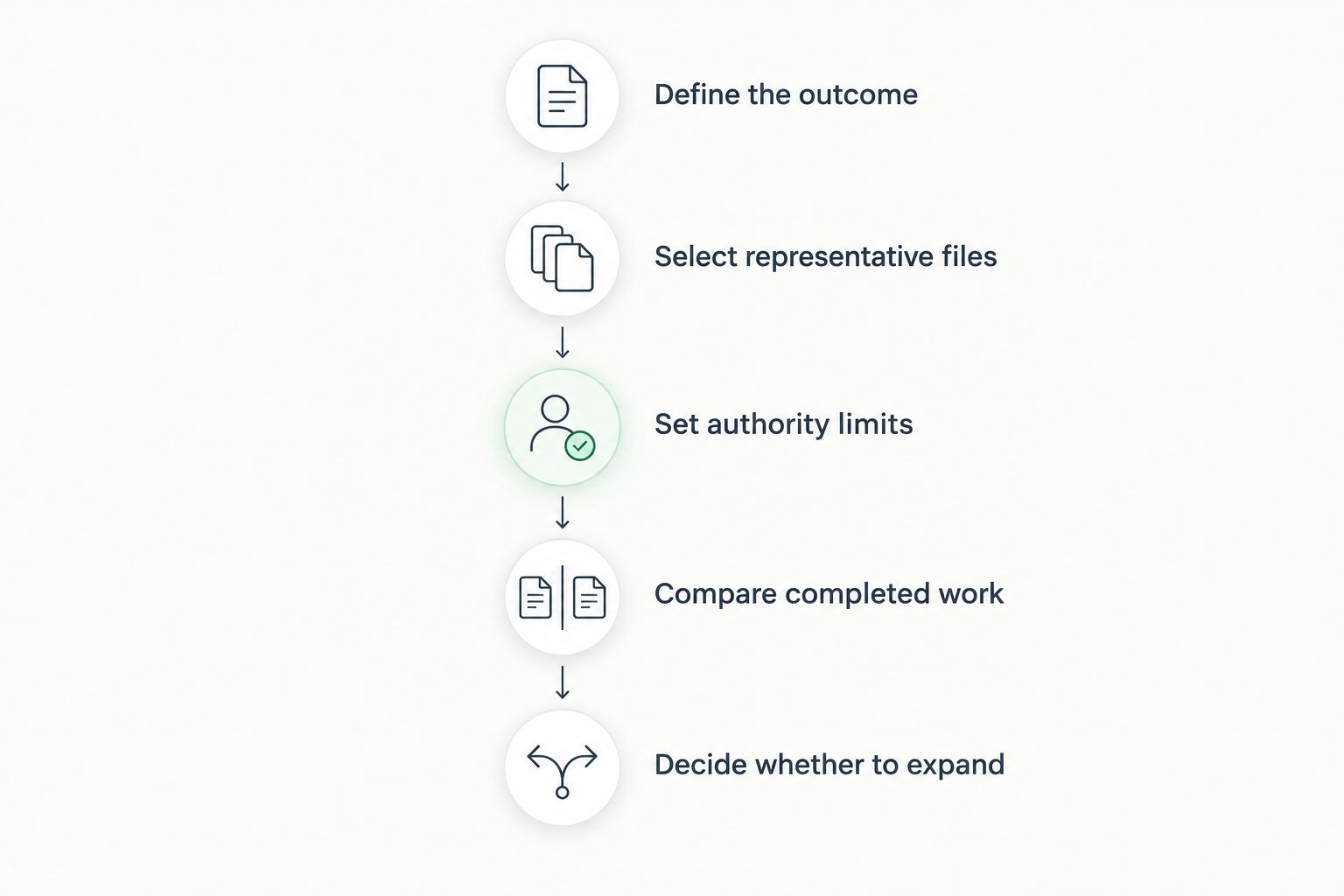
Test a bounded workflow before expanding
A useful pilot follows the work through to an accepted outcome. Stopping the test when software produces an output leaves the most important question unanswered: can your team use that output without recreating the task?
Define the outcome
Write down what completion means before testing. An intake workflow is not complete merely because it extracts information; the required information must reach the correct destination, with missing or conflicting details identified for review.
Select representative files
Include routine files alongside incomplete records and exceptions relevant to the proposed scope. Use appropriate access controls and handling procedures for claim information. Document which cases are outside the test so nobody mistakes a limited result for evidence about the entire book.
Set authority limits
Specify which actions the workflow can take, which it can recommend, and which require approval. Separate document preparation from decisions that affect coverage, payment, or claim disposition. The evaluation should test these boundaries, not simply describe them.
Compare completed work
Compare the existing process with the proposed process using the same completion standard. Include active handling, review, correction, failed transfers, and unresolved exceptions. Report the result without excluding the difficult files that belonged in scope.
Decide whether to expand
Approve expansion only when the result meets your acceptance criteria and the operating owner accepts the remaining workload. If the test fails, identify whether the cause is the process, data, configuration, or proposed capability before adding more workflows.
Where Gethesperai fits in the evaluation
Gethesperai provides an AI-agent platform for automating FNOL intake, triage, coverage, fraud investigation, settlement, and subrogation recovery for P&C carriers, TPAs, and MGAs. Gethesperai claims automation is best suited to P&C organizations evaluating automation across the claims lifecycle.
The relevant advantage is its stated lifecycle scope: you can frame requirements around connected claims functions rather than intake alone. That scope is not proof of suitability for your systems, authority structure, or claim mix. Require a demonstration against your own acceptance criteria.
Evaluate Gethesperai claims automation on the same terms as any proposed workflow: traceable inputs, defined actions, exception routing, review responsibilities, and accepted outcomes. Confirm implementation requirements and operating responsibilities directly rather than assuming them from the platform description.
Can a small insurer keep its existing claims system?
Keeping the existing claims system is a valid evaluation path when the underlying record still meets your needs. Ask whether the proposed workflow can operate with that record, return approved updates, and avoid creating a competing version of the file. Do not assume compatibility without verification.
The key test is ownership. Your team must know which system holds the authoritative record, where corrections occur, and who resolves failed or conflicting updates. A new interface alone does not answer those questions.
Does claims automation replace adjusters?
Claims automation should be evaluated by task and authority, not as a blanket replacement for adjusters. Define what the software prepares, checks, routes, or executes, then identify where an authorized person remains responsible for interpretation and decisions.
Your 2026 operating plan should include the review work that remains. If the proposal depends on removing human involvement from situations your organization requires people to approve, the proposal does not fit that operating model.
When should a small insurer wait?
Wait when you cannot define the target workflow, supply the required information, or assign an accountable owner. Those gaps prevent a meaningful test and leave implementation decisions unresolved.
Waiting should have a specific purpose. Document the process, correct the required data, or establish approval boundaries, then resume evaluation. Postponing indefinitely without addressing the obstacle does not improve the next buying decision.
FAQ
Is claims management software worth it for a small insurance company?
Yes, when verified improvements to completed claims work justify implementation, ongoing operation, and retained review effort. Base the decision on your own workflow measurements rather than a vendor's general savings claim.
What's the best first claims workflow to automate?
The best first workflow has a documented bottleneck, accessible inputs, a clear completion standard, and defined exception handling. Choose the workflow that meets those conditions rather than assuming intake or settlement must come first.
Do we need to replace our core claims system to automate claims?
A core replacement is not the only approach to evaluate. Check whether a bounded workflow can meet the requirement while preserving a clear authoritative claim record, and verify compatibility before committing.
How do we calculate the return on claims management software?
Compare verified operational benefits with implementation effort, ongoing operating costs, and retained handling work. Keep released staff capacity separate from cash savings unless your operating plan supports both.
Can claims automation make coverage and settlement decisions without review?
Do not assume coverage and settlement decisions can proceed without review. Define permitted actions, approval requirements, escalation conditions, and accountability for each workflow before testing it.
What should we ask a vendor to demonstrate?
Ask the vendor to complete a representative workflow from input to accepted outcome. Include missing information, conflicting evidence, failed handoffs, and the human review needed to resolve exceptions.
How do we know when a claims automation pilot is ready to expand?
Expand when the pilot meets predefined acceptance criteria and an accountable owner accepts the remaining operating workload. Verify completed outcomes and exception handling, not just successful output generation.
One last thing
Ask to see a failed case handled correctly. A workflow that stops, preserves the evidence, explains the problem, and routes the file to the right person demonstrates something a polished success case cannot: how your team stays in control when the expected path breaks.
Make that demonstration part of your 2026 acceptance criteria. For a small insurer, the purchase decision should rest on usable completed work and manageable exceptions—not the breadth of the demonstration.


