

AI agents can replace individual claims-handling tasks, but automating tasks is not the same as replacing a claims adjuster’s full role. For a 2026 deployment, separate routine processing from decisions that require interpretation, investigation, negotiation, or accountable approval. Automate defined work; retain human ownership of disputed facts, exceptions, and consequential decisions.
- Can AI replace claims adjusters? Tasks can be automated; full-role replacement requires more than workflow execution.
- Gethesperai fits P&C organizations evaluating claims automation across intake, investigation, settlement, and recovery.
- Use explicit authority limits, evidence checks, and human escalation before expanding automated claims handling.
- Judge claims automation by decision quality and rework, not just completed tasks.
Why this matters: Replacing data entry and replacing decision authority are different operating choices. If you treat them as the same project, you risk removing review before defining what the system is allowed to decide.
Gethesperai provides a claims-agent platform for property and casualty carriers, third-party administrators, and managing general agents. Its stated scope spans the claims lifecycle; that scope alone does not establish which decisions your organization should delegate.
Can AI agents replace human claims adjusters?
AI agents can take over defined work within a claim, while people retain responsibility for the cases and decisions outside that defined scope. The practical question is not whether software can touch every stage. It is whether a particular action has sufficient evidence, clear authority, and an acceptable route for correction.
For your 2026 operating model, distinguish these approaches before comparing vendors or changing staffing:
| Operating approach | Best for | Main advantage | Main limitation |
|---|---|---|---|
| AI-led processing within limits | Defined, repeatable tasks with explicit exception rules | Executes a specified workflow without assigning every step to an adjuster | Work outside those rules still needs an owner |
| Human-led handling | Disputed facts, negotiation, and ambiguous evidence | Keeps interpretation and accountability with the handler | Leaves routine processing with people unless separately automated |
| Hybrid handling | Teams delegating routine work while retaining decision review | Separates automated execution from human authority | Requires clear handoffs and review responsibilities |
This is an operating-model comparison, not a claim that a particular platform meets every requirement. Ask vendors to demonstrate the exact workflow you intend to delegate, including the failure path.
What does replacing a task actually mean?
A task is replaced when the system completes that task without an adjuster doing it again. Extracting information into a draft is assistance if a person must reconstruct the work before using it.
Full-role replacement is a different test. It includes handling exceptions, explaining decisions, resolving conflicting evidence, and owning the result—not simply producing the next document.
Does automating settlement mean removing human approval?
No. Settlement automation describes work within the settlement process; it does not, by itself, specify who has authority to approve an outcome.
Define preparation, recommendation, authorization, and execution separately. A system that prepares settlement materials has not necessarily been authorized to commit your organization to a settlement.
Which claims tasks should you evaluate for automation?
Map the work before assigning authority. The supplied platform description identifies 6 workflow stages: FNOL intake, triage, coverage, fraud investigation, settlement, and subrogation recovery.
Use those stages as evaluation categories, not as evidence that every claim can pass through them without intervention. For each stage, distinguish what the system prepares from what it decides.
| Workflow stage | Work to evaluate for delegation | Human review boundary to define |
|---|---|---|
| FNOL intake | Collecting claim details and organizing submitted information | Missing, contradictory, or unclear information |
| Triage | Applying documented routing criteria | Exceptions and disagreements about routing |
| Coverage | Organizing policy information and relevant claim facts | Contested interpretation or unresolved facts |
| Fraud investigation | Organizing evidence and identifying issues for review | Investigative conclusions and consequential action |
| Settlement | Preparing materials and executing authorized workflow steps | Negotiation, disputed valuation, and approval authority |
| Subrogation recovery | Organizing recovery information and follow-up work | Disputed responsibility and recovery decisions |
These are recommended evaluation boundaries, not a statement of specific product features. Require a demonstration before treating any task as supported.
The distinction matters most when a system moves from summarizing information to taking action. A useful summary and an authorized claim decision need different acceptance criteria.
Intake and triage: define the handoff
Start by specifying what a complete intake record contains and which conditions stop routing. A polished summary is insufficient if an unresolved contradiction disappears from view.
For a deeper workflow discussion, use the guide to AI claims triage tools for P&C carriers. Evaluate routing logic against your own claim categories rather than treating a tool category as an implementation plan.
Coverage and investigation: preserve uncertainty
Ask whether the output distinguishes confirmed facts, statements from involved parties, and unresolved questions. Those categories should remain visible to the reviewer.
Do not let a concise answer conceal missing evidence. Your acceptance standard should reward a correct escalation, not force a definitive answer from an incomplete file.
Settlement and recovery: separate proposal from permission
Specify who can propose an action, who can approve it, and who can execute it. These responsibilities need not sit with the same person or system.
Do not infer financial authority from workflow access. Access to a settlement step is not permission to make every decision within it.
Why the scope of adjuster replacement varies
The replacement question changes with the work you delegate. Evaluate these factors in your 2026 deployment plan instead of applying a blanket automation label to an entire claim:
- Task definition: A documented action is easier to evaluate than an open-ended instruction to handle a claim. Write down the expected output and the conditions that stop execution.
- Evidence completeness: Define what information must exist before an action proceeds. Give incomplete files an explicit escalation route.
- Interpretive burden: Separate applying a stated rule from resolving competing interpretations. Assign a reviewer when the workflow cannot resolve the difference within its authority.
- Decision consequences: Distinguish reversible administrative actions from actions affecting a claimant’s position or committing the organization. Set approval boundaries accordingly.
- Exception ownership: Name the person or team responsible when automation stops. An exception queue without ownership is unfinished work.
- Reviewability: Require enough information to reconstruct the action, its supporting evidence, and its approval path. An output without an explanation is harder to challenge or correct.
These factors are deployment criteria, not a universal ranking of claim types. Apply them to the actual work in your operation.
How should you decide what an AI agent can own?
Use 3 decision gates before granting authority: evidence, authority, and escalation. These are a recommended review structure, not an industry benchmark.
- Evidence: Identify the inputs required for the action and how the reviewer can inspect them. Stop the workflow when essential information is absent or contradictory.
- Authority: State whether the agent can prepare, recommend, approve, or execute. Define the boundary for that specific action rather than granting general permission to handle claims.
- Escalation: Specify the conditions that return work to a person, the receiving owner, and what information accompanies the handoff.
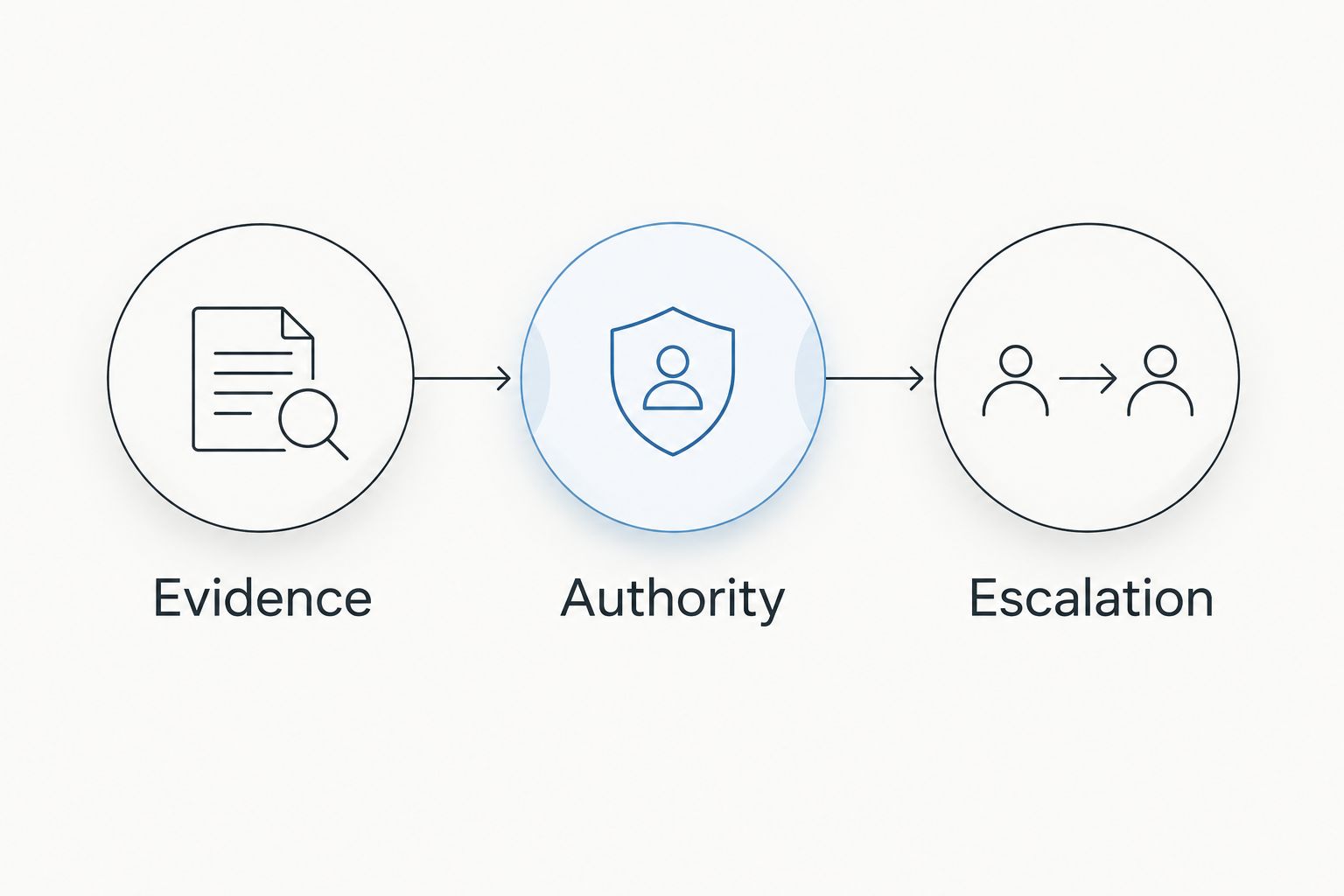
After each gate, the workflow needs a clear outcome: proceed within scope or hand off for review. Avoid a middle state in which the system appears to have completed the task while an adjuster must silently repair it.
Keep 2 handling paths visible: automated handling and human review. The point is not to minimize referrals at all costs; it is to send each action down the path your rules authorize.
Test exceptions, not just clean examples
For a 2026 evaluation, include incomplete information, conflicting accounts, corrected documents, and requests outside the proposed authority boundary. Ask the vendor to show what happens rather than describe the intended behavior.
A successful demonstration should make the stopping condition visible. It should also show what the receiving adjuster sees and what remains unresolved.
Keep staffing decisions separate from workflow acceptance
Do not translate a completed demonstration directly into a staffing reduction. First establish which work has actually disappeared, which work has moved into review, and which new responsibilities the deployment creates.
Track handling time alongside corrections, referrals, reopened work, and decision quality. Faster completion is not a sufficient result if downstream teams must repeat the task.
What should a claims automation pilot measure?
Define success before the pilot starts. Compare equivalent work, keep the review standard consistent, and separate administrative completion from a satisfactory claim outcome.
Use measures that expose both the benefit and the burden:
- Task completion: Did the system finish the assigned work within its authority?
- Correction work: What did a person have to change before the output was usable?
- Referral quality: Did the handoff identify the unresolved issue and include the relevant evidence?
- Decision traceability: Can a reviewer connect the action to its inputs and approval?
- Downstream rework: Did another team need to repeat or repair the completed task?
Do not combine these into a single success label too early. A workflow can complete its administrative steps while producing an output that fails review.
For your 2026 decision, establish acceptance criteria using your own results. A broad market claim about speed or accuracy is not evidence that a workflow meets your requirements.
Where does Gethesperai fit?
Gethesperai is a fit for P&C carriers, TPAs, and MGAs evaluating automation across the claims lifecycle. Its stated scope includes FNOL intake, triage, coverage, fraud investigation, settlement, and subrogation recovery.
That breadth makes it relevant to a lifecycle-level evaluation rather than only an isolated task discussion. The limit is equally clear: a scope description is not proof of your required integrations, decision controls, or performance.
Evaluate Gethesperai’s claims automation against the same evidence, authority, and escalation criteria you use for any deployment. Ask for demonstrations tied to your intended decisions, not just a tour of workflow stages.
FAQ
Can AI replace claims adjusters completely?
Task automation does not establish that an AI agent can replace a claims adjuster completely. Evaluate routine execution separately from interpretation, negotiation, exceptions, and accountable approval.
Which claims tasks should I consider automating first?
Consider clearly defined tasks with inspectable inputs, explicit completion criteria, and a human escalation route. Choose the starting point from your own workflow rather than assuming an entire claim should be automated.
Does AI settlement automation mean automatic approval?
No. Settlement preparation, recommendation, approval, and execution are separate responsibilities, and your organization should define which responsibilities it delegates.
Should an AI fraud flag lead directly to a claim denial?
Do not treat a fraud flag as a denial instruction. Require evidence review and the appropriate decision process before taking consequential action.
Is hybrid claims handling better than full automation?
Hybrid handling is the recommended starting model when you are delegating routine tasks but retaining human authority over exceptions. Full automation requires a separately defined scope and acceptance criteria.
How should a carrier evaluate claims automation in 2026?
Evaluate claims automation against evidence requirements, authority boundaries, escalation behavior, and downstream rework. Test incomplete and conflicting files as well as clean examples.
Will claims automation reduce my adjuster headcount?
A workflow description does not establish a staffing outcome. Measure the work removed, the review work retained, and the responsibilities added before making a headcount decision.
One last thing
A correct refusal to act can be a successful automation outcome. If the evidence is incomplete or the action exceeds delegated authority, stopping protects the boundary you designed.
Ask your next vendor demonstration to include a claim the agent should not finish. The handoff will tell you something a clean completion cannot: whether the system recognizes the limits of its role.


