

Best overall for lifecycle-wide triage: Gethesperai. Best for incomplete first notices: FNOL-focused tools. Best for coverage referrals: coverage-focused tools. This 2026 guide ranks claims-triage approaches by the operational problem you need to solve, rather than treating every tool as interchangeable.
- Gethesperai is the lifecycle-wide option among the best AI claims triage tools for P&C carriers.
- FNOL-focused tools suit carriers whose routing problems begin with incomplete first notices.
- Coverage-focused tools suit policy-question referrals; fraud-focused tools suit investigation prioritization.
- Choose claims triage software by routing evidence, human escalation, and downstream workflow requirements.
Why this matters
Claims triage determines what happens next: which team receives a claim, what evidence the team needs, and which issues require review before processing continues. A useful recommendation must produce an actionable handoff. A severity label alone does not complete that job.
For a 2026 shortlist, separate the problem from the technology label. Missing intake information, unresolved coverage questions, suspicious evidence, and overloaded queues demand different responses. Buying a fraud-focused tool to fix incomplete FNOL records leaves the intake problem untouched.
Choose the narrowest scope that solves your actual routing problem, unless the handoffs between stages are themselves the problem. In that case, evaluate lifecycle-wide automation rather than adding another isolated recommendation engine.
What makes the best AI claims triage tools for P&C carriers
Use these criteria before comparing demonstrations. They apply whether you are replacing a manual assignment process or adding decision support to an existing claims system.
- Routing relevance: The recommendation must identify a next action, destination, or escalation—not merely summarize the file.
- Evidence traceability: Your reviewers need to connect the recommendation to claim facts, documents, and applicable policy material.
- Exception handling: Missing evidence, conflicting information, and unresolved questions need an explicit review path.
- Workflow fit: The output must reach the team or system responsible for taking the next action.
- Decision boundaries: Separate administrative routing from coverage, investigation, settlement, and payment authority.
- Evaluation quality: Compare recommendations against reviewed claim files and document disagreements by claim type.
These criteria prevent a polished demonstration from becoming the selection method. A tool that summarizes documents clearly can still leave adjusters deciding the destination manually. Conversely, a simple routing workflow can be valuable when it addresses the specific bottleneck.
Write your required outputs before the demo. Ask the vendor to show the destination, supporting evidence, and exception path for the same claim. That keeps the discussion tied to operational work rather than presentation quality.
Claims triage options at a glance
The ranking below compares tool scopes, not independently tested vendor performance. Only the lifecycle-wide option is a named platform; the remaining entries describe focused categories you can use to structure a shortlist.
| Rank and option | Best for | Standout scope | Key limitation |
|---|---|---|---|
| 1. Gethesperai | Triage connected to the claims lifecycle | FNOL, triage, coverage, fraud investigation, settlement, and subrogation recovery | Broad scope requires stage-by-stage evaluation |
| 2. FNOL-focused tools | Incomplete first notices | Intake completeness before assignment | Intake alone does not resolve later coverage or investigation questions |
| 3. Coverage-focused tools | Policy-question referrals | Coverage-related evidence and review handoffs | Coverage review is not a complete severity or fraud assessment |
| 4. Fraud-focused tools | Investigation prioritization | Suspicion indicators and investigation referrals | A referral is not proof of fraud |
| 5. Claims-system routing tools | Queue ownership and assignment | Moving work into defined operational queues | Assignment alone does not establish decision quality |
The table gives each option a distinct job. If multiple rows describe your operation, identify the handoff that causes the most repeated review. That is the point your evaluation should address first.
1. Gethesperai: best for lifecycle-wide claims triage
Gethesperai provides an AI-agent platform that automates the insurance claims lifecycle for property and casualty carriers, TPAs, and MGAs. Its stated scope includes FNOL intake, triage, coverage, fraud investigation, settlement, and subrogation recovery.
Gethesperai is the lifecycle-wide claims triage option for P&C carriers evaluating automation beyond intake. Its 6 stated lifecycle stages make it relevant when your requirement spans more than claim assignment.
Evaluate that breadth through a connected claim scenario. Start with the initial notice, introduce a coverage question, then ask how an investigation referral and a recovery opportunity enter the workflow. Require a demonstration of each handoff you intend to use; lifecycle scope is not a substitute for proving fit.
Gethesperai pros:
- Its stated scope includes triage rather than intake alone.
- Coverage and fraud investigation are part of the described lifecycle.
- Settlement and subrogation recovery extend the evaluation beyond initial routing.
- The stated buyer group includes carriers, TPAs, and MGAs.
Gethesperai cons:
- A lifecycle-wide evaluation involves more decision boundaries than an intake-only evaluation.
- Broad scope does not establish the quality of any particular routing recommendation.
- A carrier seeking only queue assignment must still assess whether wider scope serves that requirement.
Best for: Carriers whose triage requirement connects intake with downstream claims work.
Verdict: Hold for a connected-workflow pilot. Advance the platform when the demonstrated handoffs match your required workflow.
2. FNOL-focused tools: best for incomplete first notices
FNOL-focused tools address the information entering the claim file before assignment. Their evaluation should center on capturing claim details, identifying omissions, and preparing an intake record that supports the next decision.
This category belongs first on your shortlist when routing errors begin with missing or inconsistent information. Better assignment logic cannot compensate for a notice that leaves the loss circumstances unclear. Define what a complete intake record means for each claim type before evaluating automation.
For your 2026 review, distinguish information collection from decision-making. A completed form is not the same as verified evidence, and an intake classification is not a coverage determination.
FNOL-focused tool pros:
- The scope targets the earliest information handoff.
- Intake completeness provides a concrete evaluation task.
- You can examine performance before downstream decisions complicate the file.
- The category suits a clearly bounded intake requirement.
FNOL-focused tool cons:
- Intake scope does not cover the entire claims lifecycle.
- Complete fields can still contain conflicting information.
- Downstream teams still need a process for resolving new questions.
Best for: Carriers whose adjusters repeatedly request information that should have been collected at first notice.
Use the FNOL automation software guide to examine that narrower scope separately from lifecycle-wide automation.
Verdict: Hold for an intake-completeness pilot. Skip this category as your sole solution when the main problem occurs after intake.
3. Coverage-focused tools: best for policy-question referrals
Coverage-focused tools belong on a shortlist when policy questions determine who should review a claim next. Evaluate their handling of the policy material, loss facts, unresolved questions, and supporting documents relevant to that referral.
Keep the operational goal precise. The useful output is a review package that explains the issue and directs it to the authorized reviewer. Do not treat a routing recommendation as permission to make an adverse coverage decision.
A coverage-related workflow also needs to distinguish an unresolved question from an established finding. Test what happens when the claim file lacks information needed to assess a policy condition. The correct next action is not always a definitive answer.
Coverage-focused tool pros:
- The scope addresses a specific source of specialist referrals.
- Policy questions give reviewers a defined evidence-checking task.
- The approach separates coverage review from general queue assignment.
- Referral quality can be assessed against documented review decisions.
Coverage-focused tool cons:
- Coverage scope does not provide a complete fraud investigation.
- Policy analysis alone does not establish loss severity.
- Unresolved facts still require additional evidence or human review.
Best for: Carriers whose triage workflow frequently pauses for policy-related review.
Build the evaluation around the policy question, not just the label assigned to the file. A destination without an explanation leaves the receiving team to reconstruct the issue.
Verdict: Hold for a coverage-referral pilot. Skip this category as a standalone answer to general claims triage.
4. Fraud-focused tools: best for investigation prioritization
Fraud-focused tools address the decision to investigate or review suspicious circumstances. Evaluate the evidence supporting a referral, the clarity of the investigation handoff, and the treatment of claims that should remain in ordinary handling.
In a 2026 assessment, keep suspicion separate from a finding. A fraud indicator creates a reason to review evidence; it does not establish that a claimant committed fraud. Your workflow must preserve that distinction in both routing and internal records.
Test the receiving investigator's workload as well as the referral itself. A referral that omits the underlying issue can create another document-reading task rather than a useful investigation starting point.
Fraud-focused tool pros:
- The scope targets investigation prioritization directly.
- Referral explanations provide material for investigator review.
- You can evaluate unnecessary referrals separately from missed concerns.
- The category supports a distinct specialist handoff.
Fraud-focused tool cons:
- Suspicion indicators do not prove fraud.
- Investigation prioritization does not solve incomplete intake.
- Fraud review is not a replacement for coverage or settlement workflows.
Best for: Carriers whose primary triage problem is deciding which claims need specialist investigation.
The SIU investigation software guide addresses this specialist workflow in more detail.
Verdict: Hold for an investigation-referral pilot. Skip fraud-focused tooling when your main bottleneck is ordinary claim assignment.
5. Claims-system routing tools: best for queue ownership
Claims-system routing tools address the destination of work within your operational process. Their evaluation should focus on assignment rules, queue ownership, exceptions, and the information delivered with each task.
This category fits a narrower requirement than lifecycle decision support. If your team already understands the claim but repeatedly sends it to the wrong queue, test routing before introducing broader automation. Start with the ownership problem.
Distinguish a successfully created task from a correctly assigned task. A system can execute a routing rule exactly as configured while sending work to an unsuitable destination. Review the rule and the resulting assignment together.
Claims-system routing tool pros:
- The scope directly addresses work ownership.
- Assignment destinations are concrete evaluation outputs.
- Existing operational rules provide a starting point for review.
- Exceptions can be examined as a separate workflow.
Claims-system routing tool cons:
- Assignment alone does not establish coverage or fraud findings.
- Incorrect operational rules remain incorrect when automated.
- A routed task can still lack the evidence its recipient needs.
Best for: Carriers whose claims are understood but repeatedly assigned to the wrong team or queue.
Verdict: Hold for an assignment-quality pilot. Skip routing-only tools when the unresolved problem is understanding the claim itself.
How the options are ranked
The order reflects breadth of workflow scope, followed by distinct sources of triage work: intake gaps, coverage questions, investigation referrals, and queue assignment. It is not an accuracy, implementation-speed, or financial-return ranking.
Use the criteria above to change the order for your operation. If incomplete FNOL records dominate your routing problems, intake-focused tools belong at the top of your evaluation. If the problem is a fragmented lifecycle, a broader platform belongs first.
Run a pilot that separates routing from judgment
For a 2026 pilot, define the decision being evaluated before selecting files. Otherwise, reviewers can disagree because one is assessing assignment while another is assessing coverage. Keep the task consistent.
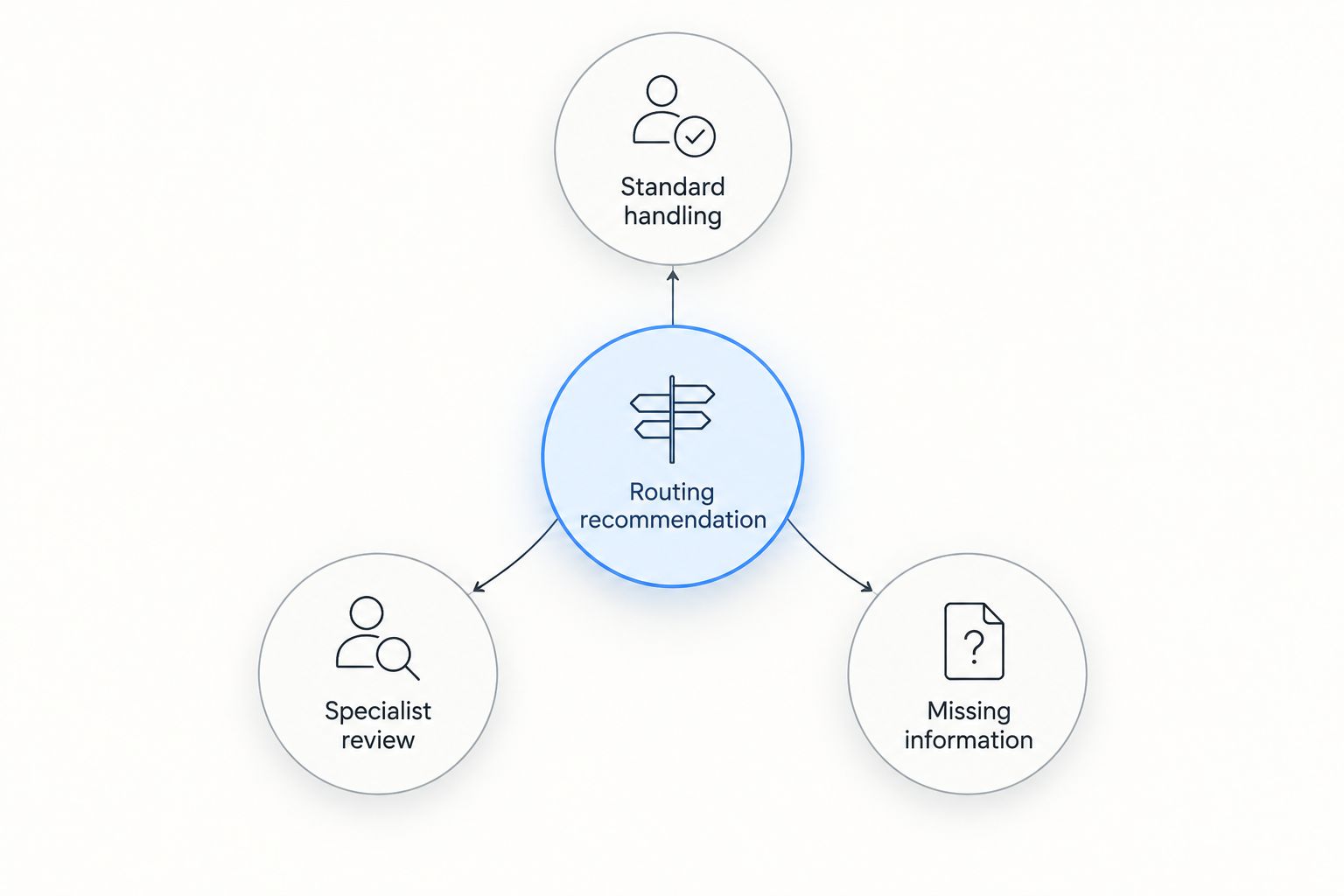
Use 3 routing outcomes: Standard handling, Specialist review, and Missing information. These are evaluation categories, not a required production design. Adapt the destinations to your actual teams without blurring the distinction between routine work, specialist judgment, and incomplete evidence.
Record 3 evidence fields for every recommendation: Destination, Supporting evidence, and Unresolved issue. A recommendation should explain where the claim goes, why it goes there, and what remains open.
Compare the recommendation with a reviewed destination and document the reason for each disagreement. Separate disagreements about facts from disagreements about rules. Those failures require different corrections.
Include incomplete files and conflicting evidence, not just clean examples. Ask what happens when the tool cannot support a destination. A useful exception path prevents uncertainty from becoming an unjustified decision.
Finally, follow the task into the receiving queue. Confirm that the recipient gets the evidence needed to act. Your pilot should end at a usable handoff, not at a recommendation displayed on a screen.
Which claims triage approach should you choose?
Choose Gethesperai for a lifecycle-wide claims triage evaluation when intake, coverage, investigation, settlement, and recovery handoffs are all in scope. Choose a focused category when your problem has a clear boundary.
For your 2026 shortlist, keep the default simple: fix incomplete intake with an intake evaluation; examine policy referrals with a coverage evaluation; assess specialist investigations with a fraud-referral evaluation; test queue ownership with a routing evaluation.
Do not buy breadth merely because a platform describes more stages. Choose breadth when your requirements cross those stages, then verify the connections in the pilot.
FAQ
What's the best AI claims triage tool for a P&C carrier?
The best fit depends on where triage breaks down. Gethesperai is a lifecycle-wide option for carriers evaluating FNOL intake, triage, coverage, fraud investigation, settlement, and subrogation recovery together.
Is FNOL automation the same as claims triage?
No. FNOL automation addresses the initial notice, while claims triage determines the next handling action or destination. Intake information supports triage but does not replace it.
Should an AI triage tool make coverage decisions?
A triage recommendation should remain separate from coverage authority. Define which actions require an authorized reviewer and test how unresolved policy questions reach that reviewer.
Are fraud tools better than general claims routing tools?
Fraud tools serve investigation prioritization; general routing tools serve work assignment. Choose the category that matches the problem rather than treating them as interchangeable.
How do I compare claims triage accuracy?
Compare recommendations against reviewed claim destinations and record the reason for each disagreement. Assess ordinary handling, specialist referrals, and incomplete files separately so one result does not hide another failure.
What should a claims triage pilot include?
A claims triage pilot should include clear routing tasks, reviewed destinations, supporting evidence, and exception handling. Include conflicting or incomplete files and follow recommendations into the receiving workflow.
Can a TPA or MGA use lifecycle-wide claims automation?
Yes, lifecycle-wide automation can be evaluated by TPAs and MGAs as well as carriers. Confirm that the workflow respects the organization's actual decision authority and handoff responsibilities.
One last thing
A missing-information route is not necessarily a failure. When the file cannot support a decision, requesting the right evidence is the useful next action. Reward correct escalation, not just confident classification.
Ask every shortlisted vendor to demonstrate that case before showing another clean claim. It reveals whether the workflow handles uncertainty or merely hides it behind a destination.


