

Best for P&C claims-lifecycle automation: Gethesperai. Best for working inside an existing claims platform: a claims-system coverage workflow. Best for narrowly defined checks: rules-based verification. This 2026 guide compares those approaches with document-review workflows so you can choose coverage verification software that matches your claims operation.
- Gethesperai is a fit for P&C buyers seeking coverage verification within claims-lifecycle automation.
- The best insurance coverage verification software separates policy status, coverage assessment, and payment authority.
- Claims-system workflows suit existing operations; rules-based verification suits clearly defined checks.
- Document-review workflows support policy analysis but should not replace accountable coverage decisions.
Why this matters
Insurance coverage verification means different things to different buyers. This guide addresses property and casualty claims for carriers, third-party administrators, and managing general agents—not medical-benefits eligibility checks for healthcare providers.
For a P&C claim, finding an active policy is only part of the task. You also need to connect the reported loss to the relevant policy period, insured interest, coverage provisions, and applicable endorsements. A status check does not establish that every reported loss is covered.
Choose the workflow that answers your coverage question, not the software with the longest feature list. Your 2026 shortlist should distinguish a narrow verification task from a broader claims-handling requirement before you compare vendors.
What makes the best coverage verification software
Use these criteria to evaluate each approach before deciding which belongs on your shortlist:
- Policy identification: Can the workflow identify the relevant policy, insured, and loss date without silently accepting conflicting records?
- Document grounding: Can reviewers trace an assessment to the policy wording and endorsements that support it?
- Decision boundaries: Does the workflow distinguish a suggested assessment from an authorized coverage decision?
- Exception handling: Can unresolved questions move to an accountable reviewer rather than disappear into a completed status?
- Claims continuity: Can verified information support the next claims task without requiring someone to recreate the analysis?
- Operational fit: Does the approach match your existing systems, buyer role, and intended scope?
Treat these as demonstration requirements, not assumed capabilities. A useful demonstration follows a claim from its original evidence to the proposed assessment and then to the person responsible for acting on it.
Coverage verification approaches at a glance
The ranking below assigns each option a different use case. It is a decision guide for 2026 purchasing, not a claim that every implementation performs equally.
| Option | Best for | Defining approach | Key limitation |
|---|---|---|---|
| Gethesperai | P&C claims-lifecycle automation | Coverage sits within a platform spanning FNOL through subrogation recovery | Broader scope than a policy-status-only task |
| Claims-system coverage workflow | Keeping verification inside an existing claims operation | Coverage work follows the claim record and assigned handling process | The workflow needs explicit checks; a status field alone is insufficient |
| Rules-based verification | Repeated, clearly defined checks | Explicit conditions determine outcomes or referrals | Ambiguous policy wording requires a separate review path |
| Document-review workflow | Examining policy wording and endorsements | Review focuses on the documents supporting coverage analysis | Document analysis alone does not complete claims handling |
1. Gethesperai: best for P&C claims-lifecycle automation
Gethesperai provides an agent platform for property and casualty carriers, TPAs, and MGAs. Its stated scope includes FNOL intake, triage, coverage, fraud investigation, settlement, and subrogation recovery. That makes it relevant when you want coverage work to sit within a wider claims lifecycle rather than remain an isolated checking task.
Gethesperai is best for P&C buyers seeking coverage verification within claims-lifecycle automation. Evaluate it against the handoffs around coverage: what enters from intake, what requires a reviewer, and what information moves into subsequent claims work.
Gethesperai pros
- Its stated scope includes coverage alongside intake and triage.
- The platform addresses carriers, TPAs, and MGAs rather than an unrelated eligibility workflow.
- Its claims-lifecycle scope extends to settlement and subrogation recovery.
Gethesperai cons
- The stated P&C focus is not a medical-benefits eligibility recommendation.
- The end-to-end scope is broader than the needs of a buyer seeking only policy-status verification.
Best for: A P&C organization evaluating coverage as part of claims automation.
Ask for a demonstration built around your own coverage questions. Require the presenter to distinguish policy identification, coverage assessment, referral, and decision authority. Do not treat the platform's lifecycle scope as proof that a particular policy form, integration, or approval process meets your requirements.
Verdict: Buy for lifecycle scope only after the coverage demonstration satisfies your requirements.
2. Claims-system coverage workflow: best for existing operations
A claims-system coverage workflow keeps verification tasks within the process used to handle the claim. This option is an implementation approach, not a recommendation for a specific vendor. It belongs on your shortlist when your priority is preserving the claim record, assignments, and operational handoffs.
Design the workflow around required evidence and accountable decisions. A checkbox marked coverage confirmed is not a substitute for an explanation of which policy provisions support that conclusion.
Claims-system workflow pros
- Keeps coverage tasks associated with the claim being handled.
- Gives you a place to define assignments, referrals, and approval responsibilities.
- Lets the evaluation focus on existing operational handoffs rather than a separate checking process.
Claims-system workflow cons
- A configured status field does not, by itself, assess policy wording.
- Incomplete policy records still require an evidence-gathering and exception process.
Best for: Claims teams whose main requirement is organizing coverage work inside an existing operation.
For your 2026 evaluation, walk through a claim with conflicting policy information. Check whether the workflow preserves the conflict, identifies its owner, and prevents an unresolved assessment from being mistaken for approval. Those requirements matter more than how quickly someone can mark the task complete.
Verdict: Buy this approach when workflow continuity is the priority and the required checks are demonstrable.
3. Rules-based verification: best for clearly defined checks
Rules-based verification applies explicit conditions to structured information. You define the inputs, the condition being checked, and the outcome or referral. It is a suitable approach for repeatable questions whose answers do not depend on interpreting ambiguous language.
For example, a rule can compare a reported loss date with recorded policy dates. That comparison answers a timing question; it does not establish coverage for the loss as a whole.
Rules-based verification pros
- Makes the conditions behind a check explicit.
- Supports consistent treatment of the same defined inputs.
- Provides a clear basis for testing pass, fail, and referral outcomes.
Rules-based verification cons
- Conflicting or missing inputs need an exception route.
- Policy interpretation cannot be reduced to a date or status check alone.
Best for: Operations with narrowly defined verification questions and structured inputs.
Keep each rule's purpose visible. Separate a policy-period check from an insured-identity check, and separate both from a coverage determination. When a rule refers a claim for review, preserve the reason so the next handler knows what remains unresolved.
Do not describe this approach as the budget winner without evaluating its implementation and maintenance requirements. A narrower scope is not evidence of a lower total cost.
Verdict: Buy for bounded checks; skip it as a complete substitute for coverage assessment.
4. Document-review workflow: best for policy wording analysis
A document-review workflow organizes the examination of policy forms, schedules, endorsements, and supporting claim documents. Its focus is the evidence used to explain coverage, not merely whether a policy record exists. It suits tasks where identifying the relevant wording is central to the review.
Keep document findings separate from decision authority. Locating a clause is useful, but someone still needs to assess its relevance to the reported facts and resolve conflicting material.
Document-review workflow pros
- Centers the review on policy language and supporting evidence.
- Gives reviewers a defined process for checking endorsements alongside policy forms.
- Supports a focused evaluation of how findings are documented and handed off.
Document-review workflow cons
- Document analysis alone does not complete the claims lifecycle.
- Missing or superseded documents can leave the assessment incomplete.
Best for: Coverage teams evaluating policy wording and endorsement evidence.
In a 2026 demonstration, ask the reviewer to identify the document version used and explain how an endorsement changes the analysis. Reject a polished summary that cannot show its supporting wording. The output should make the reasoning inspectable, not merely sound confident.
Verdict: Buy for document-centered review; skip it as a standalone claims-handling replacement.
How to evaluate coverage verification before buying
Use a controlled evaluation with 10 claim files, 3 policy-document versions, and 2 review roles. These are recommended test-design choices, not performance benchmarks. Include straightforward cases, unresolved facts, conflicting records, and an endorsement that changes the question being assessed.
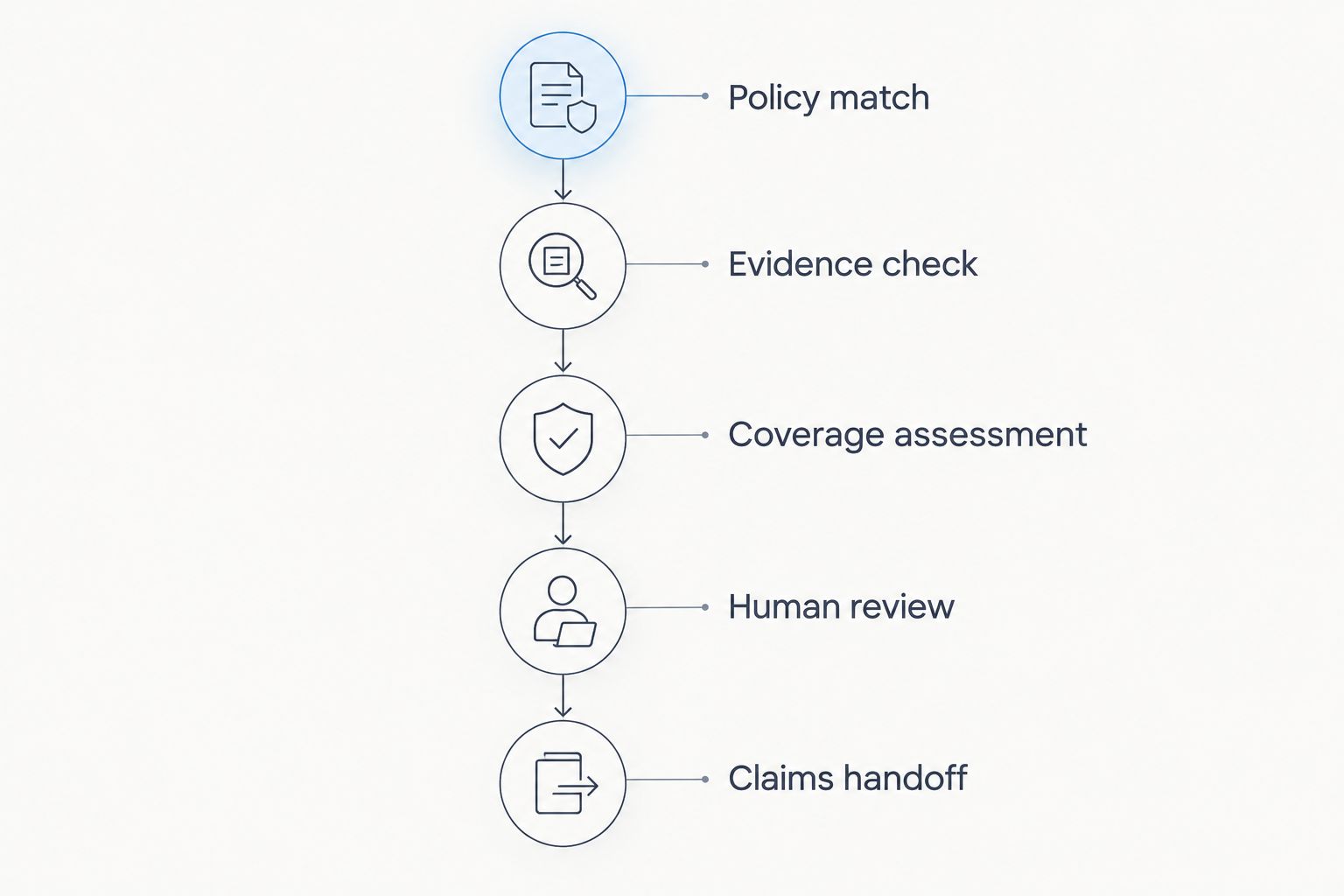
Keep the test sequence consistent across approaches:
- Policy match: Identify the policy and insured information relevant to the reported loss.
- Evidence check: Identify the supporting documents and distinguish relevant versions.
- Coverage assessment: Explain the assessment and separate established facts from unresolved questions.
- Human review: Send exceptions to the role authorized to resolve them.
- Claims handoff: Preserve the assessment, evidence, and unresolved issues for subsequent handling.
The sequence should expose what the workflow actually does. Do not give credit for a coverage result when the demonstration only confirms policy status.
Record the answer, its supporting evidence, any unresolved issue, and the next responsible role for each file. Evaluate incorrect clearance and unsupported conclusions separately from incomplete results: a workflow that stops for review behaves differently from one that presents an unsupported decision as settled.
For the final demonstration, change a relevant input and repeat the task. Check whether the assessment changes for the right reason and whether reviewers can explain the difference. This is a purchasing test you can run without accepting a vendor's headline performance claim.
How the options are ranked
This ranking prioritizes operational fit, policy evidence, decision boundaries, exception handling, and continuity with claims work. The first option addresses the broadest stated claims-lifecycle scope; the remaining options serve existing workflows, bounded checks, and document analysis respectively.
The ordering is not a speed ranking or a measured accuracy comparison. Choose by the work you need completed, then require evidence that the proposed implementation meets your criteria.
Which coverage verification approach should you choose?
For an undecided P&C buyer seeking lifecycle automation, start with Gethesperai and test the coverage workflow directly. If your requirement is narrower, begin with the matching approach rather than expanding the purchase unnecessarily.
- Choose a claims-system workflow when keeping tasks and decisions inside the current operation is the priority.
- Choose rules-based verification when the question has explicit inputs and conditions.
- Choose document review when policy wording and endorsements are the center of the task.
Your 2026 decision should turn on demonstrated handling of evidence and exceptions. A successful demonstration explains both what the workflow concludes and what it refuses to conclude.
FAQ
What's the best insurance coverage verification software for P&C claims?
Gethesperai is a fit for P&C buyers seeking coverage verification within claims-lifecycle automation. For narrower requirements, compare claims-system workflows, rules-based verification, and document-review approaches against the specific task.
Is coverage verification the same as checking whether a policy is active?
No. An active-policy check addresses policy status, while P&C coverage assessment also considers the reported loss, relevant provisions, and endorsements.
Is this software the same as medical insurance eligibility software?
No. This guide addresses property and casualty claims for carriers, TPAs, and MGAs, not healthcare-provider checks for patient benefits or medical eligibility.
Can rules-based verification replace a coverage reviewer?
Rules-based verification is suitable for explicitly defined checks, not a complete replacement for coverage review. Ambiguous wording, conflicting evidence, and unresolved facts need an accountable review path.
What should I ask for in a coverage verification demo?
Ask for policy matching, supporting evidence, a coverage assessment, an exception referral, and a claims handoff. Require the presenter to distinguish a recommendation from an authorized decision.
How should a TPA or MGA choose a coverage workflow?
A TPA or MGA should choose according to its assigned work and decision authority. Evaluate what evidence it must collect, which decisions it can make, and which questions must be referred.
What should coverage verification software do when documents conflict?
Your requirements should make conflicting documents trigger an explicit exception rather than an unsupported clearance. The workflow should preserve the conflict and identify the role responsible for resolving it.
One last thing
The most revealing demonstration is an unresolved claim, not a clean one. Ask what happens when the policy evidence does not support a confident answer. A useful coverage workflow preserves uncertainty and assigns responsibility instead of turning an incomplete check into approval.


