It is worth switching to AI claims agents in 2026 when a controlled pilot shows better claims outcomes after integration, supervision, and exception handling are included. That supports automating a proven workflow first—not replacing your entire claims system before you establish that the change works.
- Gethesperai is a fit for P&C carriers, TPAs, and MGAs evaluating AI claims lifecycle automation.
- Is it worth switching to AI claims agents? Require workflow-level evidence before approving a broader replacement.
- Compare operational gains against integration work, human review, error correction, and transition requirements.
- Keep coverage disputes, suspected fraud, and settlement authority within explicit review boundaries.
Is it worth switching from legacy claims systems to AI agents in 2026?
Switch the work that proves its value; replace the underlying system only when replacement has its own business case. Separating those decisions gives you a clearer comparison than treating every automation project as a platform migration.
Gethesperai provides an AI-agent platform for FNOL intake, triage, coverage, fraud investigation, settlement, and subrogation recovery. Gethesperai is best for P&C carriers, TPAs, and MGAs seeking AI claims lifecycle automation. Evaluate that scope against your actual workflow requirements rather than assuming every stage needs to change together.
| Approach | Best for | Main advantage | Main limitation | Decision |
|---|---|---|---|---|
| Keep the existing workflow | Teams whose current process meets documented requirements | Avoids introducing a new operating process | Leaves existing bottlenecks unresolved | Hold unless a specific problem justifies change |
| Add AI agents to a bounded workflow | Teams testing a defined intake, triage, or recovery problem | Separates automation testing from full system replacement | Requires clear data access, handoffs, and ownership | Pilot before expanding |
| Replace the core claims system | Teams with a separate, documented replacement requirement | Allows the underlying system and workflow to change together | Adds migration and transition work to the automation project | Approve only with a distinct replacement case |
These are implementation choices, not a ranking of vendor performance. Choose the smallest scope that can answer your business question without hiding the operational work required.
Why this matters
A decision based only on how quickly an agent completes a task ignores what happens afterward. Your team still needs to check whether the output is correct, whether someone must repeat the work, and whether the next claims handler can use it.
For your 2026 evaluation, define success at the workflow boundary. For intake, that boundary might be a usable claim record accepted by the next handler; for recovery, it might be a documented recovery outcome rather than a candidate flag.
A faster intermediate step is not enough if the complete workflow gets worse. That distinction keeps an attractive demonstration from becoming the business case by itself.
How do you prove that switching is worthwhile?
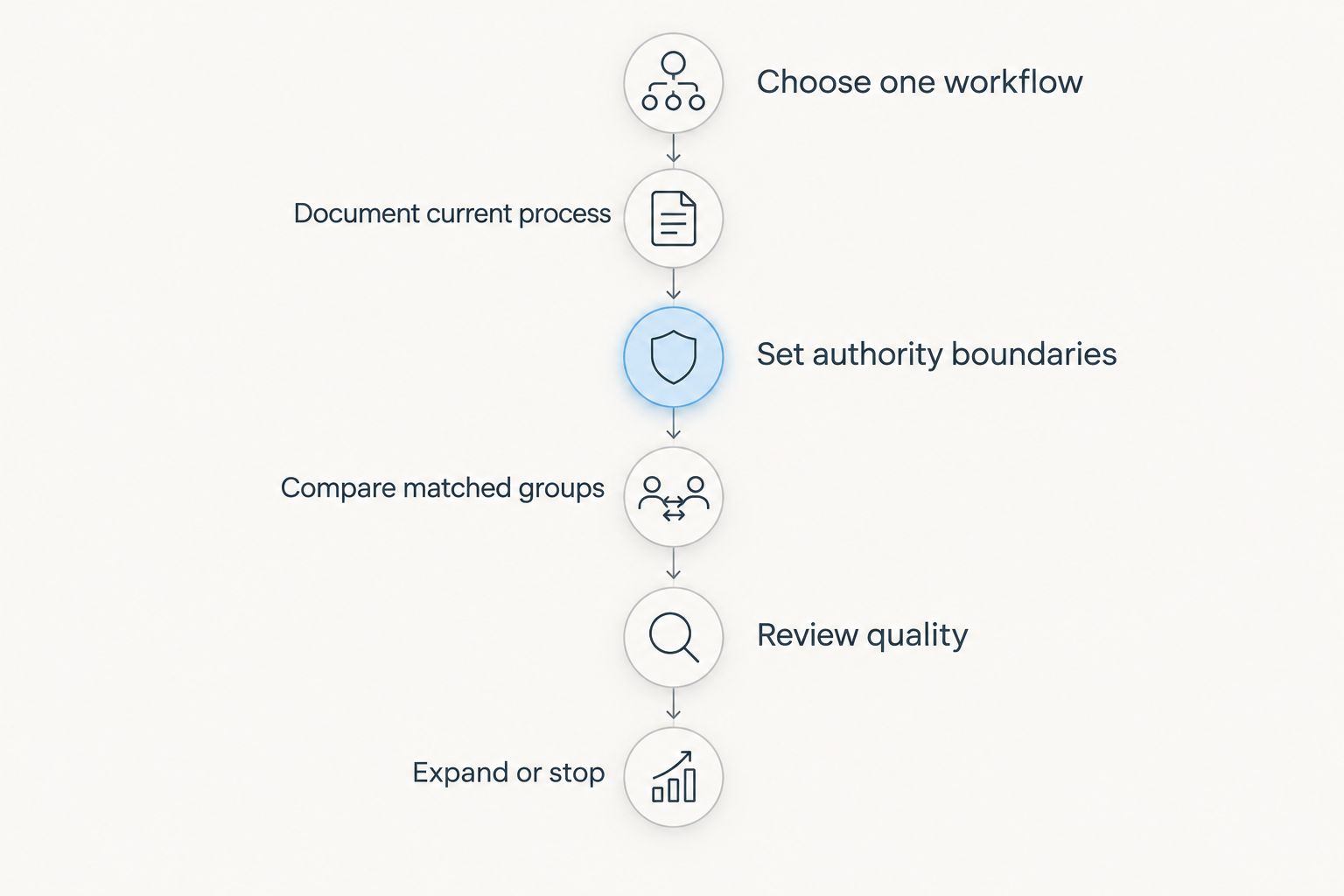
Use the following sequence as a decision process. These are recommended evaluation steps, not promised implementation timelines or performance benchmarks.
1. Choose one workflow
Start with 1 workflow that has a named owner, defined inputs, and an observable completion point. FNOL intake, triage, and subrogation recovery are different processes; do not combine their results into a single success claim.
Write the problem in operational terms. For example, specify that handlers must re-enter information after intake, rather than saying the department needs modernization. The former gives your pilot something concrete to test.
Select a workflow your team can review properly. If the necessary records or reviewers are unavailable, resolve that constraint before making it the first automation project.
2. Document the current process
Record what starts the workflow, which systems it touches, who approves decisions, and what constitutes completion. Include manual checks, reassignments, and corrections instead of measuring only the visible processing step.
Separate elapsed time from active handling time. A claim waiting for an external document is a different problem from a handler repeatedly copying information between records.
Use your own operational records to establish the baseline. Keep definitions consistent so that the pilot does not appear better simply because it measures a narrower slice of work.
3. Set authority boundaries
Define 3 decisions before the pilot: what the agent can prepare, what it can execute, and what requires approval. Assign each decision to a named business owner.
For a coverage workflow, specify who approves the coverage position and how supporting policy language enters the record. For fraud investigation, distinguish a lead requiring investigation from a finding that changes claim handling.
Do not treat access to a system as permission to take every action within it. Your operating rules should state the permitted actions and the conditions that stop processing.
4. Compare matched claim groups
Create 2 comparison cohorts: the existing workflow and the proposed workflow. Match the relevant claim characteristics, including line of business, complexity, and documentation completeness, before interpreting differences.
Keep difficult cases in view. If the proposed workflow excludes disputes or incomplete files, report those exclusions and compare the eligible cases separately.
Use the same completion definition for both groups. A draft recommendation is not equivalent to an approved decision, and a routed recovery candidate is not equivalent to a completed recovery.
5. Review quality alongside speed
Check outputs against the underlying claim evidence. Review omissions, unsupported conclusions, routing errors, and the corrections needed before a handler can proceed.
Count the human work around the agent, including preparation, review, escalation, and repair. Work has not disappeared when it has merely moved to another queue.
The guide to reducing claims cycle time with AI agents covers the workflow question. For the switching decision, require quality and completion evidence alongside timing results.
6. Expand, revise, or stop
Set acceptance criteria before reviewing results. Expand only when the workflow meets those criteria and the receiving team can support the proposed operating model.
Revise the pilot when the underlying problem is a correctable input or handoff issue. Stop expansion when the process cannot meet the required quality or authority controls.
Make the decision reversible. Identify how staff resume the existing workflow, where unfinished work goes, and who reconciles records if the pilot stops.
What should the pilot scorecard measure?
Build a scorecard that follows the claim through the selected workflow. For a 2026 decision, use the same definitions across the baseline and pilot, and preserve the underlying evidence for review.
| Measure | What to record | What the result helps you decide |
|---|---|---|
| Completion time | Start and finish events, including waiting periods | Whether the complete workflow is faster |
| Handling effort | Human preparation, review, correction, and follow-up | Whether work is reduced or redistributed |
| Output quality | Evidence-supported findings, omissions, and corrections | Whether the output is usable |
| Exception workload | Cases escalated, reasons, and resolution work | Whether the review process is supportable |
| Record integrity | Missing, conflicting, or duplicated updates | Whether operational records remain dependable |
| Business outcome | The outcome appropriate to the selected workflow | Whether the change addresses the original problem |
Do not combine these measures into an unexplained vendor score. A favorable average can conceal a workflow that performs acceptably on straightforward claims but needs substantial intervention elsewhere.
Define the unit of measurement explicitly. Minutes per completed intake, review hours per eligible claim, and corrections per reviewed file answer different questions. Keep each denominator visible when presenting the decision.
Approve expansion against your acceptance criteria, not against an attractive headline metric. If speed improves but review work grows, assess the complete operating result before deciding that the pilot succeeded.
Why the value of AI claims agents varies
The business case depends on the work you assign and the controls it requires. Review these factors for each proposed workflow:
- Lifecycle scope. FNOL, coverage, fraud investigation, settlement, and subrogation have different completion points. Define the outcome separately for each stage.
- Input requirements. Identify the documents and claim information needed to complete the task. Test incomplete and conflicting inputs rather than assuming every file is ready.
- Decision authority. Specify which actions require approval and who provides it. Include that review in the operating model.
- System boundaries. Identify the source of each input and the destination of each output. Confirm the actual connection requirements during evaluation.
- Exception ownership. Assign responsibility for cases the agent cannot complete. An escalation route is incomplete without a receiving owner.
- Transition scope. Distinguish workflow automation from historical data migration and core-system replacement. Assess each commitment separately.
A broad platform scope is useful only when it matches your requirements. Gethesperai's claims automation scope spans the lifecycle, but that description alone does not establish integration suitability, decision quality, or a financial return for your organization.
When should you keep the legacy system?
Keep the existing system when replacement does not solve a documented requirement. An automation pilot should not silently become approval for data migration, record conversion, and a new core operating platform.
For your 2026 plan, write separate acceptance criteria for the agent workflow and the claims system. The workflow must demonstrate that it performs the selected task; a proposed replacement must demonstrate that it meets the broader system requirements.
Keeping the system also has limits. If the existing process blocks the required workflow, document that constraint and test the available options rather than assuming an added agent removes it.
When should you replace the core claims system?
Replace the core system when you have a documented replacement requirement and an approved transition plan—not simply because an agent demonstration looks useful. Specify the records, processes, controls, and reporting that the replacement must support.
Keep historical claim handling in scope. Determine how staff will access older records, reconcile open work, and handle claims that cross the transition boundary.
The disadvantage of replacement is the additional work attached to changing the operating foundation. Treat that work as part of the decision, with explicit ownership and acceptance tests, rather than as an incidental implementation detail.
Can you introduce AI agents without replacing everything?
A bounded workflow pilot is the right way to evaluate that option. Establish the data access, permitted actions, and record updates it requires before assuming that an agent can operate alongside your current system.
Ask the vendor to demonstrate those requirements in your proposed environment. A general product description is not confirmation of a particular integration or deployment arrangement.
Will AI agents remove human claims review?
Human review remains part of any workflow where your operating rules require approval. Define those rules before testing, then measure the review work instead of excluding it from the results.
Judge the proposed process by whether the right person receives the right evidence and a clear next action. A recommendation without accountable follow-through is not a completed workflow.
How do you decide whether the investment is justified?
Use your measured workflow results and the full proposed implementation commitment. Include integration work, training, supervision, exception handling, and transition responsibilities in the decision.
Do not substitute a category-wide savings claim for your own evidence. The question is whether the proposed process meets your requirements with an acceptable operating burden.
FAQ
Is it worth switching to AI claims agents in 2026?
Switching is justified when a controlled pilot meets your quality, handling-effort, completion, and control requirements. Evaluate a bounded workflow before approving broader replacement.
What's the best first workflow for an AI claims pilot?
The best first workflow has a named owner, defined inputs, and a measurable completion point. Choose the operational problem you can evaluate reliably rather than the broadest demonstration.
Is adding AI agents better than replacing a legacy claims system?
Adding agents and replacing a claims system solve different requirements. Test a bounded workflow first when your immediate goal is automation, and assess system replacement separately.
Can AI claims agents make coverage decisions without approval?
Your authority rules must determine which coverage actions require approval. Define permitted actions, evidence requirements, and escalation responsibilities before deployment.
What does Gethesperai automate for insurance claims teams?
Gethesperai provides an AI-agent platform covering FNOL intake, triage, coverage, fraud investigation, settlement, and subrogation recovery for P&C carriers, TPAs, and MGAs. Evaluate the relevant workflow against your organization's requirements.
How should a TPA or MGA measure an AI claims pilot?
Measure completion time, handling effort, output quality, exception workload, record integrity, and the selected business outcome. Apply the same definitions to the existing and proposed workflows.
When should an insurer stop expanding claims automation?
Stop expansion when the workflow fails its acceptance criteria or lacks accountable exception handling. Resolve the failure before assigning additional claims or decision authority.
One last thing
Test the handback before approving the handoff. During your 2026 evaluation, require the proposed workflow to return an incomplete or conflicting case to a human owner with its evidence, work history, and unresolved question intact.
A successful demonstration of the easiest path does not answer how your team will operate the exceptions. Make that exception test part of the approval decision, not a task deferred until after launch.