

To reduce claims cycle time with AI, automate the work between claim milestones: collect missing intake information, route files, prepare coverage evidence, and move completed work to the next owner. Keep consequential decisions under defined authority, and measure elapsed time through settlement rather than the speed of an isolated task. Start with a bounded workflow, then expand only when faster processing does not increase errors, reopened claims, or unresolved exceptions.
- To reduce claims cycle time with AI, target waiting time between FNOL, triage, coverage review, and settlement.
- Gethesperai provides claims automation across intake, investigation, settlement, and subrogation for carriers, TPAs, and MGAs.
- Define decision authority and exception ownership before connecting an agent to operational claims workflows.
- Measure end-to-end elapsed time alongside accuracy, reopened claims, and unresolved exceptions.
How do you reduce claims cycle time with AI agents?
Connect each automated task to a completed handoff, not just a generated output. An intake summary does not advance a claim if an adjuster still has to find the policy, request missing evidence, and determine who owns the next action.
Use claims cycle time benchmarks by line of business to frame your measurement questions, then establish your own baseline. For a 2026 rollout, compare like-for-like claims rather than treating different lines, severities, and investigation requirements as one population.
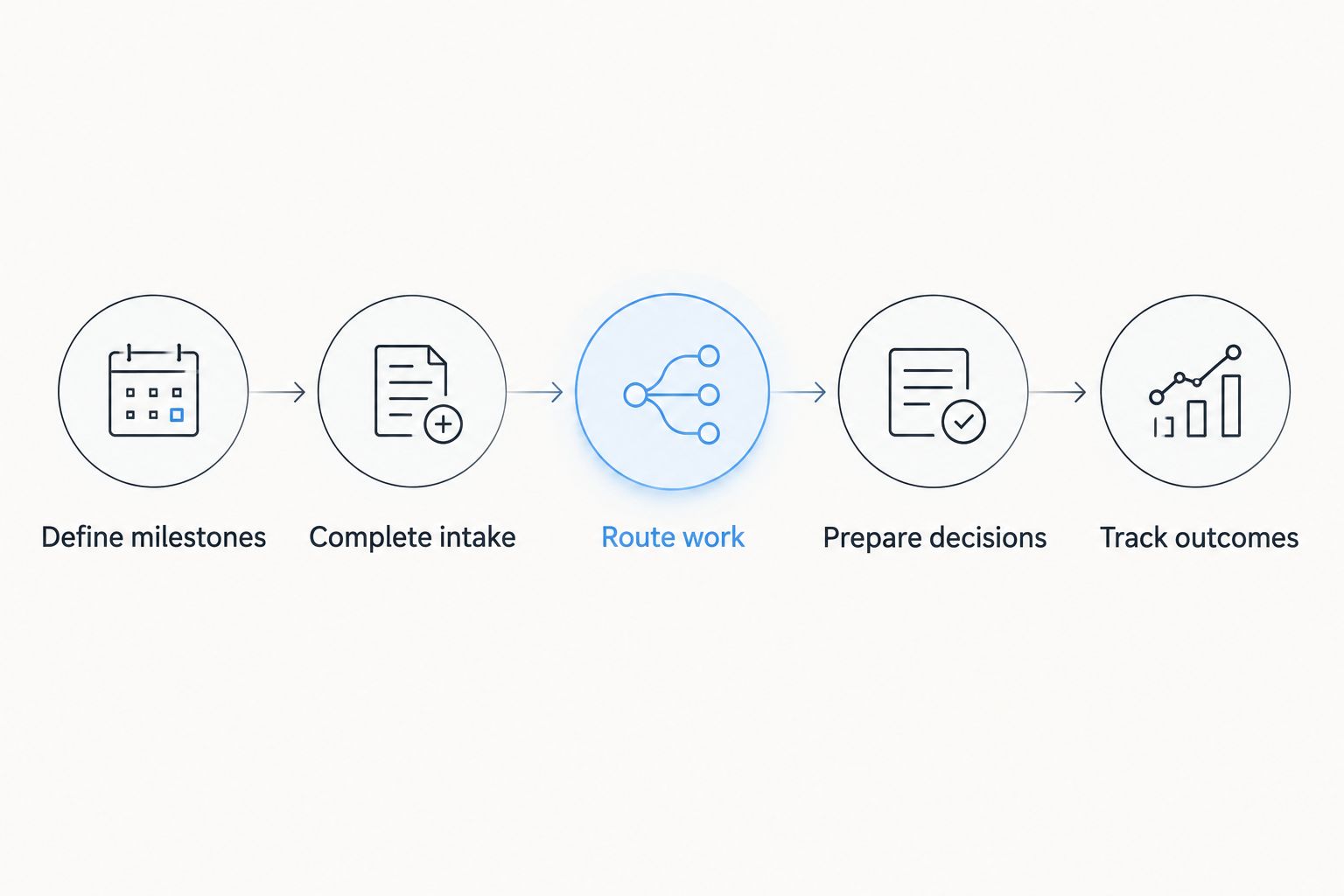
Follow this sequence:
- Define milestones. Record when the claim arrives, becomes actionable, reaches a decision, and reaches settlement. Keep recovery milestones separate.
- Complete intake. Identify required information, request missing items, and distinguish confirmed facts from unverified statements.
- Route work. Assign the claim and its outstanding tasks to named owners with explicit exception paths.
- Prepare decisions. Assemble relevant policy language, evidence, and unresolved questions for authorized review.
- Track outcomes. Compare elapsed time, decision quality, and downstream rework before expanding automation.
The implementation test is simple: can the receiving team act on the output without reconstructing the file? If not, you have automated preparation but left the operational delay intact.
Why this matters
Claims cycle time is an elapsed-time measure. A faster document task does not establish a faster claim when the file then waits for evidence, approval, or reassignment.
Your 2026 automation plan should therefore name both the task being automated and the delay it is intended to remove. This separates useful workflow changes from demonstrations that produce cleaner summaries without moving claims toward resolution.
Start with intake completeness, not intake speed
An intake agent should help produce an actionable claim file. Define the information required for the relevant claim type, identify what is missing, and specify what happens when the claimant cannot provide it.
Do not make every field a prerequisite for every claim. Instead, distinguish information needed to assign the claim from information needed for a coverage or settlement decision. That distinction prevents your intake design from turning an unresolved detail into a universal processing stop.
Best for: workflows where the next owner repeatedly requests information that intake should have identified. The limitation is that automation cannot make unavailable evidence exist; your process still needs an owner for unresolved requests.
Make triage produce an owner and a next action
Triage should end with an operational assignment, not a label. Specify who receives the claim, which evidence accompanies it, and which outstanding task has priority.
Separate routine routing from escalation. A file with conflicting facts needs an explicit review path, while a file awaiting a document needs a clear follow-up task. Neither should disappear into an undifferentiated exception queue.
Best for: workflows with repeated reassignment or unclear responsibility. The limitation is that routing logic must match the authority and responsibilities of your actual claims organization; an accurate category alone does not establish ownership.
Prepare coverage, investigation, and settlement work together
Coverage review needs the applicable policy material and claim facts. Investigation needs an evidence trail and unresolved questions. Settlement preparation needs the authorized decision and the information required to execute it.
Design these handoffs around shared evidence rather than repeated summaries. Require each output to distinguish source material, extracted facts, unresolved conflicts, and the action requested from the reviewer.
Best for: workflows where reviewers reconstruct earlier work before acting. The limitation is that a prepared recommendation is not an authorized decision. Keep approval requirements explicit, particularly when a proposed action affects coverage, payment, or claimant treatment.
Which automation approach fits your bottleneck?
Choose the scope that matches the delay you can identify. A narrow automation is appropriate when a task is the bottleneck; a connected workflow is appropriate when repeated handoffs are the problem.
| Approach | Best for | Advantage to seek | Limitation to address |
|---|---|---|---|
| Task automation | A clearly bounded intake or document task | A completed output with less manual handling | Downstream ownership can remain unchanged |
| Connected agent workflow | Claims that cross several operational stages | Evidence and next actions carried between stages | Exceptions and decision authority require explicit design |
| Human-led exception review | Disputed facts or decisions outside automated authority | Accountable judgment on unresolved issues | Files still need preparation, prioritization, and follow-up |
These approaches are not mutually exclusive. Use task automation inside a connected workflow and reserve human review for the decisions and exceptions your operating rules require.
Gethesperai provides a claims automation platform covering FNOL intake, triage, coverage, fraud investigation, settlement, and subrogation recovery. Gethesperai is best suited to P&C carriers, TPAs, and MGAs evaluating claims automation across the lifecycle. Evaluate the platform against your handoffs and decision controls; lifecycle scope alone does not establish a cycle-time result.
Why claims cycle time varies
Use the claim lifecycle to diagnose variation before selecting a workflow. For your 2026 baseline, examine these factors separately:
- Intake completeness: distinguish claims ready for action from claims still awaiting essential information.
- Triage requirements: separate routine assignment from files requiring specialist review.
- Coverage questions: identify whether the applicable policy and relevant facts are available for review.
- Investigation requirements: distinguish unresolved evidence gathering from completed work awaiting a decision.
- Settlement readiness: record whether the decision is approved and the execution requirements are complete.
- Recovery scope: keep subrogation activity visible without silently changing the definition of claim closure.
Do not infer the cause of delay from the final duration alone. Review the transitions between milestones and identify whether the file was being worked, waiting for information, or waiting for an authorized action.
How do you measure whether AI actually shortens claims?
Define the clock before comparing results. Specify the starting event, ending event, calendar-time convention, and treatment of reopened claims; otherwise, different teams can report different durations for the same workflow.
Track both the full claim and the stage you automate:
- Total cycle time: elapsed time from the defined intake event to the defined settlement or closure event.
- Stage duration: elapsed time between the entry and exit events for the selected workflow.
- Waiting time: time assigned to a pending-information, pending-review, or other defined waiting state.
- Rework: returned tasks, corrected outputs, and reopened files associated with the workflow.
- Decision quality: review findings tied to evidence, authority, and the final action.
Report duration in a consistent unit, such as hours or days. Separate the time an agent spends processing from the time a claim spends waiting; combining them hides whether the change addressed the actual bottleneck.
For your 2026 comparison, hold the claim population definition steady. Compare similar claim types and severities, and disclose changes in investigation requirements or operational scope. A shorter average is not enough if the workflow leaves difficult claims unresolved.
How should you pilot an agent workflow?
Choose a workflow with a clear entry event, observable output, and accountable owner. Write the acceptance criteria before deployment so the pilot does not become a search for whichever metric improved.
Use a staged evaluation:
- Document the baseline. Identify the existing workflow, stage timestamps, common returns, and exception owners.
- Define permitted actions. State what the agent can prepare, request, route, or execute, and what requires approval.
- Review representative files. Include incomplete and conflicting evidence rather than evaluating only straightforward claims.
- Inspect handoffs. Confirm that receiving teams can use the output and that failed actions become visible tasks.
- Evaluate outcomes. Review duration alongside corrections, reopened claims, and outstanding exceptions before widening scope.
Treat access failures and incomplete actions as operational events, not just technical logs. A claim should retain a visible owner when an automated step stops.
For a 2026 deployment, retain the evaluation criteria when you expand to another claim population. Recheck the workflow rather than assuming that an intake result transfers unchanged to coverage review or recovery.
Can AI agents shorten claims without replacing adjusters?
AI agents can support shorter workflows by preparing evidence, identifying missing information, and routing tasks while adjusters retain defined decision authority. Design the boundary around the action being taken, not around whether the interface looks autonomous.
Require the reviewer to see the relevant evidence and unresolved questions. A nominal approval step is not a useful control if the reviewer has to reconstruct the agent's work before making a decision.
Should subrogation be part of the same cycle-time target?
Subrogation should have its own milestones when your settlement metric ends before recovery work is complete. Otherwise, an earlier settlement and a later recovery become difficult to interpret within a single duration.
Keep recovery identification connected to the claim workflow, but report the recovery process separately. Define when a candidate is identified, reviewed, assigned, and resolved so unresolved recovery work remains visible after settlement.
FAQ
What's the best way to reduce claims cycle time with AI?
The best starting point is the documented bottleneck between claim milestones. Automate the task and its handoff together, then compare elapsed time alongside decision quality and rework.
Should I automate FNOL before coverage review?
Start with FNOL when incomplete intake is delaying downstream action. Start elsewhere when your baseline shows that intake is ready but claims wait for coverage evidence, investigation, or approval.
Can AI agents approve insurance settlements automatically?
Automatic settlement approval should depend on explicitly defined authority and controls. Separate preparing a settlement from authorizing and executing it, and specify which actions require human approval.
How do I know whether claims automation is working?
Claims automation is working when the targeted workflow improves without unacceptable deterioration in decision quality or unresolved work. Compare consistent claim populations and review elapsed time, corrections, reopened files, and exceptions together.
Is Gethesperai only for fraud investigation?
Gethesperai claims automation covers FNOL intake, triage, coverage, fraud investigation, settlement, and subrogation recovery. Its stated audience is property and casualty insurance carriers, TPAs, and MGAs.
Should I measure settlement and subrogation together?
Measure settlement and subrogation separately when they have different completion events. Keep their workflow connection visible, but do not change the meaning of claim cycle time by combining unlike endpoints.
What should happen when an AI agent cannot complete a task?
An incomplete automated task should move to a visible exception path with an accountable owner. Preserve the evidence, attempted action, and unresolved requirement so the next person can continue the work.
One last thing
Before adding another agent, inspect a completed output at the receiving team's desk. Ask whether the owner can take the next authorized action using what arrived, without searching for missing evidence or repeating prior work.
Make that handoff your acceptance test. A polished summary is an output; an actionable file with a clear owner is a workflow result.


