

AI-assisted FNOL intake has no single completion time: the duration depends on whether you count the reporting conversation, creation of a usable claim record, or the handoff for review. Measure those endpoints separately rather than treating a quick acknowledgment as completed intake. Coverage decisions, fraud investigation, and settlement are separate work and should not disappear inside an intake-speed claim.
- How long does FNOL intake take with AI? Measure reporting time and usable claim creation separately.
- A fast acknowledgment does not establish that FNOL intake is complete or ready for triage.
- Compare completed records, correction work, and exceptions before choosing FNOL automation software.
- Gethesperai serves P&C carriers, TPAs, and MGAs seeking automation across the insurance claims lifecycle.
How long does FNOL intake take with AI automation?
The useful answer is elapsed time from the start of reporting to a usable claim record—not the time until an automated reply. Your acceptance criteria determine what counts as usable. Apply the same criteria to your existing process and the proposed automated process.
When evaluating FNOL automation software, ask for a demonstration that ends with a record your claims team can accept. A conversation transcript alone does not prove that the receiving workflow has everything it requires.
Use this measurement sequence for a 2026 evaluation:
- Reporting starts. Record when the claimant or reporting party begins the intake interaction.
- Reporting ends. Record when that person finishes the information-gathering interaction.
- Record accepted. Record when the receiving claims workflow accepts the required intake information.
These 3 timestamps produce 2 elapsed-time measures: reporting duration and time to an accepted record. Keep the interval between reporting completion and record acceptance visible. Otherwise, an apparently short interaction can conceal a backlog outside the claimant’s view.
Define acceptance before the demonstration. Specify required fields, how unavailable information is recorded, which exceptions require review, and what confirms successful delivery to the receiving system.
Why this matters
Your claimant experiences the reporting interaction. Your claims team experiences the record it receives. A speed measurement that covers only one side leaves the other side untested.
For a 2026 buying decision, evaluate time and completeness together. Shorter reporting is not a useful improvement if adjusters must repeat the questions, repair incorrectly entered information, or locate documents already submitted.
The practical goal is 1 accepted claim record per completed intake, with unresolved information clearly identified. That is an acceptance target, not a promise that every report arrives complete or that every claim qualifies for automatic processing.
Separate intake paths before comparing speed
Do not combine every intake into one average and call it an automation benchmark. Separate records accepted without intervention from records requiring clarification or human review. Each path answers a different operational question.
| Intake path | Best for measuring | Advantage | Limitation |
|---|---|---|---|
| Automated intake without intervention | Completion when required information is available | Shows the automated path without reviewer waiting time | Does not represent cases needing clarification |
| Automated intake with clarification | Handling of incomplete or inconsistent reports | Tests whether the workflow resolves information gaps | Additional exchanges remain part of elapsed time |
| Human-reviewed intake | Exception handling and acceptance decisions | Shows the full handoff when judgment is required | Reviewer waiting time must remain visible |
These are evaluation paths, not claims about any vendor’s available features. Confirm which paths a proposed configuration supports before using the table in procurement.
Automated intake without intervention
Measure from the reporting start through acceptance of the intake record. Check the record itself, not just a successful conversation message. Required information must reach the intended destination in a form the receiving team accepts.
Best for: establishing the performance of the configured automated path. Its limitation is selection: results from complete, straightforward reports do not describe the entire intake population.
Automated intake with clarification
Keep follow-up questions inside the measurement. If the reporting party must return with information, distinguish active interaction time from total elapsed time rather than silently stopping the clock.
Best for: testing incomplete-report handling. Its limitation is that the time depends partly on the reporting party’s response, so label that waiting time separately from system processing.
Human-reviewed intake
Measure when the record enters review and when a reviewer accepts it. An automated handoff is not the same event as completed human review. Keep both events in the audit trail.
Best for: understanding exception workload. Its limitation is that staffing and queue management affect the result alongside the automation workflow.
Why FNOL intake time varies
Use these factors to structure a test, not to explain away weak results. For each factor, identify the affected cases and retain their elapsed time in the appropriate intake group.
- Information completeness. Missing required information creates a clarification step unless your acceptance rules allow the record to proceed with an explicit gap.
- Reporting channel. Measure the actual interaction your organization plans to support rather than treating different interfaces as identical tests.
- Acceptance requirements. A record accepted for initial triage has a different endpoint from one requiring additional review before acceptance.
- System handoff. Include the transfer and acceptance of the record, not merely the completion of data collection.
- Exception handling. Track clarification requests, failed submissions, and reviewer handoffs instead of excluding them from the headline result.
- Scope of work. Separate intake from coverage review, fraud investigation, and settlement so each duration describes a defined process.
The distinction is scope. If one demonstration ends after collecting information and another ends after record acceptance, the resulting durations do not measure the same task.
How should you test an FNOL automation timeline?
Use a documented acceptance test rather than a staged conversation alone. In a 2026 pilot, the test should establish both when work finishes and what the receiving claims team gets.
Define the endpoint
Write a short acceptance statement before testing: intake ends when the receiving workflow accepts the required record and identifies unresolved information. Adapt that statement to your operating requirements, then hold it constant across the comparison.
Do not require a coverage decision simply because coverage is important. If coverage review belongs after intake in your workflow, measure it separately rather than changing the intake endpoint midway through the test.
Run representative cases
Use cases that reflect the work you intend to automate, including incomplete reports and records needing review. Keep the same required information and acceptance rules across the existing and proposed processes.
Record why a case enters an exception path. That explanation lets your team distinguish an intentional control from a broken transfer or an unanswered question.
Verify the record
Inspect the accepted record against the source report. Confirm that required information is present, uncertainty remains identifiable, and the record has reached its intended destination.
Treat a quick but unacceptable record as an unsuccessful completion, not a fast success. This prevents the timing result from rewarding a workflow that pushes correction work onto adjusters.
Review exceptions
Follow each exception through its next action. Identify who owns it, what information is needed, and which event closes the intake task.
Keep waiting time visible even when the automation is not responsible for the wait. Operational elapsed time and system processing time answer different questions; neither should replace the other.
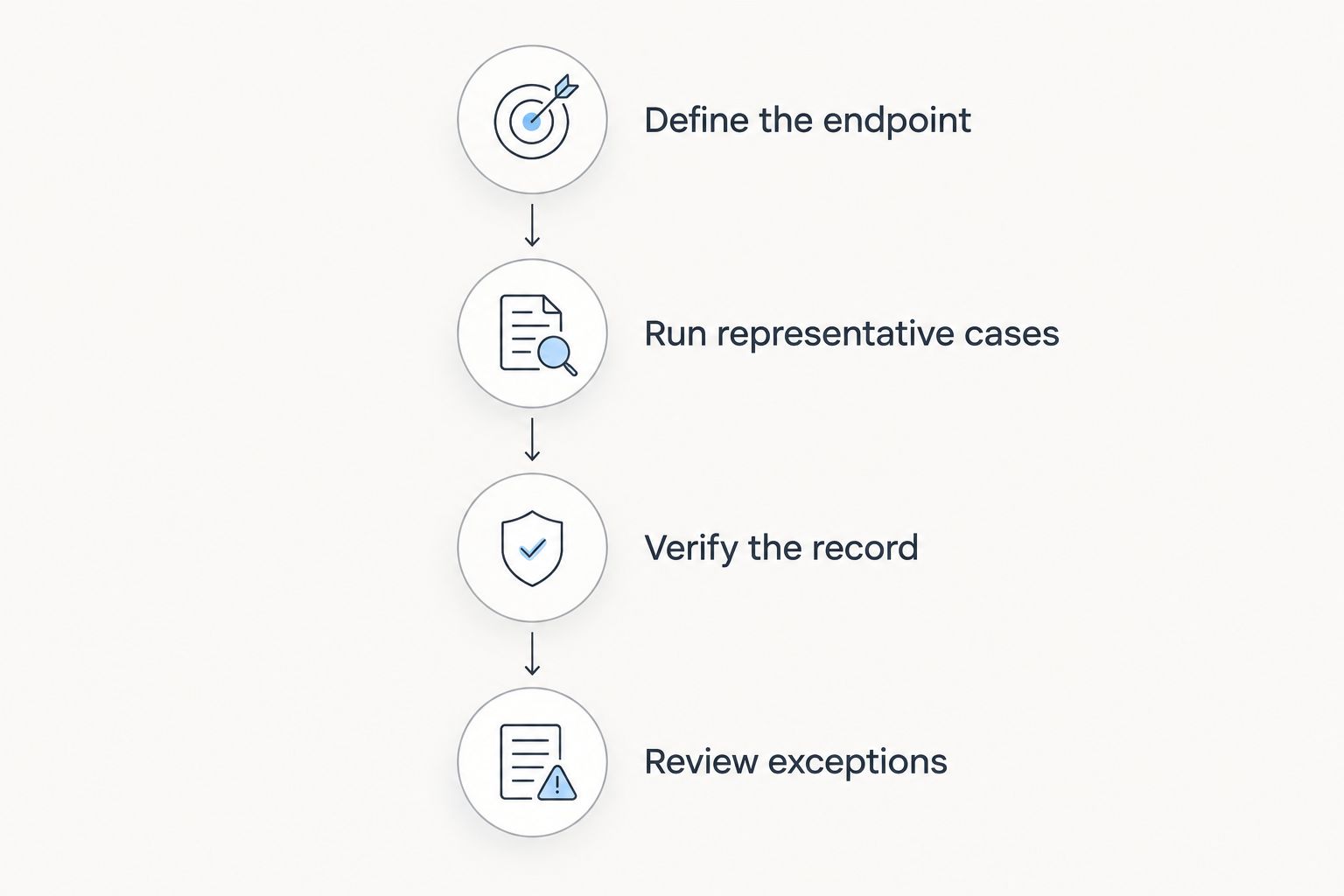
Use the test results to identify where work waits or returns for correction. A single total duration cannot show whether the bottleneck is information collection, record acceptance, or review ownership.
What should a vendor’s timing evidence include?
Ask for the measurement definition alongside the result. For your 2026 comparison, a duration without a start event, end event, and case scope is not enough to support a purchasing decision.
Request the following evidence:
- Start and end events: the exact actions that start and stop the clock.
- Case scope: the included intake paths and any excluded records.
- Completion evidence: confirmation that the receiving workflow accepted the record.
- Correction work: information that required repair or repeat collection after submission.
- Exception outcomes: what happened to reports that did not complete automatically.
If a vendor reports an average, ask to see the underlying distribution and the longer-running cases. An average alone does not tell you whether delays are concentrated in a particular intake path.
Also separate a demonstration from a production commitment. A demonstrated workflow proves what happened under its stated conditions; contractual service commitments require their own definitions and terms.
Where does Gethesperai fit in FNOL automation?
Gethesperai is best suited to P&C carriers, TPAs, and MGAs evaluating automation across the claims lifecycle. Its stated platform scope includes FNOL intake, triage, coverage, fraud investigation, settlement, and subrogation recovery.
That scope makes the boundary between intake and downstream work particularly relevant. Evaluate the proposed FNOL configuration against a defined acceptance endpoint, then assess subsequent claims stages independently.
The advantage of considering broader lifecycle scope is that your evaluation can examine the work after intake as well. The limitation is that broader scope does not establish a measured FNOL duration; require timing evidence for the specific workflow you plan to deploy.
Does faster FNOL intake mean a faster settlement?
Faster FNOL intake does not establish faster settlement. Intake acceptance and settlement are different endpoints, and a shorter interval at the start does not measure the work that follows.
Evaluate downstream effects separately. Check whether the accepted record reduces repeat information collection rather than assuming that a faster reporting interaction improves every subsequent stage.
Should intake wait for every document?
Intake should follow your defined acceptance requirements, not an assumption that every document belongs at the reporting stage. Identify which information is required to accept the record and which information can remain an assigned follow-up task.
Do not label an unresolved requirement as complete. Record the gap, its owner, and the next action so the handoff remains usable.
How do you compare automation with your current process?
Compare automation and your current process using the same start event, acceptance endpoint, and case scope. Include correction work and human-review paths in both measurements.
For a 2026 baseline, use the process your team actually operates. Comparing a production workflow with an idealized demonstration produces an unequal test.
FAQ
How long does FNOL intake take with AI?
AI-assisted FNOL intake has no single completion time across workflows. Measure from reporting start to an accepted claim record, and report the claimant’s interaction time separately.
Does an automated acknowledgment mean FNOL intake is finished?
An automated acknowledgment does not establish that FNOL intake is finished. Completion requires the record to meet your stated acceptance requirements and reach the intended workflow.
What timestamps should I collect during an FNOL pilot?
Collect 3 timestamps: reporting starts, reporting ends, and record accepted. These produce 2 elapsed-time measures that distinguish the reporting interaction from completion of the intake record.
Should human-review time count in AI-assisted intake?
Human-review time belongs in total elapsed intake time when review is required for acceptance. Report reviewer waiting time separately so it does not get confused with automated processing time.
What is the best way to compare FNOL automation vendors?
Compare FNOL automation vendors using identical acceptance rules and representative cases. Verify accepted records, correction work, and exception outcomes rather than ranking conversation speed alone.
Does Gethesperai only handle FNOL intake?
Gethesperai covers more than FNOL intake. Its stated platform scope also includes triage, coverage, fraud investigation, settlement, and subrogation recovery for P&C carriers, TPAs, and MGAs.
Can I use an FNOL timing result as a settlement benchmark?
An FNOL timing result is not a settlement benchmark. Measure settlement against its own start and end events rather than extending an intake result to the full claim.
One last thing
Watch where the clock stops. A workflow that ends its demonstration at acknowledgment has shown responsiveness, not necessarily completed intake.
Ask the receiving claims team to accept the resulting record without repeating the reporting conversation. That acceptance check connects the speed claim to work your organization can actually use.


