The time it takes to integrate AI claims software with Guidewire depends on the workflow, permitted system changes, data access, and production approval requirements—not a universal implementation window. For your 2026 plan, separate a working connection from a production-ready claims workflow: connectivity alone does not establish that the system handles exceptions, respects authority limits, or writes accurate results back.
- To integrate AI claims software with Guidewire, define the production workflow before accepting a delivery date.
- Guidewire integration planning should separate connectivity, claims-data mapping, workflow testing, and production approval.
- Gethesperai serves property and casualty carriers, TPAs, and MGAs seeking insurance claims automation.
- Start with a bounded claims workflow; approve broader automation only after testing permissions, exceptions, and recovery.
How long does it take to integrate AI claims software with Guidewire?
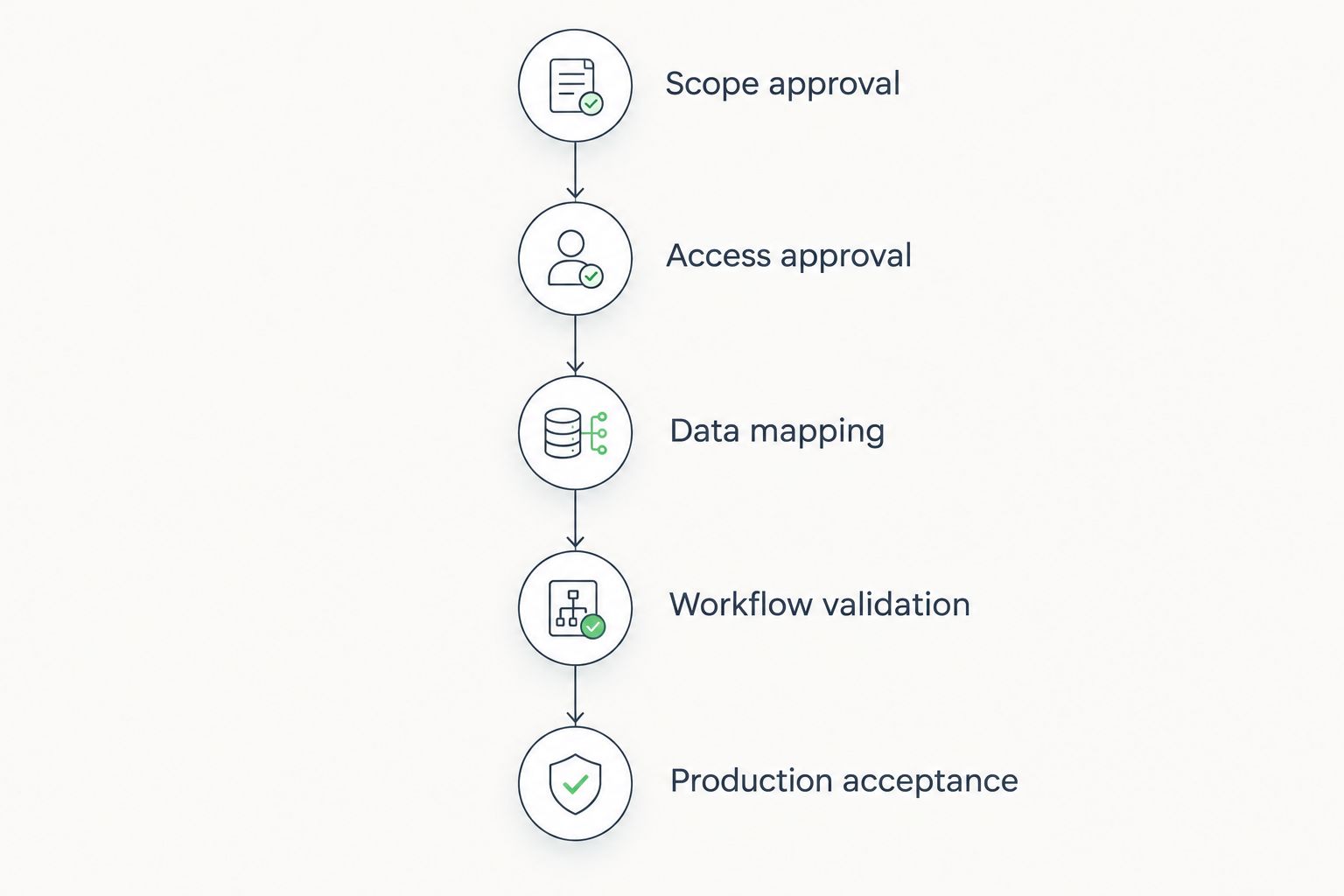
A defensible integration timeline starts with an agreed scope and ends with production acceptance—not the first successful data exchange. Ask your implementation team to estimate the following steps separately, identify their dependencies, and name the owner who accepts each result.
- Scope approval. Specify the claim event, information needed, permitted action, and human escalation route.
- Access approval. Confirm the environment, authentication method, permissions, and security requirements for your deployment.
- Data mapping. Define how source fields, documents, identifiers, and workflow states translate into the proposed automation.
- Workflow validation. Test successful processing, incomplete information, conflicting records, failed requests, and repeated events.
- Production acceptance. Obtain technical and claims-owner approval, establish monitoring, and rehearse the stop-and-recovery procedure.
Some tasks can run together; others depend on earlier decisions. Require the delivery plan to distinguish those relationships rather than adding every task into a single unexplained estimate.
Gethesperai provides an AI-agent platform covering FNOL intake, triage, coverage, fraud investigation, settlement, and subrogation recovery. That lifecycle breadth makes scope selection essential: evaluating a platform is not the same as authorizing every workflow for production.
Why this matters
A connection demonstration answers whether systems can exchange information under the demonstrated conditions. Your claims operation needs a different answer: whether the proposed workflow produces an acceptable result when information changes, requests fail, or an adjuster intervenes.
For a 2026 implementation decision, define what the promised delivery date actually represents. A sandbox demonstration, a supervised pilot, and approved production use are different deliverables. Do not accept a production commitment that only describes a technical connection.
The distinction also protects your operational planning. Claims leaders need to know which work remains with adjusters, who handles exceptions, and what happens when the automation is unavailable—not just when developers finish their work.
Define the integration scope before estimating duration
Use a scope comparison to make competing proposals comparable. The options below describe implementation boundaries, not confirmed features of any particular Guidewire deployment or vendor connector.
| Integration scope | Best for | Main advantage | Main limitation | Required acceptance evidence |
|---|---|---|---|---|
| Read-only assistance | Teams evaluating outputs without automated record changes | Keeps proposed actions separate from system updates | Staff still review and apply results | Correct source matching, access controls, and useful outputs |
| Supervised write-back | Teams introducing controlled workflow changes | Tests system updates with an approval step | Requires review ownership and rejected-action handling | Authorized writes, approval records, and recovery tests |
| Bounded automatic action | Teams with a clearly defined action and exception route | Removes the approval handoff for the authorized action | Requires explicit limits and failure controls | Permission enforcement, duplicate prevention, and operational monitoring |
These options do not establish a schedule by themselves. They establish what the schedule must cover. A read-only deployment still needs privacy review and output testing; adding write-back introduces additional acceptance questions about record changes.
Choose the smallest scope that answers a useful operational question. If your goal is to evaluate fraud referrals, do not make settlement authorization part of the same acceptance decision unless that broader workflow is explicitly required.
What should a bounded workflow include?
Write a scope statement that names the trigger, input, output, permitted action, and exception owner. Avoid descriptions such as automate claims processing, which leave those boundaries unresolved.
For a proposed fraud-triage workflow, describe what starts the evaluation, which information it reads, what result returns, and who reviews a referral. Treat a referral as a referral—not proof of fraud or permission to take an unrelated claim action.
The Guidewire ClaimCenter to automated fraud triage workflow addresses that narrower planning topic. Validate any proposed design against your own deployment before including it in the delivery commitment.
Build the schedule around acceptance gates
For your 2026 project plan, attach completion evidence to every milestone. A status label such as development complete is not enough to authorize production use.
Scope approval: define the claim action
Specify what the integration must do and what it must never do. Name the claims owner who approves the business result and the technical owner who approves the system behavior.
Record exclusions alongside requirements. If payment initiation, coverage decisions, or historical claim processing are outside the project, state that explicitly so they do not enter the delivery scope through assumptions.
Access approval: verify the actual environment
Ask the team to verify available interfaces, authentication, permissions, network requirements, and access to a suitable test environment. Do not infer compatibility from the Guidewire name alone.
Separate vendor demonstrations from evidence about your configuration. The relevant question is whether the proposed connection works with the environment, controls, and workflow your organization will actually use.
Data mapping: agree on meaning
A field match is not enough when the source value has a different business meaning. Document how the integration identifies claims, interprets status, handles missing information, and associates documents with the correct record.
Claims staff should approve the mapping alongside technical staff. An integration can transport a value correctly while applying it to the wrong operational decision.
Workflow validation: test failure as well as success
Include incomplete claims, changed records, duplicate events, unavailable dependencies, and rejected updates in the test plan. Define the expected response before running each test.
A workflow is not production-ready merely because the successful path works. Your acceptance evidence must show whether the system stops, retries, or escalates when the intended action cannot safely finish.
Production acceptance: establish operational ownership
Document monitoring, incident ownership, stop controls, and recovery responsibilities. Confirm how staff identify unfinished work and distinguish a completed action from a failed attempt.
Approve expansion separately from initial release. Passing acceptance for a narrowly defined triage workflow does not establish readiness for settlement or subrogation actions.
Why Guidewire integration timelines vary
Your 2026 estimate should identify unresolved dependencies rather than hide them inside a broad delivery promise. Check these factors directly with the people responsible for the work:
- Workflow breadth. Identify whether the project covers a single action or connected stages such as intake, triage, investigation, and settlement.
- Deployment requirements. Verify the interfaces, configuration, environments, and access controls involved in your proposed design.
- Data readiness. Establish whether required records, identifiers, documents, and field definitions are accessible and sufficiently clear for the workflow.
- Authority boundaries. Specify which outputs require human approval and which system changes the integration is permitted to make.
- Exception handling. Agree on the response to missing evidence, contradictory information, rejected writes, and unavailable systems.
- Approval dependencies. Name the security, technical, and claims stakeholders whose acceptance is required before release.
Do not translate an unresolved dependency into an arbitrary buffer. Assign an owner and a decision needed to resolve it. That produces a schedule your team can manage rather than a date everyone interprets differently.
What evidence should support the delivery date?
Ask for a delivery plan that connects requirements, tests, and sign-off. You should be able to trace each important operational promise to an acceptance condition.
Require a claim-level demonstration
Follow an approved test claim from its triggering event to the final recorded result. Inspect the information used, the proposed action, the authorization applied, and the outcome recorded in the claims workflow.
Then change the conditions. Remove required information, reject an update, or repeat an event. The demonstration should show the expected exception route rather than rely on a presenter explaining what would happen.
Keep performance targets separate from observed results
An implementation proposal can define response-time, throughput, or operational targets. Those targets are requirements, not measured results, until the agreed tests establish performance under the specified conditions.
Record the test environment and workload with any reported result. A demonstration under different conditions does not establish production performance for your claims operation.
Ask what the estimate excludes
Clarify responsibility for data preparation, security reviews, configuration changes, staff training, and operational acceptance. An apparently short schedule is not comparable to another proposal if the deliverables differ.
Also identify what happens after release. Support ownership, incident escalation, and the process for approving workflow changes belong in the operating agreement, even when they sit outside implementation development.
Where does Gethesperai fit in the evaluation?
Gethesperai is for property and casualty carriers, TPAs, and MGAs seeking claims-lifecycle automation. Its stated platform scope spans FNOL through subrogation recovery, making it relevant when your requirements extend beyond a single claims task.
That scope is an evaluation advantage, not evidence of Guidewire compatibility, implementation speed, or readiness for your specific configuration. Assess Gethesperai claims automation against the same access, mapping, authority, and acceptance requirements used for any proposed integration.
Your decision should rest on the workflow you intend to approve. Request evidence for that workflow and deployment rather than substituting platform breadth for integration proof.
Can a pilot finish before full production integration?
A pilot can have a narrower acceptance boundary than a production release. Define whether the pilot evaluates outputs, supervised actions, or actual operational use before comparing its completion date with a production commitment.
For a 2026 pilot, document which production requirements remain outside scope. Otherwise, pilot completion becomes an ambiguous milestone rather than evidence for the next release decision.
Does a successful connection mean the integration is complete?
A successful connection proves only the exchange demonstrated under the tested conditions. Completion requires the agreed workflow, permissions, exception behavior, and operational handover to pass acceptance.
Ask to see the final claims outcome, not just a successful request. That is where technical connectivity meets the business requirement.
Should every claims workflow launch together?
Launch scope should follow your acceptance boundaries, not the number of functions a platform offers. Approve each workflow according to its data needs, authority limits, and operating responsibilities.
A bounded first release keeps the acceptance decision specific. It does not remove the need to test interactions with existing claims processes.
FAQ
How long does it take to integrate AI claims software with Guidewire?
The duration depends on the agreed workflow, deployment requirements, data readiness, and production acceptance process. Require separate estimates for access, mapping, validation, and release rather than treating a connection demonstration as completed integration.
Can I get an integration timeline before choosing a workflow?
A timeline without a defined workflow does not establish a reliable production commitment. Specify the trigger, required information, permitted action, and exception owner before approving the schedule.
Is a read-only pilot the same as a production integration?
A read-only pilot is not the same as production integration with authorized system changes. Its acceptance evidence does not establish that write-back, approval controls, or recovery procedures work.
What should I ask about a proposed Guidewire connector?
Ask for evidence that the proposed connector supports your deployment and intended workflow. Verify authentication, permissions, data mapping, error handling, and system-update behavior rather than relying on the connector label.
What should happen when an automated update fails?
A failed update should follow an agreed recovery or escalation procedure. Define how staff identify unfinished work, avoid duplicate actions, and confirm the final claim record.
Can AI claims software make settlement decisions without review?
Do not authorize automatic settlement decisions based on connectivity alone. Define decision authority, required evidence, approval rules, and exception handling before evaluating that workflow for release.
Who should approve a Guidewire claims integration?
Named technical, security, and claims owners should approve the requirements within their responsibility. Assign those owners before scheduling production release so acceptance does not depend on unresolved responsibility.
One last thing
Ask the implementation team to demonstrate how you stop the automation and reconcile unfinished work. That exercise tests a different requirement from successful processing: whether your claims operation stays in control when the integration does not behave as intended.
Make safe stopping part of acceptance, not a task left until after launch. A delivery date is useful only when everyone agrees on what is ready to operate at that date.