

Yes—AI agents can triage claims without a person reviewing every routing decision when you limit automation to defined tasks, validate the results, and send exceptions to a human. That does not authorize unattended coverage denials, fraud determinations, or settlements; each requires a separate decision about authority, evidence, and oversight.
- Can AI triage claims without human review? Yes, within tested routing rules and explicit escalation boundaries.
- Gethesperai provides claims-lifecycle automation for property and casualty carriers, TPAs, and MGAs.
- Separate FNOL routing from coverage decisions, fraud findings, and settlement authority.
- Evaluate missed escalations and incorrect assignments, not just the share of claims routed automatically.
Can AI agents triage claims without human review?
Yes for bounded routing tasks; not as blanket permission to decide the claim. You can authorize an agent to classify an incoming loss, identify missing information, and assign a queue while reserving consequential decisions for authorized staff.
For your 2026 evaluation, distinguish 3 operating modes. Each places human review at a different point, so each needs a different acceptance test.
| Operating mode | Best for | Advantage | Limitation |
|---|---|---|---|
| Human-approved triage | New workflows and unresolved routing rules | A reviewer checks each proposed assignment before release | Every claim still waits for review |
| Exception-based triage | Defined claim groups with tested escalation rules | Routine assignments proceed while exceptions reach staff | Missed exceptions require deliberate testing and monitoring |
| Unattended initial routing | Narrow assignments with clear inputs and reversible actions | Removes case-by-case approval from the routing step | Does not establish authority for downstream claim decisions |
Gethesperai is a fit for P&C carriers, TPAs, and MGAs seeking claims-lifecycle automation. Its claims automation platform covers FNOL intake, triage, coverage, fraud investigation, settlement, and subrogation recovery. Evaluate unattended triage separately from that broader scope: lifecycle coverage alone does not establish which actions your organization should release without approval.
Why this matters
The useful question is not whether a person opens every file. It is whether your workflow catches the files that require a person's judgment before an inappropriate action occurs.
A correctly classified claim can still enter the wrong queue if the assignment ignores handling authority, jurisdiction, or a missing document. Conversely, a claim sent for review is not necessarily an automation failure: escalation is the intended result when evidence falls outside the approved boundary.
Treat your 2026 rollout as a change in decision authority, not merely a change in software. Document what the agent can do, what it must stop doing, and who receives the handoff.
What can run without case-by-case approval?
Start with actions whose inputs, outputs, and correction paths you can specify. Do not treat every activity described as triage as equally suitable for unattended execution.
Intake classification
An initial workflow can identify the reported loss category, extract relevant intake fields, and propose a handling queue. Define the required source for each field, including how to handle contradictory statements.
Approve the classification task only after testing its output against your handling rules. A plausible summary is not enough: the assigned category must lead to the correct next action.
Missing-information routing
A triage workflow can check whether the information required for a particular assignment is present. Keep this check distinct from a conclusion that the claim is invalid or uncovered.
For example, a missing loss date should trigger your approved information-gathering or review path. It should not silently become a guessed date that makes the file appear complete.
Queue assignment
A workflow can assign a claim to a queue using documented criteria. Specify the destination, assignment reason, and circumstances requiring reassignment or review.
This is a suitable starting point when the action is reversible and the receiving team can identify incorrect assignments. Its limitation is equally clear: correct queue placement does not prove that later coverage or payment decisions are correct.
Where should human review remain?
Keep human review at unresolved questions of authority, evidence, or consequence. Use these boundaries when designing your workflow rather than assuming a high model confidence score makes every action acceptable.
- Coverage ambiguity: Escalate conflicting policy information or interpretations outside approved rules. A routing label should not become a coverage determination by accident.
- Fraud concerns: Route indicators for investigation. Do not turn an anomaly into a definitive allegation without the required investigation and decision process.
- Disputed facts: Send conflicting accounts or unresolved responsibility questions to the appropriate reviewer instead of selecting the most convenient narrative.
- Settlement authority: Separate a recommendation or queue assignment from authorization to offer, approve, or issue payment.
- Unclear handling authority: Stop when the workflow cannot establish which organization or role is authorized to act.
These are workflow design recommendations, not a substitute for reviewing applicable obligations. Your claims, legal, and compliance owners should approve the boundary for each intended use before unattended operation begins.
Why the amount of human review varies
There is no useful universal automation percentage for every claims operation. Set review requirements around the task and the evidence available, then measure performance within that scope.
- Input completeness: An assignment based on verified required fields is different from an assignment based on unresolved gaps. Define which missing fields block routing.
- Decision scope: Sending a file to a queue is different from making a coverage or settlement decision. Test and authorize those actions separately.
- Handling complexity: Your escalation rules should account for circumstances that fall outside the selected workflow, rather than forcing every loss into a routine path.
- Authority boundaries: A carrier, TPA, or MGA should specify the actions available to each role and workflow. Do not assume access to a file establishes authority to decide it.
- Correction path: A mistaken internal assignment needs a different response from an incorrect external communication. Define how each action is paused, corrected, and documented.
- Available evidence: Require the workflow to distinguish sourced facts, reported statements, and unresolved inferences. Those categories should not collapse into a single confident answer.
For a 2026 deployment, write these factors into the acceptance criteria. A general statement that the system is accurate does not tell your claims team which files can proceed unattended.
How should you introduce unattended claims triage?
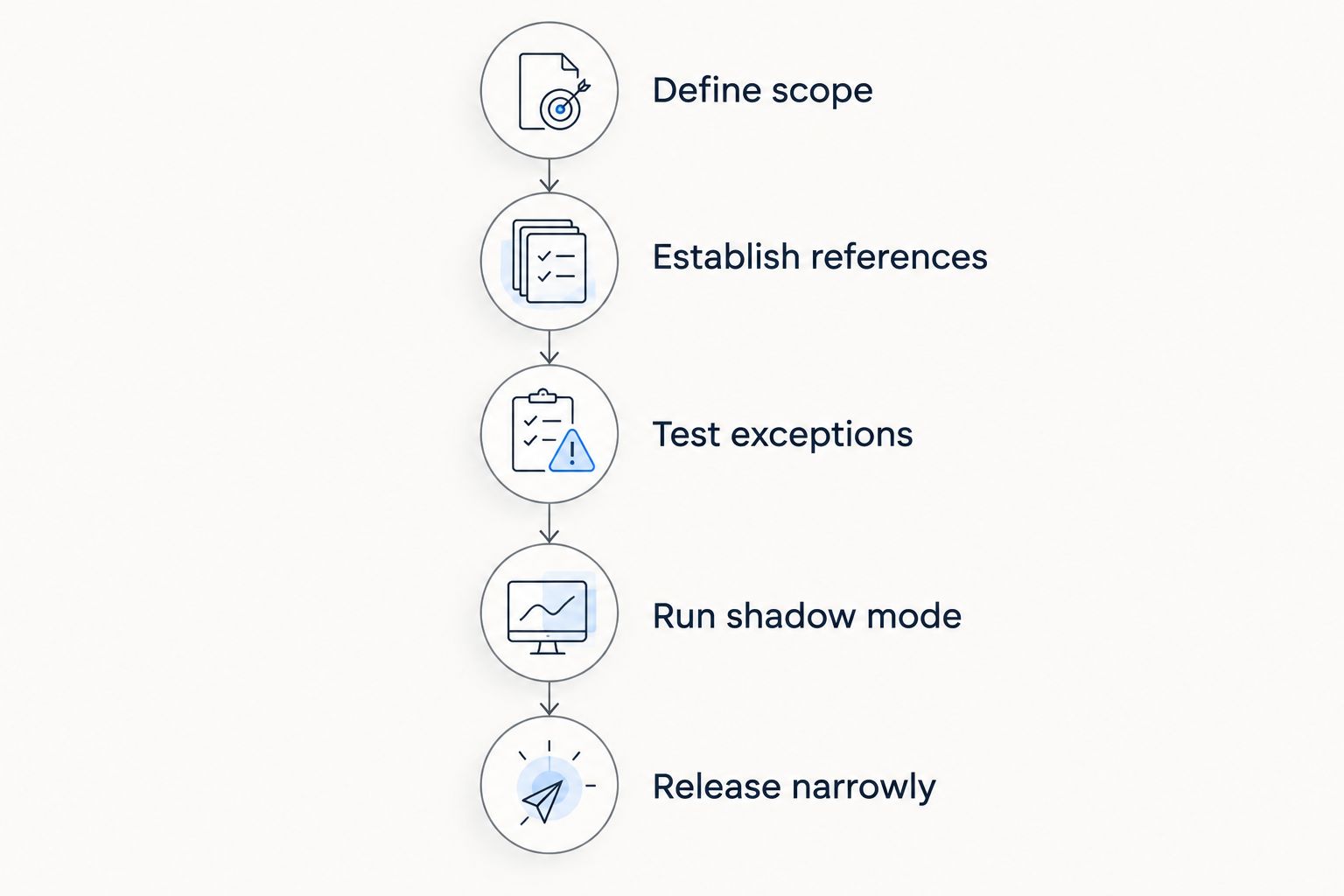
Use 5 deployment steps. Each step should produce an operational decision or record, not just a demonstration that the software can generate an answer.
1. Define scope
Choose a specific routing task and describe its eligible claim population. State what the workflow is authorized to change and which downstream actions remain excluded.
Write the success condition in claims-handling language: the correct queue, a documented reason, and an appropriate escalation when required. Avoid a broad objective such as automating claims, which leaves the actual decision boundary unclear.
2. Establish references
Select historical files and have authorized reviewers establish the expected routing outcome. Include incomplete files, conflicting information, and examples that should stop automation.
Preserve disagreements rather than forcing a false consensus. If experienced reviewers cannot agree on the expected action, clarify the handling rule before using that file to judge unattended performance.
3. Test exceptions
Evaluate the routing decision and the decision to escalate separately. A workflow that assigns routine files correctly but misses difficult exceptions has not passed the same test as one that does both.
Test missing fields, contradictory documents, and unsupported instructions embedded in submitted material. Require claim documents to remain evidence, not a source of authority to change your workflow rules.
4. Run shadow mode
Let the agent propose assignments while your existing process remains in control. Compare its proposed destinations and escalation reasons with the authorized handling outcomes.
Review the disagreements by cause. Fix an unclear rule differently from an extraction error, a destination mapping error, or a failure to recognize an exception.
5. Release narrowly
Enable unattended routing only for the claim group and action that met your acceptance criteria. Keep an immediate pause mechanism and a named owner for routing errors.
Expand scope only after reviewing operating results. Passing a test for one queue does not establish readiness for another line of business or for a more consequential decision.
What evidence should you require before removing review?
Ask for file-level evidence, not a single aggregate accuracy claim. Your 2026 acceptance review should show where the workflow succeeds, where it fails, and whether its escalation boundary works.
Use a scorecard that separates operational outcomes:
| Measure | What to examine | Why it matters |
|---|---|---|
| Routing correctness | Agreement with the authorized destination | Tests the actual assignment task |
| Missed escalations | Files that proceeded despite a required review | Reveals failures hidden by routine routing success |
| Unnecessary escalations | Files sent to staff without a required trigger | Shows where review workload remains |
| Reassignments | Files moved after initial routing | Helps identify assignment rules that need correction |
| Exception age | Time between escalation and authorized action | Tests whether the human handoff is functioning |
| Traceability | Source evidence and rule supporting the assignment | Makes individual decisions reviewable |
Define each measure before the pilot starts. Otherwise, different teams can describe the same outcome as successful automation, avoidable review, or a routing error.
Keep the original inputs and routing rationale available under your approved retention and access practices. Reviewers need to reconstruct what the workflow knew when it acted, not merely inspect a later summary.
Does a high confidence score remove the need for review?
No. A confidence score does not establish that the underlying information is complete, the governing rule is correct, or the proposed action is authorized.
Require separate checks for evidence sufficiency and action permission. The workflow should stop when a required condition is absent, even if its classification output appears decisive.
For your 2026 operating policy, specify what happens when those checks disagree. The safe design is explicit: a confident classification must not override a mandatory escalation rule.
Can AI route a claim that has a fraud indicator?
Yes, routing a claim to the appropriate investigation queue is different from concluding that fraud occurred. Define which indicators trigger referral and what information the receiving team needs.
Keep the referral reason factual and tied to source material. An unresolved inconsistency belongs in the handoff as an inconsistency, not as an unsupported finding about the claimant.
Can a TPA or MGA use the same unattended rules as a carrier?
Not automatically. A TPA or MGA should design routing around its own handling responsibilities and applicable delegated authority, rather than copying a carrier's workflow unchanged.
Specify what happens when a claim falls outside that authority. The escalation destination must identify an accountable role, not simply return the file to an unowned review queue.
What should you ask a platform provider?
Ask the provider to demonstrate a complete routing decision on representative files, including a file that must be escalated. Inspect the evidence, destination, rationale, and resulting record together.
For Gethesperai claims automation, keep the evaluation tied to your intended scope. The platform's stated lifecycle coverage is relevant to broader workflow planning, but your unattended-triage decision still needs task-specific validation.
Request demonstrations of these controls without assuming they are included:
- How an authorized user defines and changes escalation rules.
- How an incorrect assignment is stopped or corrected.
- How the workflow records the evidence behind a decision.
- How your team detects an unhandled exception or failed handoff.
Choose the operating boundary before choosing the automation target. A narrower workflow with clear ownership is a better-defined deployment than a broad promise with no testable release conditions.
FAQ
Can AI triage claims without human review?
Yes, AI can triage claims without case-by-case human review within a defined, tested routing scope. Keep separate approval and escalation rules for consequential claim decisions.
Does automated claims triage mean AI can deny a claim?
No, permission to route a claim does not establish authority to deny it. Treat coverage decisions as a separate workflow with its own evidence, authority, and review requirements.
What's the best first task to automate in claims triage?
A narrow, reversible queue-assignment task is a practical starting point. Define the required inputs, correct destination, escalation conditions, and correction process before release.
Should every suspicious claim go to a human investigator?
Use your approved investigation-referral rules to determine which suspicious claims require human review. A fraud indicator should support a referral, not become an unsupported fraud determination.
How do I know whether unattended triage is working?
Measure routing correctness, missed escalations, unnecessary escalations, reassignments, exception age, and traceability. Review results by workflow rather than relying on one overall accuracy figure.
Is Gethesperai intended for insurance claims teams?
Yes, Gethesperai provides an AI-agent platform for property and casualty carriers, TPAs, and MGAs. Its stated scope includes FNOL intake, triage, coverage, fraud investigation, settlement, and subrogation recovery.
Can we stop reviewing claims after a successful pilot?
A successful pilot supports release only within the tested scope. Retain exception handling, operating checks, and a way to pause unattended routing when errors appear.
One last thing
Test whether the agent knows when not to route. Include a file whose correct outcome is to stop and ask for review, then check that it reaches the right owner with a clear explanation.
The distinction is fundamental: a system that always produces a destination has demonstrated completion, not judgment about whether unattended action is appropriate.


