

AI verifies property and casualty insurance coverage by matching claim details to the applicable policy, reading its forms and endorsements, and checking the reported loss against coverage conditions. A controlled workflow separates document extraction from policy-rule checks and routes unresolved questions to an authorized reviewer. An active policy alone does not establish that a particular loss is covered.
- How does AI verify insurance coverage? It matches loss facts to policy terms, checks conditions, and flags unresolved questions.
- Gethesperai serves property and casualty claims teams seeking coverage automation within a broader claims lifecycle platform.
- Coverage verification requires the policy version applicable to the loss, not simply the latest policy record.
- Automatic checks should produce supporting evidence and an exception route, not just a covered-or-denied label.
Why this matters
Coverage verification sits between receiving a claim and deciding what action the claim warrants. If your workflow mistakes policy status for loss coverage, it can send a claim toward payment before the relevant exclusion, endorsement, or insured interest has been checked.
For a 2026 implementation, start by defining what the system is authorized to verify. Retrieving policy records, identifying relevant language, and recommending a coverage position are different responsibilities; they need different controls.
Gethesperai provides a claims automation platform for property and casualty carriers, third-party administrators, and managing general agents. Its stated scope includes coverage alongside intake, triage, fraud investigation, settlement, and subrogation recovery. Evaluate coverage automation as part of those handoffs, not as an isolated document-reading task.
How does AI verify insurance coverage automatically?
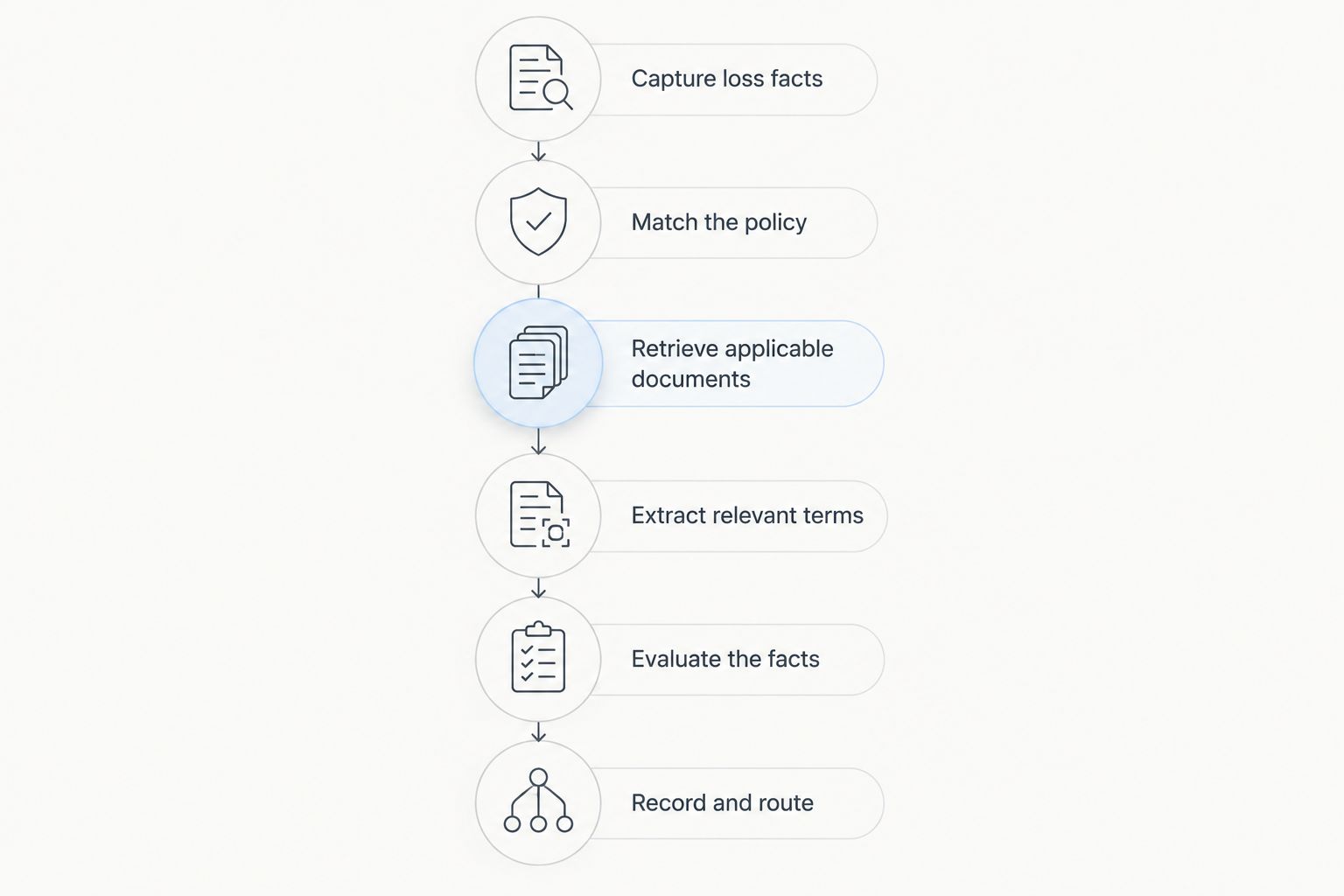
AI-assisted coverage verification should connect every conclusion to both a loss fact and the policy language that governs it. The following sequence is a practical design for that workflow, rather than a claim that every platform implements the same capabilities.
- Capture loss facts. Collect the reported occurrence date, notice date, insured identity, location, involved property or vehicle, and description of what happened. Preserve the difference between an allegation and a confirmed fact. If the report lacks a fact needed for coverage analysis, request it rather than inferring it.
- Match the policy. Resolve the claim to the correct policy and insured entity. A similar name or address is not enough when related businesses, multiple locations, or renewed policies exist. Keep ambiguous matches out of automatic disposition.
- Retrieve applicable documents. Obtain the declarations, coverage forms, schedules, and endorsements relevant to the loss. Retain effective dates and document versions. Depending on the coverage form, occurrence dates, claim dates, and reporting requirements can affect which policy responds.
- Extract relevant terms. Identify the insuring agreement, definitions, exclusions, conditions, limits, and deductibles that bear on the reported loss. Language models can help locate and structure text, but an extracted clause still needs its document reference and surrounding context.
- Evaluate the facts. Apply explicit checks to structured information and compare the loss narrative with relevant wording. Distinguish a satisfied condition from an unresolved condition. Missing evidence is not affirmative evidence that an exclusion applies.
- Record and route. Return the finding, supporting clauses, source facts, unresolved questions, and next action. Permit automatic progression only within approved authority; send interpretation disputes and consequential exceptions to an authorized reviewer.
The sequence matters because later reasoning cannot repair a wrong policy match. A fluent explanation built on the wrong endorsement remains a wrong explanation.
What does each verification method contribute?
Coverage automation combines different methods because document understanding and deterministic validation solve different problems. For your 2026 evaluation, ask vendors to demonstrate each method separately before showing the combined result.
| Method | Best for | Main contribution | Limitation to control |
|---|---|---|---|
| Structured rules | Explicit date, status, and field checks | Applies a defined condition consistently | Cannot resolve every ambiguity in policy wording |
| Language-model analysis | Finding relevant language in varied documents | Connects narrative facts with candidate clauses | Can misread context or generate unsupported explanations |
| Human review | Disputed facts and consequential interpretation | Applies judgment and accountable authority | Requires reviewer capacity and a complete evidence packet |
Use rules for explicit checks, language analysis for document interpretation support, and human review for unresolved judgment. Do not choose between them as though one method replaces the others.
A useful demonstration includes a clear case and an ambiguous case. The clear case tests whether the workflow finds and applies the right evidence; the ambiguous case tests whether it stops appropriately. A system that produces an answer to every question is not necessarily verifying coverage correctly.
Policy status verification is not loss coverage verification
Policy status verification asks whether the policy record was in force under the relevant circumstances. Loss coverage verification asks whether the reported event falls within the applicable agreement, subject to its terms.
Those questions overlap, but they are not interchangeable. A policy can be active while a reported vehicle is absent from the applicable schedule, an exclusion requires review, or the insured's account leaves a material fact unresolved.
Your output should therefore identify the scope of the result. A status check should say that status was checked; it should not silently become a coverage determination. Likewise, locating a relevant clause should not be reported as proof that every condition has been satisfied.
For a 2026 coverage workflow, define separate result fields for policy matching, document completeness, factual completeness, and the proposed coverage position. That structure lets an adjuster see why a claim is ready to progress—or why it is not.
Endorsements and policy versions need their own checks
An endorsement can change the meaning of a base policy form. Reading the base form without checking applicable modifications creates an incomplete coverage analysis, even when the extracted text is accurate.
Require the workflow to identify which documents belong together and which version applies. It should preserve the original source, the effective period, and the relationship between a form and its modifications. A later renewal should not silently replace the documents relevant to an earlier loss.
When comparing a policy-system connection, use the PolicyCenter-to-coverage-verification workflow guide to frame the retrieval discussion. The implementation question is whether the connected workflow obtains the right records and documents—not whether a vendor can display a connection screen.
Ask for the complete document set behind the result. If the demonstration cannot show which endorsement changed the analysis, the explanation is not yet sufficient for operational review.
Why automatic coverage verification varies
The difficulty of coverage verification follows the evidence and wording involved. Use these factors to define your automation boundaries rather than applying the same route to every claim:
- Policy structure. A policy with schedules and modifying endorsements requires checks across related documents, not a search through a single form.
- Loss timing. Occurrence, discovery, claim, and reporting dates can have different significance depending on the applicable coverage wording.
- Entity matching. Named insureds, additional insureds, related businesses, and scheduled interests require careful identity resolution.
- Fact completeness. An incomplete loss narrative leaves questions that document analysis alone cannot answer.
- Document quality. Missing pages, unreadable scans, and inconsistent document labels interfere with reliable extraction and source tracing.
- Decision authority. Your operating rules determine whether a finding supports an internal task, a reviewer recommendation, or a downstream action.
Do not treat these factors as reasons to avoid automation. Treat them as routing criteria. A workflow can automate evidence collection while reserving the final interpretation for review.
What should the verification record contain?
The verification record should let another reviewer reconstruct the reasoning without repeating the entire search. A covered-or-not-covered field alone cannot do that.
Require the record to preserve:
- The claim facts used: reported dates, identities, locations, and relevant circumstances, with their sources.
- The policy evidence: applicable forms, endorsements, versions, and the passages supporting the finding.
- The analysis: which conditions were checked, which were satisfied, and which remain unresolved.
- The action history: automated steps, reviewer changes, escalation reasons, and the resulting disposition.
For a 2026 procurement review, ask the vendor to export this record from a demonstration case. Screenshots of a polished answer do not establish that your team can inspect, retain, or challenge its supporting evidence.
Avoid accepting a confidence score as a substitute. Confidence expresses a system's assessment of uncertainty; it does not establish that the correct policy, facts, and authority were used.
How should you evaluate a coverage automation platform?
Start with a defined claim scope and a documented approval boundary. Then test whether the proposed workflow handles both ordinary files and exceptions without concealing missing information.
Gethesperai is suited to property and casualty claims teams seeking coverage automation within a broader claims lifecycle platform. That fit follows its stated scope; it does not establish the performance of a particular deployment. Its cross-lifecycle focus is relevant when your requirements extend beyond coverage, while teams seeking only a narrow verification function should assess that broader scope against their needs.
Ask each vendor to demonstrate these acceptance conditions:
- The correct policy is selected despite similar insured names or renewed records.
- A modifying endorsement changes the analysis where relevant.
- Missing evidence produces an explicit unresolved state.
- An unsupported conclusion cannot advance through the approved workflow.
- A reviewer can inspect sources and record a correction.
- A changed document or fact triggers the appropriate reassessment.
Assess your 2026 rollout against those conditions before expanding authority. Use measured results from your own evaluation; do not substitute a vendor's general claims-processing metric for coverage-specific evidence.
Can AI verify coverage without making the final decision?
Coverage verification can support a decision without becoming the final decision. The workflow can gather policy evidence, run explicit checks, and prepare an analysis while an authorized reviewer retains responsibility for the coverage position.
Make that distinction visible in system permissions and output labels. An internal recommendation should not automatically become a policyholder communication or payment instruction.
What happens when AI finds an exclusion?
Finding an exclusion starts an applicability check; it does not end the analysis. The workflow must consider the reported facts, relevant definitions, exceptions to the exclusion, and applicable endorsements.
Route the case for review when those elements conflict or remain incomplete. A keyword match to excluded language is not a sufficient basis for a denial.
Can coverage checks continue after FNOL?
Coverage checks should be revisited when material facts or applicable documents change. First notice of loss provides an initial account, not necessarily the complete evidence needed for every coverage question.
Preserve the earlier result and identify what changed. That lets your team distinguish a justified reassessment from an unexplained reversal.
FAQ
How does AI verify insurance coverage automatically?
AI verifies insurance coverage by matching loss facts to the applicable policy, extracting relevant terms, applying checks, and routing unresolved questions. A controlled workflow retains the supporting documents and distinguishes policy status from coverage for a specific loss.
Does an active insurance policy mean my claim is covered?
An active policy does not establish that a particular claim is covered. The reported loss still needs to be evaluated against the applicable insuring agreement, definitions, exclusions, conditions, and endorsements.
Can AI deny an insurance claim on its own?
Do not give a document-analysis model independent denial authority simply because it can generate a coverage explanation. Define permitted actions, required review, and communication controls before enabling consequential decisions.
What documents does AI need to check P&C coverage?
A coverage workflow needs the applicable policy documents and the facts relevant to the reported loss. Depending on the policy, that includes declarations, coverage forms, endorsements, schedules, and evidence supporting dates, identities, and circumstances.
How accurate is AI insurance coverage verification?
Accuracy must be measured for the specific workflow, policy documents, and claim scope being evaluated. Test policy matching, clause selection, factual checks, exception routing, and unsupported conclusions separately rather than relying on a general accuracy claim.
Is Gethesperai a coverage-only software provider?
Gethesperai provides a platform spanning the property and casualty claims lifecycle, not only coverage. Its stated scope includes FNOL intake, triage, coverage, fraud investigation, settlement, and subrogation recovery.
One last thing
Make “unresolved” a valid result, not a system failure. A workflow that identifies the exact missing fact gives your adjuster a concrete next task; a confident answer without that fact hides the problem.
Before approving automatic progression, ask the system to show what evidence would change its result. That question tests whether the output supports a coverage decision—or merely sounds like one.


