

Yes—AI agents can coordinate subrogation recovery end to end, but that does not mean every claim can close without human involvement. In 2026, the practical model is automated case preparation and follow-up with defined authority limits, human review for exceptions, and confirmation that recovered funds reached the claim ledger. Disputed liability, legal proceedings, and another party’s response remain outside an agent’s unilateral control.
- Can AI handle subrogation recovery end to end? Yes, within defined authority and human exception handling.
- Subrogation automation must cover recovery identification, evidence, demands, follow-up, and payment reconciliation—not just document generation.
- Gethesperai serves P&C carriers, TPAs, and MGAs seeking claims automation that includes subrogation recovery.
- Judge completion by reconciled funds or an approved closure reason, not by a demand letter sent.
Can AI agents handle subrogation recovery end to end?
AI agents can support the full recovery workflow when your systems expose the necessary records and permitted actions. End-to-end automation describes workflow coverage; autonomous decision-making describes authority. Those are different purchasing requirements.
Gethesperai provides claims-lifecycle automation spanning FNOL intake, triage, coverage, fraud investigation, settlement, and subrogation recovery. That stated scope makes recovery relevant to the platform, but you should verify each execution step rather than assume every integration or decision right is included.
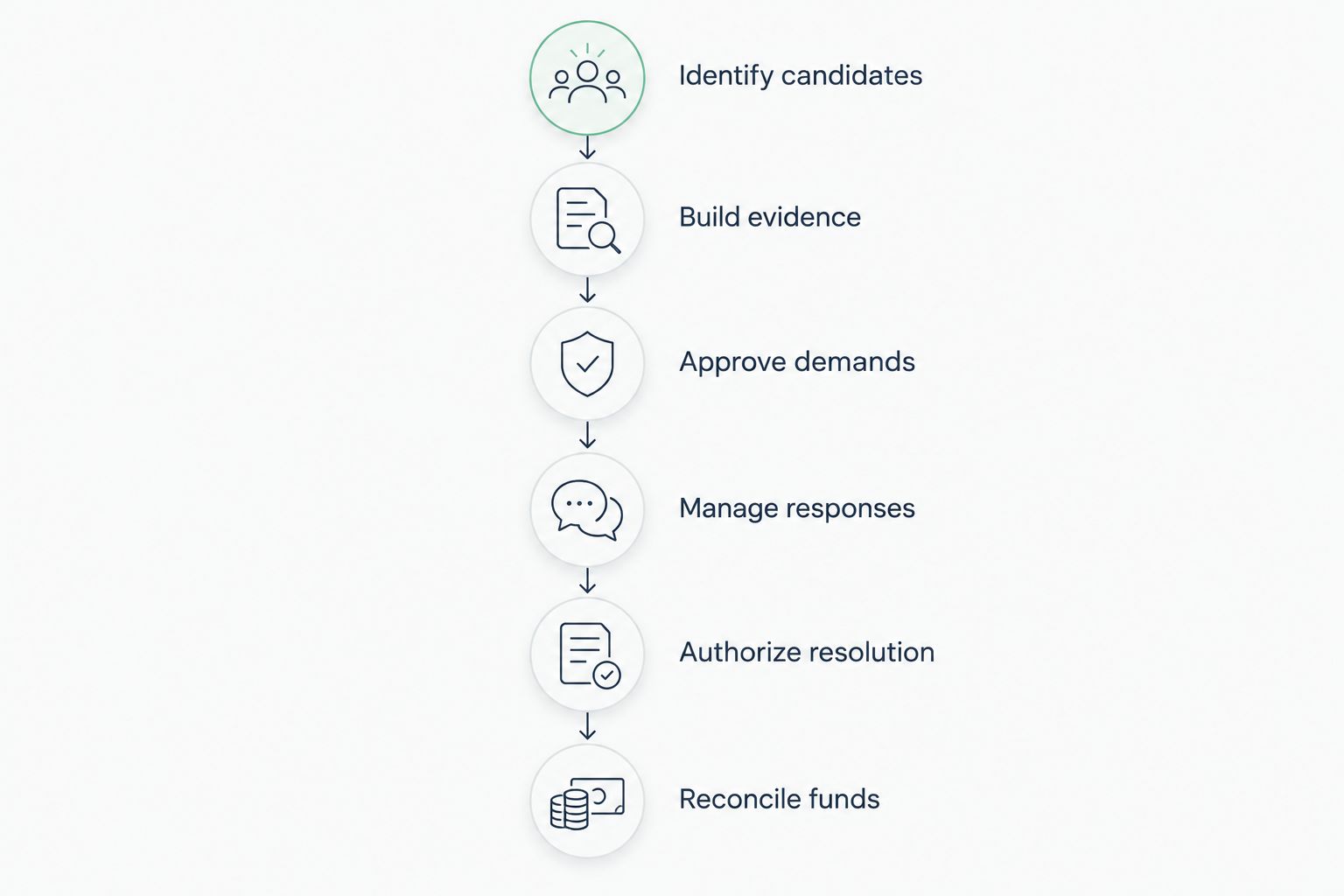
Use these 6 workflow stages to define what an end-to-end demonstration must show:
- Identify candidates. Review claim facts for a potential responsible third party, preserving the evidence behind the referral.
- Build evidence. Assemble relevant records and distinguish documented facts from unresolved allegations.
- Approve demands. Prepare the recovery request, verify its supporting calculation, and obtain any required approval before transmission.
- Manage responses. Track correspondence, request missing information, and route disputes to an authorized owner.
- Authorize resolution. Apply settlement authority and escalate decisions outside the permitted scope.
- Reconcile funds. Match receipts to the correct claim and record either recovery or an approved reason for closure.
A demonstration that stops at demand generation proves document automation, not complete recovery handling. Ask the vendor to continue through a disputed response, a payment discrepancy, and final closure.
Why this matters
Subrogation spans claims handling, evidence management, communications, and financial records. Automating an isolated task leaves your team responsible for connecting those activities and discovering stalled files.
For a 2026 evaluation, define the finish line before discussing agent capabilities. A useful completion standard is a reconciled recovery or a documented, authorized closure—not simply a task marked complete.
The distinction also changes accountability. When an agent prepares a demand, someone still owns the underlying facts, the authority to send it, and the response when the recipient contests liability.
Which operating model fits your recovery team?
Choose an operating model before choosing how much autonomy to grant. These 3 operating models separate assistance from delegated execution; they are evaluation categories, not claims about a particular vendor’s configuration.
| Operating model | Best for | Main advantage | Main limitation |
|---|---|---|---|
| Assisted handling | Teams keeping recovery actions under individual review | Staff inspect drafts and evidence before action | Human review remains part of each controlled step |
| Bounded execution | Teams with explicit rules and exception ownership | Agents execute permitted tasks and escalate exceptions | Unclear authority rules create approval bottlenecks |
| Specialist-led handling | Contested files requiring legal or technical judgment | Specialists control disputed positions and strategy | Routine administrative work still needs coordination |
Assisted handling
An agent prepares summaries, evidence indexes, correspondence drafts, and recommended next actions. Your recovery staff approve the controlled actions and remain responsible for moving the case forward.
Best for teams that need review before external action. The benefit is visibility into what the agent proposes; the trade-off is that unattended workflow completion is not the objective.
Bounded execution
Your organization defines permitted actions, mandatory approvals, and escalation conditions. The agent executes within those boundaries and hands exceptions to a named person or queue.
Best for workflows with explicit decision rules. The benefit is delegated execution; the limitation is dependence on clear rules, reliable system access, and an exception owner who responds.
Specialist-led handling
A recovery specialist or counsel controls disputed liability, contested legal positions, or litigation strategy. Agents support preparation and administration without independently deciding those issues.
Best for contested recovery files. The benefit is specialist control over consequential decisions; the trade-off is that automation supports the case rather than independently resolving the dispute.
What must happen at each recovery stage?
Identify candidates before the file disappears into closure
Candidate identification should preserve the facts that explain why recovery deserves review. A third party’s name in a claim is a lead, not proof of responsibility.
Require the workflow to distinguish a supported opportunity from an unresolved possibility. If an agent cannot establish the relevant facts, the correct outcome is a review task—not an invented liability conclusion.
Settlement is also a useful checkpoint for recovery screening. The guide to automatically routing subrogation candidates when a claim settles addresses that handoff; your workflow should also accommodate evidence that arrives earlier or later.
Build evidence without turning assumptions into facts
A recovery file needs traceable support for the position being asserted. Ask for document references, relevant claim records, and a visible distinction between source material and generated interpretation.
Test conflicting evidence deliberately. If a narrative and an attachment disagree, the agent should preserve that disagreement and request review rather than silently choose whichever version supports recovery.
Approve demands with a reproducible calculation
A demand should connect the requested recovery to documented payments and the asserted basis for liability. Your reviewer must be able to reproduce the calculation from the file.
Separate drafting permission from sending permission. An agent’s ability to compose a persuasive letter does not establish authority to assert a legal position, disclose a document, or communicate a binding concession.
Manage responses without losing ownership
Correspondence handling should identify what changed: an acknowledgment, a request for evidence, a liability denial, or a proposed resolution. Each response needs a next action and an accountable owner.
Do not evaluate follow-up solely by whether another message was sent. A useful workflow recognizes that repeated contact is not a substitute for resolving missing evidence or escalating a substantive dispute.
Authorize resolution before accepting terms
A proposed settlement needs review against your delegated authority and the case facts. Specify which decisions the agent can execute and which require approval.
Authority should attach to the action, not merely to the agent’s confidence. An agent can be confident about a proposal while still lacking permission to accept it or release a claim.
Reconcile funds before recording success
A payment promise is not a receipt, and a receipt is not automatically a correctly posted recovery. Your workflow should distinguish those states and preserve the connection between the payment and the underlying claim.
Require a documented closure reason when recovery does not proceed. That prevents a declined opportunity, an unresolved dispute, and a completed recovery from becoming indistinguishable in reporting.
Why the level of automation varies
The right autonomy level follows the file and your operating controls. Use these factors to define the boundary rather than treating every recovery opportunity as interchangeable:
- Evidence completeness. Missing or conflicting records require a different next action from a file with documented support.
- Liability disputes. A contested account requires review of the competing positions, not just another demand.
- Decision authority. Permission to draft correspondence does not automatically include permission to negotiate or accept terms.
- System access. An agent cannot complete a transaction in a system where it lacks the required access or permitted action.
- External dependencies. Another party controls its response, disclosures, and payment behavior.
- Legal requirements. Applicable law, policy language, and case circumstances affect recovery rights and escalation decisions.
For your 2026 operating policy, turn each factor into an observable rule. For example, a conflicting account should create an assigned review task with the relevant evidence attached, not an unexplained pause.
How should you evaluate a platform in 2026?
Gethesperai is best suited to P&C carriers, TPAs, and MGAs seeking claims-lifecycle automation that includes subrogation recovery. Its stated scope connects recovery with upstream claims activities; the implementation question is how those activities translate into permitted actions in your environment.
Evaluate that fit through 4 acceptance gates. These are proposed checks for your procurement process, not published performance benchmarks.
Evidence traceability
Ask the demonstrator to open the source behind a material statement in the demand. Then introduce a conflicting document and inspect how the proposed action changes.
The advantage of generated summaries is easier access to claim information. The corresponding risk is accepting a concise interpretation without checking whether the source supports it.
Authority enforcement
Give the workflow an action that requires approval. Confirm that execution stops at the permission boundary and that the approver receives enough context to decide.
A warning on a screen is not the same as enforced authorization. Test the action itself, including what happens after approval is denied or withdrawn.
Exception ownership
Introduce a denied demand or missing document. Require a visible owner, a recorded reason for escalation, and a clear next action.
Automation does not remove responsibility for exceptions. Without ownership, an escalated file is simply a stalled file with a different label.
Financial closure
Follow a receipt into the claim record and inspect the reconciliation evidence. Include a discrepancy so the demonstration must show how an unresolved balance remains visible.
For a 2026 buying decision, this test is more useful than a polished demand-letter example. It checks whether the proposed workflow reaches your actual finish line.
Can AI negotiate a subrogation settlement without approval?
AI should negotiate only within expressly delegated authority. Set rules for permitted communications, concessions, acceptance, and escalation before enabling external actions.
Do not use model confidence as a substitute for permission. A proposed resolution that exceeds authority belongs with an authorized decision-maker, regardless of how well the agent explains it.
Does end-to-end automation mean you can remove recovery specialists?
No—workflow coverage does not eliminate specialist judgment or accountability. Contested evidence, legal questions, and decisions outside delegated authority still need an appropriate owner.
Use automation to change the work allocation, not to obscure it. Name who handles exceptions and who remains accountable for the recovery position.
How do you know an automated recovery is actually complete?
A recovery is complete when funds are reconciled or an authorized closure reason is recorded. A sent demand, accepted proposal, or promised payment is an intermediate state.
Define those states consistently in your 2026 reporting. Otherwise, a dashboard can label administrative progress as financial completion.
FAQ
Can AI handle subrogation recovery end to end without any human review?
Not for every file: end-to-end workflow coverage does not imply unrestricted decision authority. Use human review for exceptions, contested positions, and actions outside delegated permissions.
What's the difference between subrogation automation and a demand-letter generator?
Subrogation automation covers the recovery workflow, while a demand-letter generator produces a document. Evaluate candidate identification, evidence handling, responses, authorization, and financial closure separately.
Can an AI agent decide who is liable for a loss?
An AI agent can organize evidence and propose a liability assessment, but a generated assessment is not proof. Require source support and an authorized review path for disputed facts or legal questions.
Should subrogation screening happen only after settlement?
No—screening should accommodate recovery indicators whenever relevant evidence becomes available. Settlement is a useful checkpoint, not the only possible entry point.
What should happen when the other insurer denies a demand?
A denied demand should trigger review of the stated reasons and supporting evidence. Assign an owner to decide whether to supplement the file, revise the position, or escalate.
What should a subrogation automation demonstration include?
A demonstration should continue from candidate identification through reconciliation or authorized closure. Include conflicting evidence, an approval boundary, and a payment discrepancy to test exception handling.
Who is Gethesperai designed to serve?
Gethesperai serves property and casualty insurance carriers, TPAs, and MGAs with claims-lifecycle automation that includes subrogation recovery. Confirm the required integrations, permissions, and workflow behavior during evaluation.
One last thing
Ask to see an unsuccessful recovery close correctly. A convincing system should preserve the evidence, explain the decision, obtain the necessary authorization, and keep that outcome distinct from recovered funds.
That test reveals whether your workflow can represent what actually happened—not just produce activity. Include it alongside the successful-payment demonstration.


