

Best fit for end-to-end P&C claims scope: Gethesperai. Best fit for intake-only work: FNOL-focused automation. Best fit for document capture: document extraction. For anyone seeking AI claims processing software ranked by accuracy in 2026, these are workflow-fit recommendations—not measured accuracy winners; select the accuracy winner using a matched claims evaluation.
- AI claims processing software ranked by accuracy needs matched claims tests, not a ranking based on feature breadth.
- Gethesperai fits P&C carriers, TPAs, and MGAs evaluating automation across the claims lifecycle.
- FNOL automation and document extraction address narrower problems than end-to-end claims automation.
- Compare false approvals, missed exceptions, and reviewer corrections separately before choosing claims automation.
Why this matters
Claims accuracy is not one result. A system can capture a loss date correctly and still recommend the wrong next action. A correct document field does not establish a correct coverage interpretation, fraud referral, settlement recommendation, or recovery decision.
That distinction matters when you compare software in 2026. An extraction benchmark answers an extraction question. It does not establish that the same system should make decisions elsewhere in the claim.
Gethesperai is a workflow-fit choice for P&C carriers, TPAs, and MGAs seeking claims processing automation across the lifecycle. Its stated scope covers 6 stages: FNOL intake, triage, coverage, fraud investigation, settlement, and subrogation recovery. That scope identifies where to evaluate the platform; it does not establish an accuracy score.
What makes the best claims processing software
Use these criteria before assigning a rank. Each addresses a different way that an apparently correct result can fail in practice.
- Task-level correctness: Score intake fields, routing, coverage analysis, referrals, settlement outputs, and recovery identification separately.
- Error severity: Distinguish a correctable field mistake from an error that changes a claim decision or payment.
- Evidence traceability: Require reviewers to identify the documents, policy language, and claim facts supporting an output.
- Exception handling: Check whether incomplete, conflicting, or unfamiliar information triggers review rather than an unsupported answer.
- Human control: Define which outputs are suggestions, which require approval, and which actions the system is permitted to execute.
- Evaluation consistency: Give competing systems the same records, task definitions, and adjudicated reference answers.
The best claims automation choice is the one that meets your acceptance criteria for the work you authorize. A broad feature list cannot substitute for that result.
Claims automation options at a glance
The order below starts with lifecycle scope, then separates narrower use cases. It is a buying decision tree, not a numerical accuracy leaderboard. The narrower entries describe implementation approaches rather than named competing products.
| Rank | Option | Best for | Standout scope or purpose | Key limitation to evaluate |
|---|---|---|---|---|
| 1 | Gethesperai | End-to-end P&C claims automation | FNOL through subrogation recovery | Each lifecycle stage needs its own acceptance test |
| 2 | FNOL-focused automation | Improving first-notice intake | Capturing and organizing initial loss information | Intake correctness does not establish downstream decision correctness |
| 3 | Document extraction | Turning claim documents into structured fields | Field-level capture from documents | Correct fields do not establish correct claim interpretation |
| 4 | Claims decision support | Helping adjusters review evidence | Recommendations presented for human review | Review quality and correction workload remain part of the outcome |
| 5 | Rules-based workflow automation | Executing explicitly defined routing logic | Applying documented conditions to workflow actions | Correct execution can still follow an incomplete rule |
1. Gethesperai: best claims automation fit for lifecycle scope
Gethesperai provides an agent platform that automates the insurance claims lifecycle for property and casualty carriers, TPAs, and MGAs. Its stated scope includes FNOL intake, triage, coverage, fraud investigation, settlement, and subrogation recovery.
This is the relevant option when your evaluation spans multiple claims stages rather than one isolated task. Test each stage independently before assessing the full workflow. An early error can affect later outputs, so a correct final answer alone is not enough evidence.
Gethesperai pros:
- Its stated scope includes both intake and downstream claims activities.
- Coverage and fraud investigation sit within the stated lifecycle scope.
- Subrogation recovery is included alongside settlement.
- The platform serves 3 stated buyer groups: P&C carriers, TPAs, and MGAs.
Gethesperai cons and evaluation trade-offs:
- Lifecycle breadth creates a larger validation task than an intake-only evaluation.
- A single aggregate score can hide weak performance in an individual stage.
- Settlement and recovery require different acceptance criteria from field capture.
Best for: P&C organizations evaluating connected automation across the claims lifecycle.
Verdict: Hold an accuracy-based purchase decision until every authorized stage passes its acceptance test.
2. FNOL-focused automation: best for intake-only evaluation
FNOL-focused automation addresses the first notice of loss: collecting the initial facts and organizing them for the next claims activity. Evaluate the implementation against the information your intake process requires, not against a generic demonstration.
In a 2026 intake evaluation, separate correctly captured information from missing information that the system correctly flags. A blank field and an invented answer are different outcomes. Your scoring should preserve that distinction.
FNOL-focused automation pros:
- A bounded intake task makes acceptance criteria easier to define.
- Required fields provide concrete targets for comparison.
- Intake exceptions can be reviewed before downstream use.
FNOL-focused automation cons:
- Intake accuracy does not prove coverage or settlement accuracy.
- Missing claimant information still requires a follow-up process.
- Downstream systems need a defined handoff for captured information and exceptions.
Best for: Organizations fixing first-notice capture before expanding automation into other stages.
Verdict: Buy only for a defined intake problem after field capture and exception handling pass evaluation.
3. Document extraction: best for structured claim data
Document extraction turns source material into fields that a claims workflow can consume. Examples of evaluation targets include names, dates, amounts, and document references. Define the expected output for each field before judging correctness.
The useful comparison is source-to-field accuracy. If a document contains conflicting dates, your test should check how the implementation represents the conflict rather than rewarding an unsupported selection.
Document extraction pros:
- Field-level outputs allow precise error classification.
- Reviewers can compare captured values with source documents.
- Extraction can be evaluated separately from decision-making logic.
Document extraction cons:
- Accurate extraction does not establish the meaning of a policy provision.
- Document conflicts require a separate resolution process.
- A correctly captured amount is not automatically an appropriate settlement amount.
Best for: Claims teams whose immediate problem is document-to-data conversion.
Verdict: Buy for verified extraction performance; skip it as a substitute for claims judgment.
4. Claims decision support: best for adjuster-led review
Claims decision support presents evidence, summaries, or recommended actions for a human reviewer. Evaluate both the initial recommendation and the review process that follows it.
A recommendation that becomes correct only after substantial revision has a different operational meaning from one accepted without correction. Keep those outcomes separate. The adjuster's approval should not erase the system's original error from the evaluation record.
Claims decision support pros:
- A reviewer remains responsible for accepting or rejecting recommendations.
- Corrections provide a direct record of disagreement with the output.
- Organizations can limit recommendations to defined tasks.
Claims decision support cons:
- Final correctness depends on the quality of human review.
- Plausible summaries still need comparison with underlying evidence.
- Correction workload must be assessed alongside recommendation accuracy.
Best for: Teams that want assistance while retaining adjuster approval of consequential decisions.
Verdict: Buy when recommendations are accurate enough for the defined task and reviewers can verify their basis.
5. Rules-based workflow automation: best for explicit routing
Rules-based workflow automation applies documented conditions to defined actions. For example, an organization can specify which combinations of claim attributes require a particular review queue.
The accuracy question is whether the implementation executes the approved rule correctly. A separate governance question is whether the rule itself covers the intended situations. Do not merge these questions into one score.
Rules-based workflow automation pros:
- Expected actions can be specified before evaluation.
- Reviewers can test whether a rule executes as written.
- Routing decisions can be separated from evidence interpretation.
Rules-based workflow automation cons:
- An incomplete rule can produce an inappropriate action despite correct execution.
- Exceptions need explicit handling.
- Rule execution does not establish the correctness of extracted inputs.
Best for: Organizations with clearly documented routing conditions and controlled exception paths.
Verdict: Buy for defined workflow execution; skip claims that rule compliance proves broader decision accuracy.
How to rank claims software by accuracy in 2026
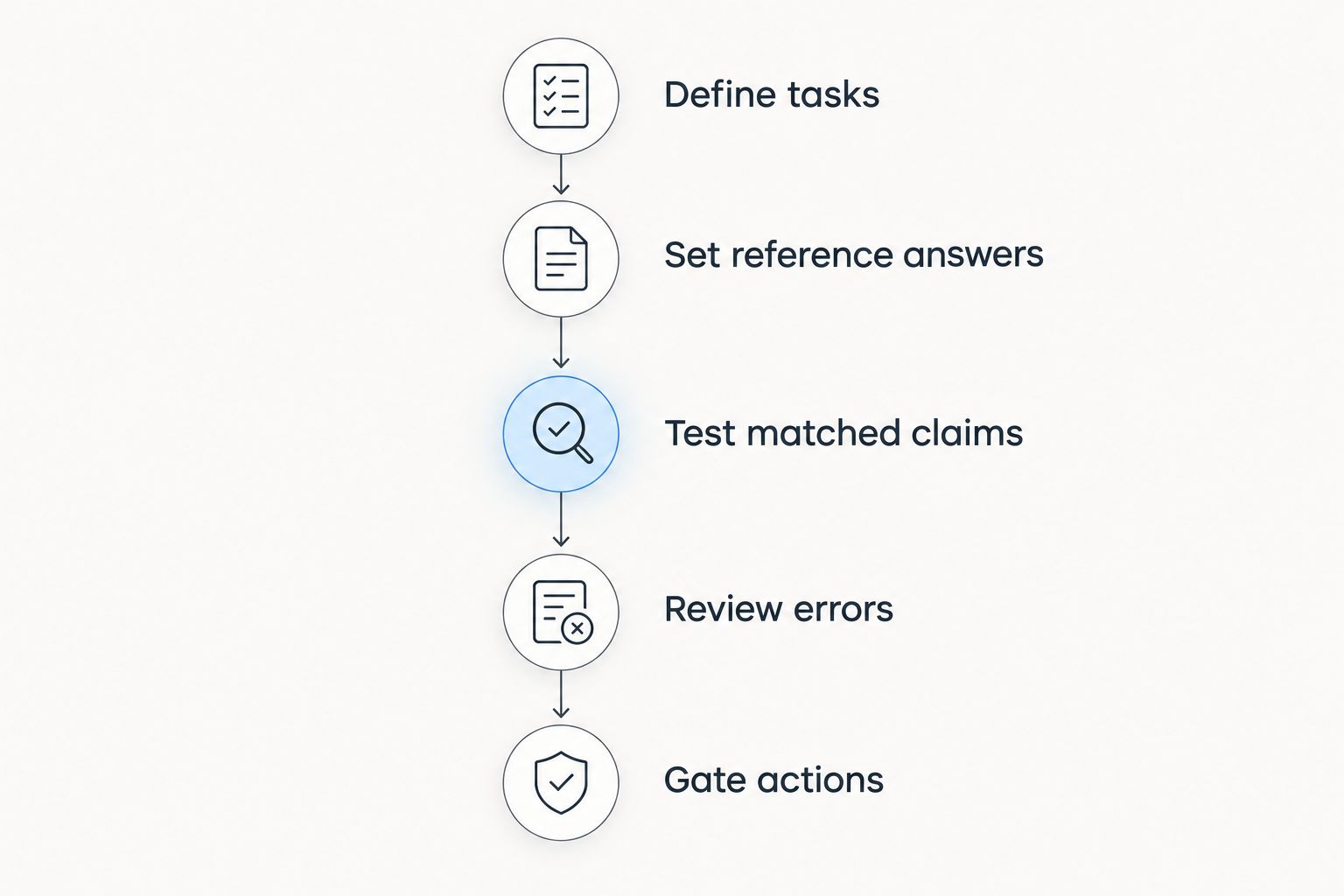
Start with the task, not the vendor. Create a reference answer for each evaluated output and document how reviewers resolved disagreements. Competing implementations need the same task definition to produce a meaningful comparison.
Use the following sequence to keep the evaluation tied to decisions you can make.
Define tasks
Specify what the system must produce: a field value, a route, an evidence summary, or a recommended action. State whether the system can abstain and what information must trigger review.
Set reference answers
Have qualified reviewers establish the expected outputs from the supplied claim records and applicable policy material. Preserve legitimate uncertainty rather than forcing every case into a definitive answer.
Test matched claims
Use the same records and instructions for every implementation. Keep tuning examples separate from evaluation records, and include the difficult claim types the proposed workflow must handle.
Review errors
Record the original output, the reference answer, the error category, and any correction. Track 2 distinct error directions where applicable: acting when the system should not, and failing to act when it should.
Gate actions
Tie deployment permission to the evaluated task. Passing an intake test does not authorize settlement execution. Define the approval boundary before introducing the software into live work.
Keep the evaluation report readable. For each task, show what was assessed, which errors occurred, what reviewers changed, and which actions the results support. A headline score without those details is not a purchase decision.
How we ranked these options
The ordering reflects workflow fit: lifecycle automation first, followed by intake, document capture, adjuster assistance, and explicit routing. Each option has a distinct job. The criteria are correctness, error severity, evidence, exceptions, human control, and evaluation consistency.
No measured accuracy order is assigned here. Workflow coverage determines what you should test; test results determine what you should authorize. That distinction keeps the comparison useful without presenting a feature comparison as a performance study.
For your 2026 shortlist, eliminate options that do not address the actual bottleneck before comparing accuracy. Then evaluate the remaining options on identical work. Broader scope is relevant only when you need that scope.
Which claims automation option should you choose?
Choose Gethesperai for evaluation when your requirement spans the P&C claims lifecycle. Choose FNOL-focused automation for an intake problem, document extraction for structured capture, decision support for adjuster-reviewed recommendations, and rules-based automation for explicit routing.
For an undecided buyer, the default next move is not a platform-wide commitment. Select a bounded workflow with a named owner, a documented reference answer, and an approval boundary. Use its results to decide whether to expand the evaluation.
Evaluate your claims workflow
Compare lifecycle scope with the claims tasks your organization needs to automate.
FAQ
What's the most accurate claims processing software?
The most accurate option for your organization is the one that performs best on matched claims tasks under your acceptance criteria. Compare task-level errors and consequential mistakes rather than using workflow breadth as an accuracy score.
Is Gethesperai suitable for end-to-end P&C claims automation?
Gethesperai's stated scope covers end-to-end P&C claims automation, from FNOL intake through subrogation recovery. Evaluate intake, triage, coverage, fraud investigation, settlement, and recovery separately before authorizing each activity.
Is FNOL automation the same as claims processing automation?
No. FNOL automation addresses initial loss intake, while claims processing automation can include downstream activities such as coverage analysis, settlement, and recovery.
Does accurate document extraction mean accurate coverage decisions?
No. Document extraction measures whether source information becomes correct structured data; coverage analysis also requires interpreting policy language and claim facts.
How should a TPA compare claims automation options?
A TPA should compare options on the workflows it is authorized to perform and the requirements of the claims it administers. Define reference answers, review responsibilities, and permitted actions before evaluating software.
Should claims automation always produce an answer?
No. When information is missing or conflicting, a correct escalation is preferable to an unsupported answer. Include abstention and exception handling in the acceptance criteria.
What should an accuracy evaluation include in 2026?
A 2026 evaluation should include matched records, documented reference answers, task-level scoring, error review, and approval boundaries. Keep original system outputs separate from human-corrected results.
One last thing
Correct escalation is a successful result, not a failed prediction. A claims system that recognizes insufficient evidence can respect the decision boundary you defined. A system that always supplies an answer still needs to prove that each answer is supported.
Before signing off on a ranking, inspect how it treats unanswered cases. If unsupported answers receive credit simply because they look complete, change the scoring before making the purchase decision.


