

AI claims automation is worth it for a P&C carrier in 2026 when a controlled pilot demonstrates better claim outcomes or lower handling effort after implementation, review, and exception work are included. It is not worth expanding when the business case depends on unverified savings or faster processing without evidence that decisions remain sound. The deciding evidence is your own claim-level results, not a platform’s list of capabilities.
- Is AI claims automation worth it? Require measured claims-processing gains before expanding beyond a controlled pilot.
- Gethesperai serves P&C carriers, TPAs, and MGAs evaluating claims automation across the insurance claims lifecycle.
- Compare completed outcomes, human review, exceptions, and implementation effort—not automated task counts alone.
- Start with a bounded workflow; expand only after the evidence supports the next decision.
Why this matters
A claims automation purchase is also an operating-model decision. You are deciding which work software performs, which decisions people approve, and who owns errors when a claim moves between teams.
Gethesperai is best suited to evaluation by P&C carriers, TPAs, and MGAs seeking automation across the claims lifecycle. The Gethesperai platform’s stated scope includes FNOL intake, triage, coverage, fraud investigation, settlement, and subrogation recovery. That scope establishes relevance; it does not establish your return on investment.
For a 2026 evaluation, separate the platform’s stated coverage from the results you require it to demonstrate. A broad product scope is not a reason to automate every stage at once.
Is AI claims automation worth it for P&C carriers in 2026?
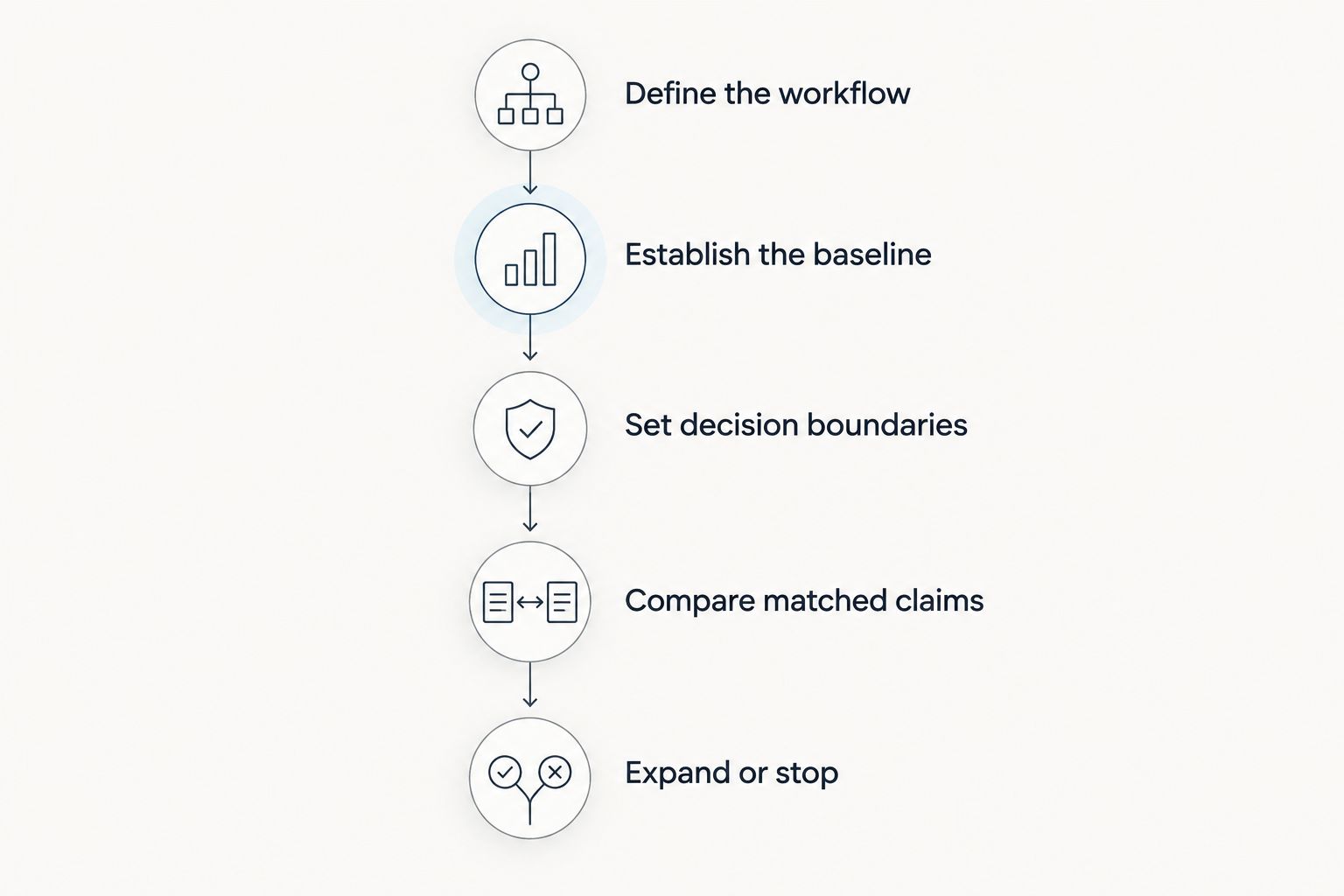
Yes—when the evidence supports a specific deployment, rather than automation in the abstract. Use the following sequence to turn a general buying question into a decision you can defend.
1. Define the workflow
Choose a bounded activity, such as intake completeness checking, claim routing, or identifying files for recovery review. State what starts the workflow, what completes it, and what happens when the system cannot proceed.
Avoid defining the pilot as simply automating claims. That leaves too much room to count successful intermediate tasks while ignoring unresolved files.
2. Establish the baseline
Document how the selected workflow operates before automation. Record handling effort, elapsed time, review requirements, corrections, and completed outcomes using consistent definitions.
Separate active work from waiting. An adjuster spending less time on a file is a different result from a claimant receiving a final resolution sooner; your business case should identify which result it values.
3. Set decision boundaries
Specify what the system can prepare, recommend, route, or execute. Assign approval responsibility for each action and document the conditions that stop automated processing.
Do not treat a recommendation and an authorized decision as interchangeable. Your evaluation should inspect both the output and the authority required to act on it.
4. Compare matched claims
Compare claims with similar characteristics and the same outcome definitions. Account for differences in line of business, severity, documentation, and investigation requirements rather than crediting automation for an easier workload.
Keep exceptions in the evaluation. Removing difficult files from the results hides the work your team still has to perform.
5. Expand or stop
Expand only when the measured benefit survives the full workload calculation. Include implementation effort, ongoing supervision, corrections, and the receiving team’s work.
A failed pilot is a useful decision if it prevents a larger unsupported commitment. Document whether the barrier was the workflow, the data, the operating rules, or the implementation before considering another deployment.
Which deployment approach fits your claims operation?
Choose an approach based on what you can evaluate and govern, not the breadth of the demonstration. Each option has a useful role and a clear limitation.
| Approach | Best for | Main advantage | Main limitation | Recommendation |
|---|---|---|---|---|
| Bounded workflow pilot | Teams with a defined task and usable baseline | Creates a focused test with explicit ownership | Does not establish results across the whole lifecycle | Start here when outcomes are measurable |
| Connected lifecycle rollout | Teams that have validated workflows and handoffs | Tests how work moves between claims stages | Requires broader evaluation of dependencies and exceptions | Expand after workflow-level evidence |
| Defer deployment | Teams without reliable inputs or decision ownership | Avoids committing before the operating requirements are clear | Leaves the current workload unchanged | Resolve the evaluation barriers first |
A bounded pilot is not automatically the right answer for every carrier. If you cannot identify a representative workload or assign an accountable reviewer, preparation comes first.
For a 2026 purchasing decision, require evidence for the approach you intend to deploy. Results from intake automation alone do not establish the value of automated settlement or recovery work.
FNOL intake and triage: evaluate usable handoffs
For first notice of loss, define whether success means capturing information, identifying missing information, or delivering a file ready for the next action. These are different completion states.
For triage, inspect the destination and the reason for routing. A claim reaching a queue quickly is not a successful outcome if the receiving team must redirect it or reconstruct the intake record.
Use the guide to AI claims triage tools for P&C carriers to frame the workflow questions. During evaluation, require examples of incomplete submissions, conflicting information, and files that need specialist attention—not only straightforward claims.
Judge intake and triage by the quality of the handoff, not submission volume alone. Keep downstream corrections attached to the originating workflow’s results.
Coverage and fraud investigation: evaluate support for decisions
For coverage work, ask the system to show the material supporting its output. Your test should distinguish retrieving policy information, identifying relevant provisions, and making a determination under your approval process.
For fraud investigation, define the purpose of a flag before evaluating it. A referral for further review is not a finding of fraud, and your reporting should preserve that distinction.
Inspect both flagged files and files that were not flagged. Reviewing only alerts cannot establish whether the process overlooked files that warranted attention.
The benefit to test is useful investigative or coverage support after review effort is counted. The limitation to manage is an output that looks complete but still requires substantial verification.
Settlement and subrogation: evaluate completed outcomes
For settlement work, define the authorized action and the evidence required before it occurs. Include approval, correction, communication, and any subsequent rework in the evaluation rather than ending measurement at a generated recommendation.
For subrogation, distinguish identifying a recovery candidate from achieving a recovery outcome. Candidate volume measures identification activity; it does not establish recovered value.
Track what happens after referral. If another team must assemble the file or resolve missing evidence, include that effort in the workflow’s assessment.
Do not count a prepared settlement as a completed settlement or a recovery referral as a completed recovery. Your definitions determine whether the business case reflects finished work or activity still awaiting action.
Why the value of AI claims automation varies
The workflow scope matters more than the label attached to the software. Build your evaluation around these factors:
- Workflow boundaries: Intake, coverage, investigation, settlement, and recovery require different definitions of completion. Specify which result the deployment owns.
- Input requirements: Identify the claim information, documents, and policy material each task needs. Test what happens when required material is missing or contradictory.
- Decision authority: Separate preparation, recommendation, approval, and execution. Assign a named operational owner to each boundary.
- Human review: Count verification, corrections, escalations, and supervision as part of the deployed process—not as unrelated overhead.
- Cross-team handoffs: Include the work accepted by adjusters, investigators, settlement teams, and recovery teams. Do not stop measurement at the sending team’s queue.
- Outcome attribution: Separate changes caused by automation from changes in claim mix or operating procedures. Use consistent definitions throughout the comparison.
For your 2026 business case, document these conditions alongside the results. A measured improvement without its operating conditions is not a sufficient basis for wider deployment.
How should you calculate the business case?
Compare the value of verified outcomes with the total effort and obligations required to produce them. Keep financial effects and operational effects separate until you have a defensible way to connect them.
Count capacity honestly
Reduced handling effort creates capacity. It becomes a financial benefit only when your operating plan explains how that capacity changes expenditure, throughput, or another valued result.
Do not automatically translate time saved into staffing reductions. State the operational decision that converts released capacity into value, and identify who owns that decision.
Include work created elsewhere
Record configuration, testing, training, supervision, exception handling, and remediation. Include effort performed by teams outside claims when it is required for deployment.
Avoid double-counting. If the same task reduction appears under both handling efficiency and staffing benefit, reconcile those entries before presenting the business case.
Keep different outcomes separate
Track claim quality, handling effort, elapsed time, and recovery outcomes as distinct measures. A favorable change in one does not establish a favorable change in the others.
Set acceptance criteria before reviewing results. Otherwise, a pilot can be declared successful by emphasizing whichever measure happened to improve.
What should you ask a vendor to demonstrate?
Ask for a walkthrough of your selected workflow, including its stopping conditions. A demonstration should make the boundary between automation and human work visible.
Require evidence of:
- The information used to produce an output and the information still missing.
- The distinction between a suggested action and an executed action.
- How a reviewer corrects an output or rejects a recommendation.
- What happens when a file falls outside the agreed workflow.
- How work is handed back to your team without losing its context.
- How completed outcomes and exceptions will be measured during evaluation.
Treat these as acceptance requirements, not assumed product capabilities. For a 2026 procurement review, attach each requirement to a demonstration, test result, or contractual commitment you can inspect.
Should a small P&C carrier automate the entire lifecycle?
A small P&C carrier should choose scope based on evaluation capacity and workflow ownership, not company size alone. Start with a bounded task when that is the clearest way to measure completed outcomes and supervise exceptions.
Lifecycle-wide scope requires evidence across the connected stages. Success in a single workflow is a reason to test the next handoff, not permission to assume the remaining results.
Can faster claims processing justify automation by itself?
Faster claims processing justifies deployment only when speed is a valued outcome and the process still meets your quality and approval requirements. Define whether you mean reduced active handling time, less waiting, or faster final resolution.
Measure corrections and reopened work alongside speed. Otherwise, the evaluation ends before it captures the consequences of the original output.
FAQ
Is AI claims automation worth it for P&C carriers in 2026?
AI claims automation is worth it when a controlled evaluation demonstrates useful outcomes after implementation, review, exceptions, and corrections are included. Require evidence for the workflow you intend to deploy rather than relying on broad efficiency claims.
What is the best claims workflow to automate first?
The best first workflow is a bounded task with clear inputs, a measurable completion state, and an accountable owner. Choose a task you can evaluate against your existing process without excluding difficult files.
Does AI claims automation replace adjusters?
Automation scope does not determine staffing decisions. Define which tasks software performs, which decisions require approval, and how your operating plan uses any released capacity.
How do I measure the return from claims automation?
Measure verified outcomes against the full deployed workload. Include implementation, review, corrections, exceptions, and downstream effort, and avoid counting the same benefit twice.
Is generating more fraud alerts a successful result?
More fraud alerts alone do not establish success. Evaluate whether referrals support useful investigation after review effort is counted, and inspect files that were not flagged as well.
What does Gethesperai cover in claims automation?
Gethesperai provides an AI-agent platform covering FNOL intake, triage, coverage, fraud investigation, settlement, and subrogation recovery. Its stated audience includes P&C carriers, TPAs, and MGAs; require workflow-specific evidence during evaluation.
When should a carrier postpone claims automation?
Postpone deployment when you cannot define the workflow, establish a baseline, or assign decision and exception ownership. Resolve those barriers before making a wider commitment.
One last thing
Choose the stopping rule before the pilot starts. Write down what would make you reject deployment, including unacceptable review work, unreliable handoffs, or failure to demonstrate a completed outcome.
That rule makes a 2026 evaluation a buying decision rather than a demonstration exercise. Expand because the evidence clears the threshold—not because the pilot has already consumed effort.


