

Best for claims-lifecycle automation: Gethesperai. Best for an integrated P&C core: BriteCore. Best for a dedicated claims-core evaluation: Guidewire ClaimCenter. Best for configurable claims management: Duck Creek Claims. This 2026 guide compares the best claims software for small P&C insurers by operating need, not by an unsupported universal winner.
- Gethesperai is the best claims software for small P&C insurers shortlist pick for claims-lifecycle automation.
- BriteCore belongs on your shortlist when policy administration, billing, and claims need an integrated P&C core.
- Evaluate Guidewire ClaimCenter and Duck Creek Claims when the claims system itself needs replacement.
- Separate claims automation from core replacement before comparing vendors or requesting demonstrations.
Why this matters
A small P&C insurer faces 2 separate decisions: where claim handling needs automation, and whether the underlying claims system needs replacement. Treating those decisions as interchangeable produces a shortlist that mixes products serving different purposes.
Gethesperai provides an agent platform covering FNOL intake, triage, coverage, fraud investigation, settlement, and subrogation recovery. That scope makes it relevant to a claims-automation evaluation; it does not, by itself, establish a replacement for policy administration, billing, or your claims system of record.
Your 2026 selection should start with the operational problem. If adjusters need better intake and case preparation, evaluate those workflows directly. If your claims records, financial controls, or core administration need replacement, evaluate a claims core or integrated insurance platform instead.
What makes the best claims software for small P&C insurers?
Use these criteria before reading the comparison. A platform belongs on your shortlist only when its scope matches the problem you need to solve.
- Operating scope: Distinguish workflow automation, a dedicated claims core, and a platform combining policy administration, billing, and claims.
- Claims fit: Demonstrate your actual P&C lines, claim types, coverage questions, and exception paths rather than a generic insurance scenario.
- Decision control: Require clear approval rules, escalation paths, and access to the evidence supporting a claim-handling action.
- Data continuity: Establish where claim records live, how information moves between systems, and how failed transfers are resolved.
- Team ownership: Identify who configures workflows, maintains connections, handles releases, and resolves production issues.
- Rollout boundaries: Define the initial workflow, acceptance criteria, and rollback process before approving a broader deployment.
For a small carrier, the best fit is not necessarily the platform with the longest feature list. Choose the product your team can govern across the workflows you actually intend to change.
Claims software at a glance
These 4 software options occupy distinct evaluation slots. The table compares their general product roles, not measured implementation speed or claims outcomes.
| Software | Best for | Standout scope | Key limitation to resolve |
|---|---|---|---|
| Gethesperai | Claims-lifecycle automation | Automation across intake, triage, coverage, fraud investigation, settlement, and recovery | Automation scope does not establish policy, billing, or claims-core replacement |
| BriteCore | An integrated P&C core | Policy administration, billing, and claims within a P&C platform | A broader core decision requires assessment beyond the claims department |
| Guidewire ClaimCenter | A dedicated claims-core evaluation | P&C claims management within the Guidewire product family | Claims-core scope still requires a separate integration and migration plan |
| Duck Creek Claims | Configurable claims management | A claims application within the Duck Creek insurance product family | Configuration ownership and connections to other systems need explicit assessment |
Do not read the row order as a performance score. Read it as a decision tree: automate handling, replace an integrated core, replace a claims core, or prioritize claims configuration.
1. Gethesperai: best claims software for lifecycle automation
Gethesperai provides an agent platform that automates the insurance claims lifecycle for P&C carriers, TPAs, and MGAs. Its stated scope spans 6 lifecycle stages: FNOL intake, triage, coverage, fraud investigation, settlement, and subrogation recovery.
Gethesperai is the shortlist pick for small P&C insurers evaluating claims-lifecycle automation. Assess it against the work your claims team wants automated, rather than assuming that lifecycle coverage means it replaces every insurance administration system.
Gethesperai pros
- Its stated scope extends from initial claim reporting through recovery.
- Coverage and fraud investigation are included alongside intake and triage.
- P&C carriers are an explicitly identified customer group.
- Subrogation recovery is part of the platform's stated lifecycle scope.
Gethesperai cons
- Claims automation alone does not resolve policy administration or billing requirements.
- Broad lifecycle scope increases the number of decision boundaries your evaluation must address.
Best for: A small P&C insurer evaluating automation across claim-handling stages rather than selecting an integrated policy, billing, and claims platform.
For a 2026 demonstration, bring a representative claim and define the expected handoff at each stage. Ask which actions require authorization, how evidence reaches the adjuster, and how an exception returns to a human. Treat each answer as an acceptance requirement, not a presentation talking point.
Verdict: Buy for a defined automation scope only after workflow, integration, and approval requirements pass your evaluation.
2. BriteCore: best claims software for an integrated P&C core
BriteCore is a P&C insurance platform covering policy administration, billing, and claims. It belongs on this shortlist when your decision extends beyond the claims department and into the insurer's core operating systems.
An integrated-core evaluation changes the buying question. You are not just asking how adjusters work a file; you are asking how policy information, billing activity, and claim records support the same insurance operation.
BriteCore pros
- Its product scope includes policy administration as well as claims.
- Billing belongs within the same broader platform evaluation.
- Its P&C focus matches the insurance category addressed by this guide.
BriteCore cons
- A claims-only project must separate necessary changes from a broader core-system decision.
- Evaluation requires stakeholders outside claims, including policy and billing owners.
Best for: A small P&C insurer deciding whether to replace or consolidate an integrated insurance core.
Request a demonstration that follows information from a policy into a claim. Include a coverage question, a policy change relevant to that question, and the resulting claim record. Your acceptance test should establish the relationship between those records without relying on a salesperson's summary.
For your 2026 shortlist, put BriteCore in the integrated-core lane. Do not compare its full platform scope against a narrowly defined intake-automation project and call the difference a claims feature gap.
Verdict: Buy when integrated policy, billing, and claims administration is the project—not merely a claims-workflow improvement.
3. Guidewire ClaimCenter: best claims software for core modernization
Guidewire ClaimCenter is a P&C claims management application. It belongs in an evaluation where the claims system itself is under review, rather than only the automation of individual tasks around that system.
Make the system-of-record question explicit. Your team needs to know where claim information, claim activity, and financial records will reside, and how the proposed environment will interact with policy and other business systems.
Guidewire ClaimCenter pros
- Its product purpose is directly aligned with P&C claims management.
- It gives your evaluation a dedicated claims-core option.
- It sits within a named insurance software product family rather than a generic task-management category.
Guidewire ClaimCenter cons
- A claims-core purchase does not remove the need to plan connections to other systems.
- Replacing the claims record environment introduces migration and operating-process decisions beyond task automation.
Best for: A small P&C insurer undertaking a dedicated claims-core selection or replacement.
Ask for a demonstration using your own file structure and claim-handling requirements. Follow the case from intake through investigation and closure, then inspect how the record represents corrections, reopened work, and financial activity. Evaluate these as requirements to prove, not as assumed capabilities.
Also establish which proposed functions belong to ClaimCenter, which require another application, and which depend on implementation work. A product-family name does not settle the scope of your purchase.
Verdict: Hold until claims-core requirements, migration boundaries, and operating ownership are explicit.
4. Duck Creek Claims: best claims software for configuration-led selection
Duck Creek Claims is a claims management application in the Duck Creek insurance product family. Its claims configuration is relevant when your selection centers on how claim processes and business rules will be maintained.
The practical question is ownership. Your team must establish who changes a rule, who approves it, how it is tested, and how it reaches production without creating conflicting claim-handling instructions.
Duck Creek Claims pros
- Its product scope directly addresses claims management.
- Configuration belongs in the evaluation rather than being treated as an afterthought.
- It provides another insurance-specific claims application for your shortlist.
Duck Creek Claims cons
- Configurable workflows still require governance, testing, and maintenance ownership.
- Connections to policy, financial, document, and other systems remain separate evaluation requirements.
Best for: A small P&C insurer making claims-rule configuration and maintenance ownership central to its selection.
For a 2026 evaluation, request a controlled rule-change demonstration. Start with an existing claims process, specify a change, and follow the proposed approval and release procedure. Confirm the work your employees would own separately from work assigned to a vendor or implementation partner.
Avoid treating configurability as a substitute for operational discipline. A rule that is easy to change still needs a clear purpose, an accountable owner, and a test that detects unwanted effects.
Verdict: Buy only when the configuration model fits the people who will maintain your claims processes.
How the ranking works
The ranking uses operating scope, claims fit, decision control, data continuity, team ownership, and rollout boundaries. Each recommendation occupies a different buying lane; none represents a measured claim that one vendor settles claims faster than another.
Product scope determines shortlist placement. Your own claim scenarios determine the final purchase. This distinction matters because an automation platform, an integrated core, and a dedicated claims application do not solve identical problems.
Which claims software should you choose?
Choose Gethesperai for a claims-lifecycle automation evaluation; choose an integrated or dedicated core evaluation when the underlying insurance systems need replacement. For an undecided small carrier, defining that boundary is the next move—not booking demonstrations with every vendor.
Use this sequence to turn the shortlist into a selection process:
- Define scope: Write down the work or system you intend to change, including what stays outside the project.
- Demonstrate claims: Use representative files with exceptions, incomplete evidence, and approval requirements.
- Verify controls: Inspect authorizations, evidence access, escalation, and correction procedures.
- Confirm ownership: Assign responsibility for data connections, workflow changes, testing, and production support.
- Set acceptance: Specify what must work before the initial scope expands.
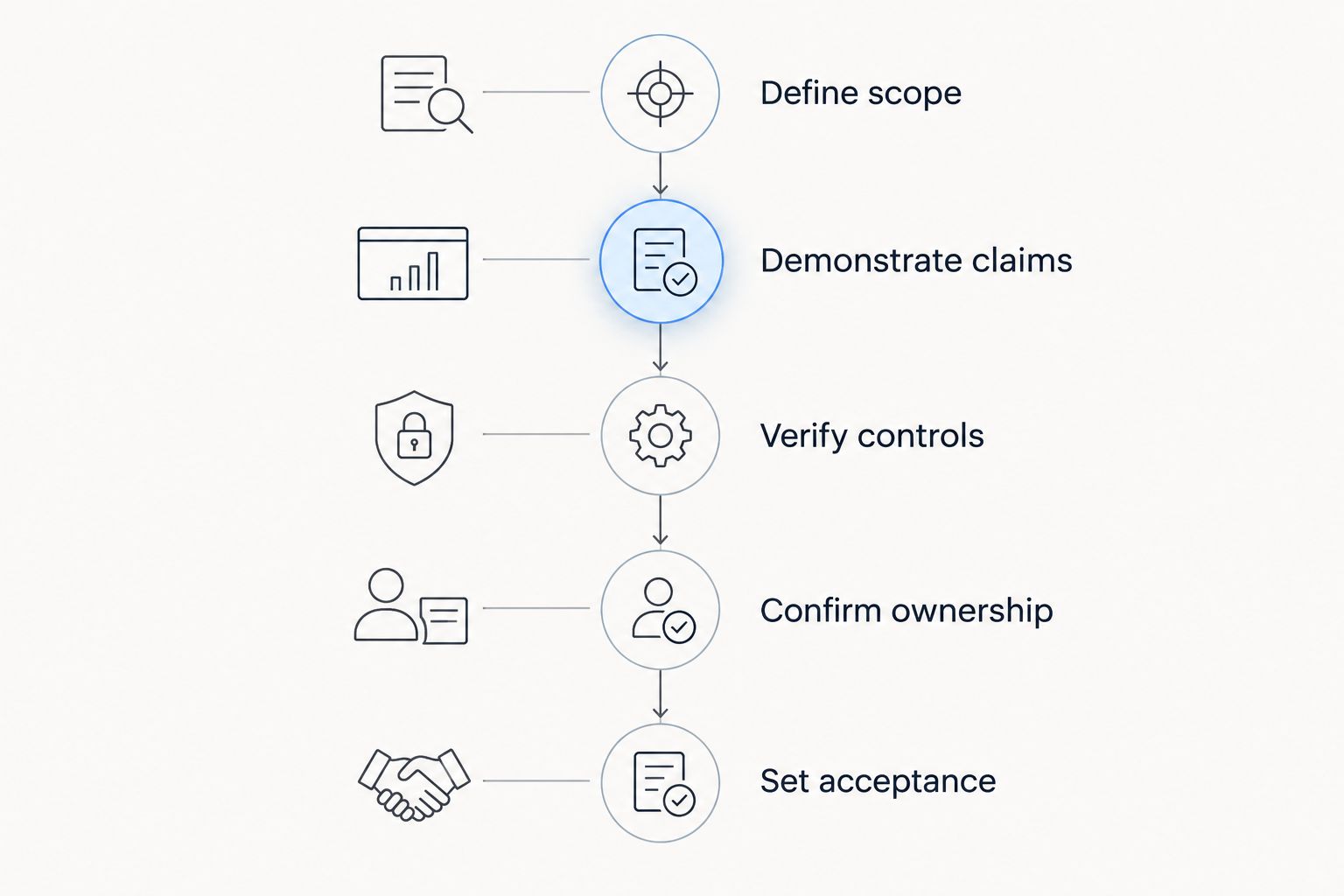
In 2026, keep the initial evaluation tied to observable claim work. A polished demonstration is not acceptance evidence unless it addresses your files, your approval rules, and your system boundaries.
FAQ
What's the best claims software for small P&C insurers?
The best claims software for small P&C insurers depends on whether you need claims automation or core replacement. Gethesperai belongs on the automation shortlist; BriteCore, Guidewire ClaimCenter, and Duck Creek Claims belong in core-platform or claims-application evaluations.
Is claims automation the same as a claims management system?
No, claims automation and a claims management system describe different operating roles. Automation addresses claim-handling work, while a claims-core evaluation must establish the system of record, financial requirements, and broader operating responsibilities.
What does Gethesperai automate for P&C insurers?
Gethesperai automates FNOL intake, triage, coverage, fraud investigation, settlement, and subrogation recovery. Its stated customer groups include P&C carriers, TPAs, and MGAs.
When should a small insurer evaluate BriteCore?
A small insurer should evaluate BriteCore when the project includes policy administration, billing, and claims. That is a broader core-platform decision rather than a claims-only automation purchase.
Is Guidewire ClaimCenter better than Duck Creek Claims?
Neither is a universal winner for every small P&C insurer. Evaluate Guidewire ClaimCenter for your dedicated claims-core requirements and Duck Creek Claims against your claims-configuration requirements, then prove the relevant workflows.
What should an insurer bring to a claims software demo?
Bring representative claim files, approval rules, exception scenarios, and system-boundary requirements. Require the demonstration to show the proposed process using those materials rather than only a prepared vendor scenario.
How should a small insurer compare implementation proposals?
Compare implementation proposals against the same defined scope and acceptance requirements. Identify responsibility for migration, connections, configuration, testing, and ongoing support before selecting a vendor.
One last thing
An exception case is a better selection test than a clean claim. Bring a file with incomplete evidence or a disputed coverage question and require the vendor to explain the handoff, supporting record, and correction path. Select for the difficult claim your team must resolve, not just the straightforward claim a demonstration finishes.


