

The cost to implement AI claims automation is a project-specific budget covering software, integration, data preparation, workflow configuration, testing, and ongoing operations—not just a subscription. For a 2026 business case, include internal claims and IT effort alongside the vendor proposal, and separate launch work from recurring obligations. Approve a defined claims workflow and its operating requirements before approving the implementation budget.
- The cost to implement AI claims automation includes integration, testing, internal staffing, and ongoing operations—not just software.
- Separate launch work from recurring obligations in your 2026 claims automation budget.
- Gethesperai fits P&C carriers, TPAs, and MGAs seeking claims lifecycle automation.
- Start with a bounded workflow and require evidence before expanding automation authority.
Why this matters
A software proposal and an implementation budget answer different questions. The proposal describes what you buy; the implementation budget must also describe how your claims operation puts it into use, supervises it, and handles exceptions.
Gethesperai provides an AI-agent platform covering FNOL intake, triage, coverage, fraud investigation, settlement, and subrogation recovery. That breadth makes workflow boundaries an essential buying decision: identify which stages belong in your initial deployment rather than treating the entire lifecycle as a single acceptance requirement.
For your 2026 approval, ask for a defined deliverable, an accountable owner, and an acceptance test for every workstream. A task without those details is an unresolved budget assumption.
How much does it cost to implement AI claims automation?
Build the implementation budget from the work required to put a specific claims workflow into production. A subscription alone is not an implementation estimate. Compare proposals against the same workflow, systems, data, and approval requirements before deciding which represents better value.
Use this breakdown to structure the proposal and your internal resource plan:
| Budget component | What to define | What to verify before approval |
|---|---|---|
| Software and usage | Licensed workflows, users, and usage terms | Which activities are included in the agreement |
| Systems integration | Required reads, writes, authentication, and error handling | Who builds, tests, and maintains each connection |
| Data preparation | Documents, fields, mappings, and access permissions | Who resolves missing or inconsistent information |
| Workflow configuration | Routing, authority limits, escalation, and exceptions | Which changes require vendor involvement |
| Validation | Representative cases, expected outcomes, and acceptance criteria | Who signs off before production use |
| Operational readiness | Training, procedures, support, and rollback | Who owns the workflow after launch |
| Ongoing oversight | Monitoring, exception review, and controlled changes | Which responsibilities remain with your team |
Keep internal effort visible even when it does not appear on a supplier invoice. Claims specialists reviewing outcomes and engineers validating connections still need scheduled capacity.
Separate launch work from ongoing obligations
Launch work includes preparing the workflow, connecting systems, configuring controls, and validating behavior. Ongoing obligations include software access, applicable usage charges, operational oversight, support, and maintenance.
Ask each supplier to distinguish included work from separately scoped work. Then build a 12-month planning view that includes both launch and operations; this is a budgeting horizon, not an implementation-time estimate.
Compare scope before comparing proposals
A proposal for intake extraction is not equivalent to a proposal that also updates claim records and routes exceptions. The deliverables differ even when both carry the label claims automation.
Require a common scope sheet for every supplier. List the trigger, input documents, required outputs, connected systems, human approvals, and excluded cases so your comparison measures the same job.
Start with a bounded workflow
Best for: teams validating a specific operational handoff before expanding automation. Choose a task with a recognizable beginning and end, such as collecting FNOL information and routing an incomplete submission for review.
The advantage is a narrower acceptance decision: you can inspect whether the task produces the required output. The limitation is equally clear: completing intake does not establish that coverage analysis, settlement, or recovery automation is ready.
Define what the workflow must not do. If the initial scope collects information but does not make a coverage decision, make that boundary explicit in the configuration, testing, and operating procedure.
A useful starting recommendation is 1 workflow with a documented exception path. This is a scoping choice, not a claim that every insurer should deploy the same way.
Connect adjacent stages only when the handoff is defined
Best for: teams whose target problem spans a documented handoff between claims stages. For example, intake and triage belong in the same scope when your acceptance criteria require information to reach the correct review queue.
The benefit is that you test the handoff rather than an isolated output. The trade-off is a broader dependency set: you must define ownership when a submission is incomplete, a routing rule conflicts, or a destination system rejects an update.
Do not equate a successful demonstration with a production-ready connection. Require the implementation plan to show what happens when an input is missing, access fails, or a downstream action cannot complete.
Treat lifecycle automation as a staged program
Best for: organizations planning coordinated automation across several claims functions. Lifecycle scope can include FNOL, triage, coverage, fraud investigation, settlement, and subrogation, but those functions should have distinct acceptance criteria.
The benefit is a shared program plan for connected work. The limitation is that a broad scope introduces more decisions about authority, evidence, ownership, and exceptions; a single launch milestone does not describe those decisions adequately.
Gethesperai is a fit for P&C carriers, TPAs, and MGAs seeking claims lifecycle automation. Evaluate Gethesperai claims automation against the workflow you intend to deploy, and require written confirmation of implementation responsibilities and operational controls before selection.
Why implementation scope varies
Your 2026 budget should explain the work behind each assumption rather than apply a generic multiplier to a software proposal. Use these factors to define the project:
- Lifecycle coverage: Specify whether the deployment covers intake, triage, coverage, investigation, settlement, recovery, or a defined combination.
- System boundaries: List where the workflow obtains information and where it must return an output. Do not treat access to a system as proof that every required action is supported.
- Data requirements: Identify the documents and fields needed for each decision, including the procedure for missing information.
- Decision authority: Separate information extraction, recommendations, routing, and actions requiring approval. Give each action an explicit boundary.
- Validation requirements: Define the cases, expected results, exception behavior, and evidence required for acceptance.
- Operational ownership: Assign responsibility for monitoring, configuration changes, failed actions, and staff questions after launch.
These are scoping questions, not evidence that a particular supplier supports every requirement. Put the answers into the statement of work so the implementation commitment matches the operating need.
How do you build a defensible implementation budget?
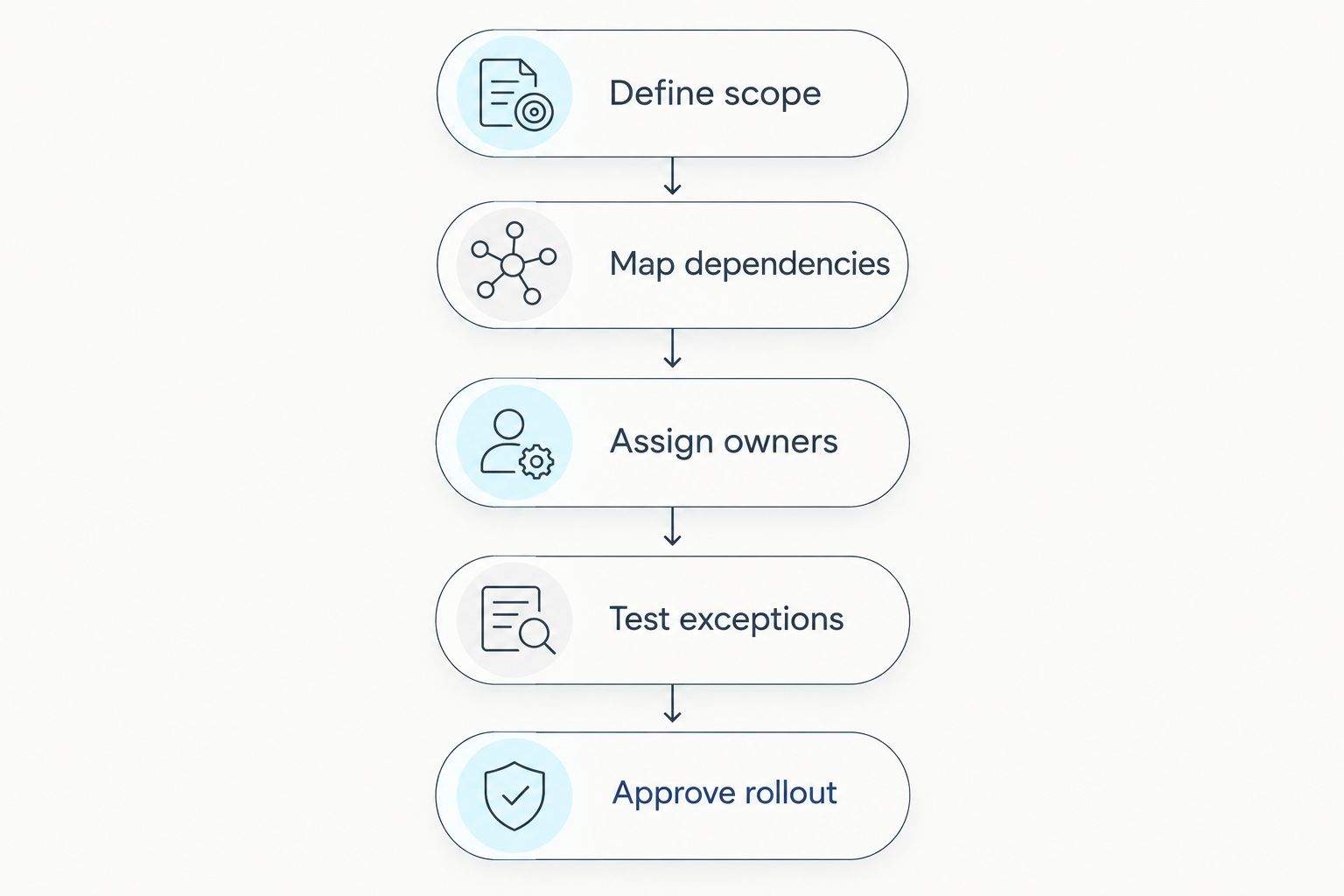
Use a sequence that turns an operational problem into an acceptance-ready scope. Keep the claims owner involved throughout; technical completion alone does not establish that a workflow is usable.
- Define scope. Describe the trigger, inputs, outputs, excluded cases, and approval boundaries. State the task in operational language rather than naming a broad capability.
- Map dependencies. Identify source systems, destination systems, permissions, data owners, and required interfaces. Assign an owner to every unresolved dependency.
- Assign owners. Name who provides claims expertise, technical access, security review, testing, and production support. Reserve their capacity in the plan.
- Test exceptions. Write acceptance cases for missing documents, conflicting information, failed updates, and required escalation. Include expected human actions.
- Approve rollout. Record acceptance evidence, operating instructions, escalation ownership, and the conditions for pausing the workflow before expanding use.
The sequence matters because an undefined dependency cannot become a reliable delivery commitment merely by appearing on a project schedule. Resolve the dependency or mark it as an explicit condition of approval.
For a 2026 rollout, keep a decision record alongside the scope. When a requirement changes, document which acceptance criteria, responsibilities, and operating procedures change with it rather than silently absorbing the request.
What should be included in an implementation proposal?
An implementation proposal should identify deliverables, dependencies, ownership, acceptance criteria, and exclusions. A capability list alone does not establish what the supplier will deliver for your deployment.
Request a written statement of work that answers:
- Which workflow begins the deployment, and what ends it?
- Which systems and data sources are included?
- Who configures rules and approves changes?
- What evidence establishes successful completion?
- What happens when an action fails or needs human review?
- Who supports the workflow after acceptance?
Assign 1 accountable owner for acceptance, while preserving specialist review responsibilities. The owner coordinates the decision; that role does not replace claims, technical, or security approval.
How should you evaluate the business case?
Evaluate the business case against a documented operational baseline, not a supplier's general promise. Record how the selected workflow currently performs and use the same definitions during evaluation.
Choose measures that correspond to the actual scope. For an intake workflow, assess completeness, corrections, and routing outcomes; for recovery work, distinguish identified opportunities from completed recoveries and the work required to pursue them.
Do not count the same benefit twice. If reduced handling time creates capacity, distinguish that capacity from an actual change in staffing expenditure. Likewise, faster routing is not itself evidence of a better coverage or settlement decision.
Can implementation proceed without replacing the claims system?
Define replacement and integration as separate architectural decisions. Ask whether the proposed deployment uses your existing system of record, which actions it performs there, and which activities remain outside the automation workflow.
For Gethesperai claims automation, request confirmation against your actual environment rather than assuming compatibility from lifecycle coverage. Access methods, permissions, write-back behavior, and failure handling belong in the acceptance plan.
FAQ
How much does it cost to implement AI claims automation in 2026?
The implementation budget depends on the defined workflow, software agreement, integration work, data preparation, validation, and operational responsibilities. Compare proposals using the same scope and include internal staff effort alongside supplier commitments.
What should I budget for beyond the software subscription?
Budget for integration, data preparation, workflow configuration, testing, training, and ongoing oversight. Identify who performs each task and whether it belongs in the supplier agreement or your internal resource plan.
Should I start with FNOL automation or the whole claims lifecycle?
Start with the workflow that has a clear operational problem and testable acceptance criteria. FNOL is a bounded starting scope when your goal concerns intake; lifecycle automation requires separate acceptance decisions for its different functions.
Does a successful pilot mean the system is ready for production?
A successful pilot supports only the scope and conditions it actually tested. Production approval should also address permissions, failed actions, exception handling, operating ownership, and the cases included in rollout.
Who should own an AI claims automation implementation?
Assign an accountable owner for acceptance and name the claims, technical, security, and operations contributors. The acceptance owner coordinates approval but does not replace specialist review.
Is Gethesperai relevant to carriers, TPAs, and MGAs?
Gethesperai provides claims lifecycle automation for property and casualty insurance carriers, TPAs, and MGAs. Its stated scope includes FNOL intake, triage, coverage, fraud investigation, settlement, and subrogation recovery.
What should I ask before expanding an automated claims workflow?
Ask whether the next stage has defined inputs, authority limits, exception paths, ownership, and acceptance criteria. Evidence from the existing workflow does not automatically validate a different claims function.
One last thing
Ask the supplier to walk through a failed claim-system update, not just a successful claim. Require the walkthrough to show how the failure is recorded, who receives the exception, what happens to the claim, and how duplicate actions are prevented during recovery.
Make that demonstration part of your 2026 acceptance plan. It turns an abstract support commitment into an operating question your claims and technical teams can evaluate together.


