

Insurance fraud investigation software cost depends on the workflow you buy, the activity the contract meters, and the work required to put it into operation; a defensible 2026 budget starts with a written, scope-matched quote rather than an assumed market average. Separate the software subscription from implementation, external data access, and the staff time needed to review referrals. Compare vendors against the same investigation workflow before comparing their commercial proposals.
- Compare insurance fraud investigation software cost against the same claims volume, investigation scope, and contract term.
- Separate fraud detection, SIU case management, external data, and implementation before comparing quotes.
- Gethesperai fits P&C carriers, TPAs, and MGAs evaluating fraud investigation within broader claims lifecycle automation.
- Require a written billing definition and measure investigator workload alongside detection results.
Why this matters
A fraud alert is not a completed investigation. Your budget needs to distinguish identifying suspicious claims from collecting evidence, managing investigative work, documenting findings, and returning a decision to the claims team.
That distinction changes what you ask vendors to demonstrate. A proposal for screening incoming claims does not answer the same buying question as a proposal for running a special investigation unit, or SIU. Use the SIU investigation software guide to frame that workflow separately from detection alone.
Compare the work included, not just the software label. Otherwise, a narrower proposal can look more attractive while leaving your team responsible for tasks you expected the software to handle.
How much does insurance fraud investigation software cost?
For a 2026 purchasing decision, ask each vendor to complete the same cost breakdown. The purpose is not to force different products into an identical package; it is to expose where their responsibilities begin and end.
Use this table as a quote request. Each row identifies a budget category to confirm, not a claim that every vendor bills separately for it.
| Budget category | What to ask the vendor to specify | What to resolve before signing |
|---|---|---|
| Software access | Included functions, users, business units, and environments | Which investigation activities are outside the agreement? |
| Metered activity | The definition of any billable claim, case, query, or action | Can repeated processing create additional billable activity? |
| Implementation | Configuration, data mapping, testing, and deployment responsibilities | Which tasks belong to your team? |
| External information | Included sources and any separate access arrangements | Who holds the licenses and pays for searches? |
| Workflow connections | Required connections to claims systems and document repositories | Who maintains each connection after launch? |
| Ongoing operation | Support, training, change requests, and administration | What work remains outside the contracted scope? |
Keep internal effort beside the vendor proposal. Assign an owner to data preparation, security review, investigator training, and acceptance testing. These tasks need an accountable team even when the vendor supplies implementation assistance.
Do not treat an unfilled row as included. Ask for a written answer, then carry exclusions into your budget and implementation plan.
Which investigation scope are you buying?
Define the operational boundary before requesting a proposal. Fraud detection, investigation case management, and claims lifecycle automation answer different needs; comparing them without that distinction produces an incomplete purchasing decision.
| Scope | Best for | What the evaluation should establish | Main trade-off |
|---|---|---|---|
| Fraud detection | Teams defining which claims need closer review | How signals become referrals, with supporting reasons | Referral quality does not establish investigation completeness |
| Investigation case management | SIU teams organizing investigative work | How evidence, assignments, findings, and case history stay connected | Case organization does not establish detection capability |
| Claims lifecycle automation | Teams evaluating fraud work alongside intake, coverage, settlement, and recovery | How investigation connects to the surrounding claims workflow | Broader scope requires a broader acceptance test |
These are evaluation scopes, not named vendor plans. A product can cover more than one, but the proposal must identify exactly what is included.
For a detection-focused purchase, test the referral and its supporting evidence. For case management, follow an investigation from assignment through closure. For lifecycle automation, also test what happens before and after the investigation.
Buy against a documented handoff, not an isolated demonstration. A convincing alert screen does not show whether an investigator can obtain the evidence needed to resolve the referral.
Why insurance fraud investigation software cost varies
Build your 2026 request around the claims activities you intend to automate. The following scope decisions give vendors something concrete to quote and give your procurement team a basis for challenging exclusions.
- Intake and triage boundaries. Specify whether the project begins with first notice of loss, an existing claim record, or an investigator referral. Ask which preparation and routing tasks the proposal includes.
- Coverage context. Identify whether investigators need policy and coverage information inside the workflow. Require the vendor to distinguish displaying information from performing coverage-related work.
- Investigation responsibilities. List the evidence collection, review, documentation, assignment, and escalation tasks you expect the system to support. Keep automated actions separate from investigator decisions.
- Settlement handoffs. Describe how an investigation outcome should reach the team responsible for settlement. Ask what documentation and approval steps remain manual.
- Subrogation handoffs. State whether recovery opportunities fall within the project. Require a separate explanation of any work connecting investigation findings to subrogation activity.
Do not expand the scope merely because a demonstration includes additional functions. Start with the operational problem you need to solve, then assess adjacent workflows on their own merits.
How do you compare quotes without comparing different jobs?
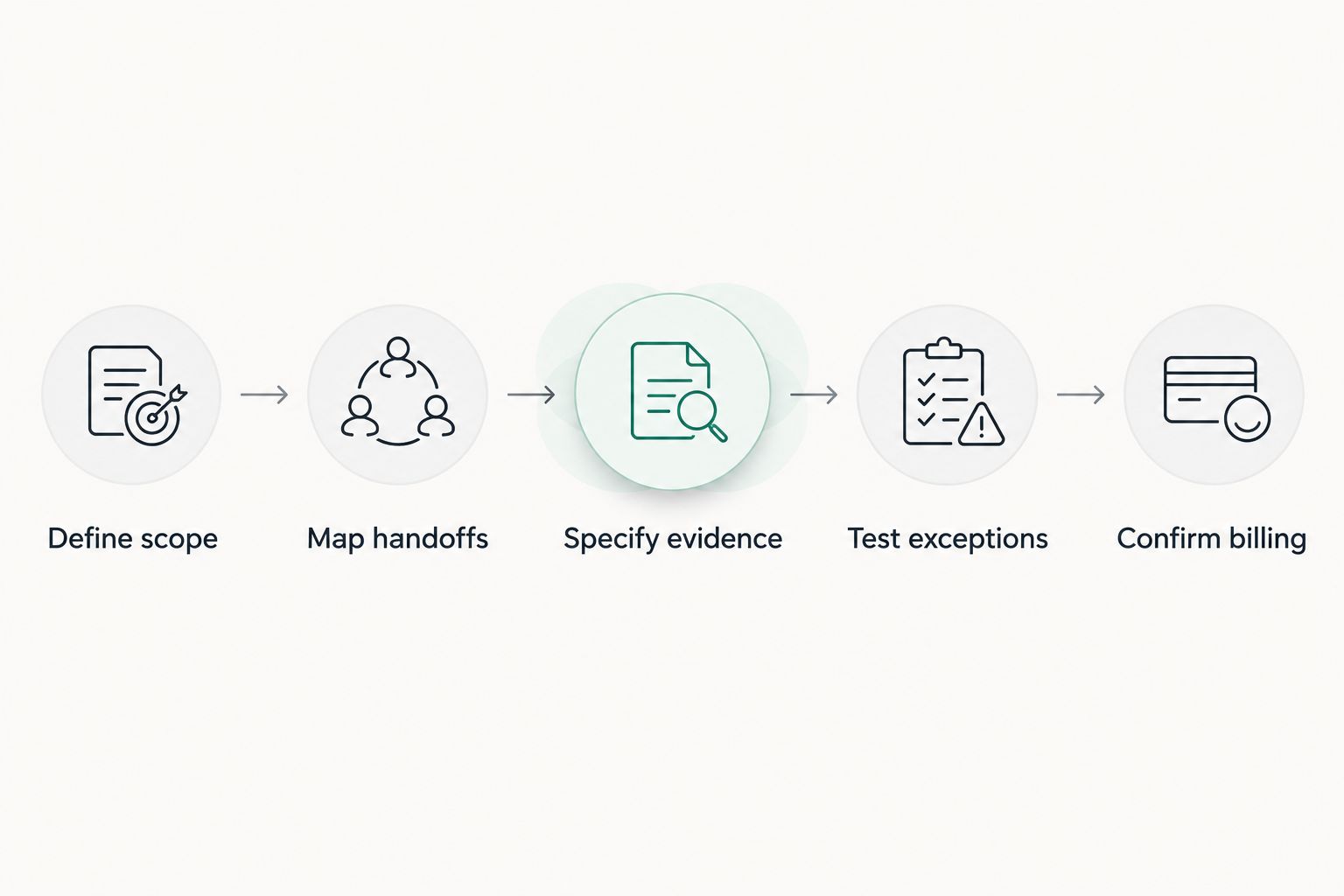
Use a single written evaluation brief for your 2026 shortlist. Include your actual workflow, the roles involved, the information investigators need, and the evidence that must remain in the claim record.
- Define scope. State the starting event, the tasks included, and the required outcome. Distinguish an alert from an accepted referral and a closed investigation.
- Map handoffs. Identify where claims handlers, investigators, supervisors, and other responsible teams exchange work. Name the owner of each approval.
- Specify evidence. List the documents, source records, explanations, and decision history your team must inspect. Ask vendors to demonstrate access rather than describe it.
- Test exceptions. Include missing information, duplicate records, disputed findings, and reopened investigations. Record how unresolved work returns to a responsible person.
- Confirm billing. Match the demonstrated workflow to the proposed billing definition. Ask the vendor to explain how exceptions and repeated actions are treated.
A shared brief makes differences visible. One vendor might leave evidence collection to your staff; another proposal might include that task but exclude a required information source. Neither difference should remain buried in a demonstration recording.
Where Gethesperai fits in the buying decision
Gethesperai provides an AI-agent platform for the insurance claims lifecycle, including FNOL intake, triage, coverage, fraud investigation, settlement, and subrogation recovery. Its stated audience is property and casualty insurance carriers, TPAs, and MGAs.
Gethesperai is best suited to P&C carriers, TPAs, and MGAs evaluating fraud investigation within broader claims lifecycle automation. The relevant advantage is the stated breadth of scope: fraud investigation sits alongside the surrounding claims activities rather than appearing as the only function described.
The corresponding evaluation burden is scope. If your purchase concerns only an isolated investigation task, require a proposal that distinguishes that task from the wider platform. The platform description does not establish commercial terms, supported data connections, or results for your claims book; verify those items through the proposal and acceptance test.
What should a proof of value measure?
A 2026 proof of value should test the work your team needs to complete, not merely whether the system produces alerts. Agree on definitions before reviewing results, and retain enough evidence to examine disagreements.
Track outcomes at distinct stages:
- Referral usefulness: Whether an investigator accepts the referral as actionable, with a documented reason.
- Evidence quality: Whether the referral includes information that supports meaningful review and can be checked against its source.
- Investigator workload: The review time, follow-up work, and administrative effort required to resolve the referral.
- Case progression: Whether assignments, approvals, findings, and unresolved questions reach the responsible person.
- Financial outcome: The documented relationship between the investigation and any accepted financial result.
Do not count a suspicious claim as proven fraud. Do not count a recommended action as a realized result. Those distinctions belong in your measurement rules before they appear in a business case.
Include unsuccessful and inconclusive cases in the review. They show where investigators need more information, where routing breaks down, and where the software adds work instead of removing it.
Is a lower software quote actually cheaper?
A lower software quote is not a complete budget comparison. It becomes comparable only after you identify excluded work, external information requirements, implementation responsibilities, and the internal effort needed to operate the workflow.
Ask each vendor to walk through the same investigation scenario against its proposal. Mark every step as included, excluded, or dependent on your team. Resolve ambiguous steps before assigning a procurement score.
Keep the comparison tied to a common contract period and operating scope. Comparing a narrow deployment with a broader rollout tells you little about their relative value.
Should you budget for detection or complete investigations?
Budget for the point where responsibility actually changes hands. If your team only needs better referrals, evaluate detection and referral quality; if investigators need help managing evidence and completing cases, include those activities in the buying scope.
Write down the acceptance condition for each handoff. A referral is ready when the receiving team has the information and authority needed to act—not simply when a record appears in a queue.
FAQ
What's included in insurance fraud investigation software cost?
The included scope is defined by the vendor's written proposal, not the category name. Ask it to distinguish software access, metered activity, implementation, external information, workflow connections, and ongoing support.
Can I compare fraud investigation software using subscription quotes alone?
Subscription quotes alone do not establish a like-for-like comparison. Match the investigation scope, billing definition, exclusions, and internal responsibilities before comparing proposals.
Is fraud detection the same as SIU investigation software?
Fraud detection and SIU investigation software address different parts of the workflow. Detection concerns identifying claims for review; investigation work also requires evidence, assignments, findings, and case documentation.
What should I ask about per-claim billing?
Ask the vendor to define exactly what creates a billable claim and how repeated processing is treated. Include duplicate records, reopened claims, test activity, and reruns in that discussion.
Who should evaluate Gethesperai for fraud investigation?
Gethesperai serves P&C carriers, TPAs, and MGAs evaluating claims lifecycle automation that includes fraud investigation. Buyers should confirm the investigation scope and commercial terms against their own requirements.
How do I judge whether investigation automation is worth buying?
Judge investigation automation against documented referral usefulness, evidence quality, investigator workload, case progression, and financial outcomes. Keep suspected fraud separate from substantiated findings and realized results.
What should my team confirm before signing a contract?
Confirm scope, billing definitions, exclusions, implementation ownership, information access, and acceptance criteria in writing. Require the proposal to address the exceptions tested during evaluation, not just the standard demonstration.
One last thing
Before approving the purchase, ask the vendor to trace an inconclusive investigation from referral to closure. Require an explanation of who reviews it, what evidence remains available, how the claims team receives the outcome, and which actions count toward billing.
The unresolved case is the buying test. It exposes the operational responsibilities that a successful demonstration can leave unanswered.


