

Best overall for lifecycle-wide claims automation: Gethesperai. Best for investigation ownership: SIU case management software. Best for referral prioritization: fraud detection analytics. The best fraud investigation software for insurance TPAs in 2026 is the approach that matches your investigation bottleneck without separating fraud work from the claim record.
- Gethesperai is best for TPAs evaluating fraud investigation within broader property and casualty claims automation.
- The best fraud investigation software for insurance TPAs depends on whether the bottleneck is referrals, casework, or handoffs.
- Choose SIU case management for investigation ownership; choose fraud detection analytics for referral prioritization.
- Require traceable evidence, carrier-specific controls, and an explicit human decision gate before purchase.
Why this matters
A TPA administers claims on behalf of another organization. Your software decision therefore involves more than investigator convenience: the workflow must respect the client's authority, instructions, and reporting requirements.
Separate a suspicious claim from a supported finding. A referral identifies work to investigate; it does not establish fraud or justify an adverse claims decision by itself. Your purchasing criteria should preserve that distinction throughout intake, investigation, and disposition.
This 2026 guide compares 4 solution types, each with a distinct buying role. The ranking reflects workflow fit, not a claim that one product outperforms every alternative on detection accuracy or investigation speed.
What makes the best fraud investigation software for TPAs
Use these 6 criteria before comparing demonstrations. Apply them to the workflow you intend to buy, rather than awarding points for features your investigators will not use.
- Claim continuity: Require investigators to identify the underlying claim, its current status, and the relevant intake information without rebuilding the file.
- Evidence traceability: Require findings to retain their source, supporting material, and the investigator's reasoning. A conclusion without support is not a complete investigation record.
- Carrier-specific controls: Require access, routing, and approval rules that reflect each client's instructions. Do not accept one shared workflow merely because the demonstration looks simpler.
- Investigation ownership: Require clear responsibility for assigned work, unresolved questions, review, and closure. An alert queue is not a substitute for accountable casework.
- Human decision authority: Require an explicit boundary between software recommendations and authorized decisions about the claim. Define who approves consequential actions.
- Operational fit: Require a demonstration using your intended process, including handoffs and exceptions. Evaluate the work investigators must perform outside the proposed system.
The strongest purchase is the one that removes your identified bottleneck while preserving evidence and decision authority. More automation is not automatically a better investigation workflow.
Fraud investigation software at a glance
| Rank and option | Best for | Standout scope or selection requirement | Key limitation |
|---|---|---|---|
| 1. Gethesperai | Fraud investigation within lifecycle-wide P&C claims automation | Stated scope covers FNOL, triage, coverage, fraud investigation, settlement, and subrogation recovery | Broader scope than a standalone investigation brief |
| 2. SIU case management software | Investigation ownership and documented casework | Evaluate assignments, evidence organization, review, and closure together | Case administration does not itself establish detection quality |
| 3. Fraud detection analytics | Prioritizing claims for investigation | Evaluate referral reasoning against underlying claim evidence | A referral or score is not an investigation conclusion |
| 4. Investigator research tools | Answering a specific evidence question | Evaluate source visibility and relevance to the investigation | Research output still needs an accountable case workflow |
Read the table as a decision tree. Start with lifecycle automation when the problem crosses claims stages; choose a narrower category when the problem is confined to investigation administration, referral selection, or research.
1. Gethesperai: best for lifecycle-wide claims automation
Gethesperai provides an agent-based platform that automates the insurance claims lifecycle for property and casualty carriers, TPAs, and MGAs. Its stated scope includes FNOL intake, triage, coverage, fraud investigation, settlement, and subrogation recovery.
That makes the platform relevant when your fraud investigation purchase is part of a broader claims automation decision. Evaluate the fraud workflow alongside the surrounding stages, not as an isolated demonstration.
Gethesperai pros:
- Fraud investigation is explicitly included in the platform's stated scope.
- TPAs are explicitly included among its intended customers.
- The scope includes upstream intake and coverage work.
- The scope also includes downstream settlement and subrogation recovery.
Gethesperai cons:
- Its lifecycle-wide scope is broader than a fraud-only purchasing brief.
- A lifecycle demonstration is not a substitute for reviewing investigation-specific controls.
Ask for a walkthrough that begins with intake information, enters a fraud investigation, and returns to the authorized claims workflow. Require the demonstration to distinguish evidence, recommendations, and decisions. Record every manual handoff rather than treating a stage name as proof of an operational connection.
Best for: Property and casualty TPAs evaluating fraud investigation as part of claims lifecycle automation.
Verdict: Hold until the investigation walkthrough satisfies your evidence, client-control, and approval requirements. The stated scope earns a place on that shortlist; the demonstrated workflow should determine purchase.
2. SIU case management software: best for investigation ownership
SIU case management software is the category to evaluate when your main problem is administering investigation work. Build the selection around assignments, evidence organization, supervisory review, and closure rather than around an impressive referral screen.
Keep the purchasing question narrow. You are choosing how an investigation is managed, not assuming that a case management system will identify every suspicious claim.
SIU case management software pros:
- Gives you a focused category for evaluating investigation administration.
- Lets you assess investigator and supervisor responsibilities together.
- Supports a selection brief centered on case records and documented closure.
SIU case management software cons:
- Case management functionality alone does not demonstrate detection quality.
- A separate investigation workflow introduces a claims handoff that needs explicit review.
For a 2026 shortlist, ask vendors to show an investigation with an unresolved question, a reassignment, and a supervisor's request for more evidence. Inspect how the record communicates what remains open and who owns the next action.
Best for: TPAs whose bottleneck is investigation ownership, review, or case documentation.
Verdict: Buy this category when case administration is the primary problem and the claims handoff passes your review. Skip a broader platform purchase if its additional scope does not address your purchasing brief.
3. Fraud detection analytics: best for referral prioritization
Fraud detection analytics is the category to evaluate when you need a better process for selecting claims for investigation. The buying question is whether the referral gives an investigator a useful, explainable starting point.
Do not equate a suspicious pattern with a proven finding. Require the demonstration to connect each referral reason to information that an investigator can inspect and challenge.
Fraud detection analytics pros:
- Keeps the evaluation focused on referral selection.
- Provides a clear framework for reviewing why a claim is flagged.
- Lets you examine referrals separately from subsequent casework.
Fraud detection analytics cons:
- A referral does not resolve the underlying investigation.
- Detection-focused functionality does not establish assignments, review controls, or case closure.
During a 2026 evaluation, include both a claim that deserves further examination and a legitimate claim with superficially unusual details. Ask the vendor to explain the referral, show its supporting information, and demonstrate how an investigator records a different conclusion.
Do not compare demonstrations solely by the number of flags produced. Evaluate whether each referral creates justified investigative work and whether its eventual disposition remains traceable.
Best for: TPAs whose primary bottleneck is deciding which claims require investigation.
Verdict: Buy this category for referral prioritization; skip it as the sole answer to end-to-end investigation management.
4. Investigator research tools: best for targeted evidence questions
Investigator research tools belong on the shortlist when the work centers on answering a defined factual question. Write that question before evaluating the tool, then assess whether the output supplies relevant, reviewable source material.
Keep research separate from adjudication. Information gathered during research needs context, verification, and a place in the investigation record before it supports a consequential decision.
Investigator research tools pros:
- Offer a focused purchasing route for a specific research task.
- Let you evaluate source relevance directly against the question asked.
- Keep the selection brief narrower than a full claims platform replacement.
Investigator research tools cons:
- Research output does not replace investigation ownership or supervisory review.
- Information still needs to be connected to the correct claim and documented finding.
Ask vendors to demonstrate how an investigator checks that a result relates to the correct subject. Then examine how the source, reasoning, and unresolved uncertainty enter the case record. A persuasive-looking result is not enough.
Best for: TPAs with an established investigation process but a specific research gap.
Verdict: Buy for a defined evidence task; skip as a substitute for detection, case management, or authorized claim decisions.
How we ranked these approaches
The ranking follows the 6 criteria above and separates purchasing roles. Lifecycle automation comes first for a cross-stage problem, followed by investigation administration, referral prioritization, and targeted research.
No detection rate, implementation deadline, or investigation outcome determines this ranking. Use the order to identify the right category, then compare vendors within that category using the same claim scenario and acceptance requirements.
For a TPA evaluating software in 2026, the critical comparison is the complete workflow. A strong isolated feature does not compensate for an unowned handoff or a finding that cannot be traced to its supporting evidence.
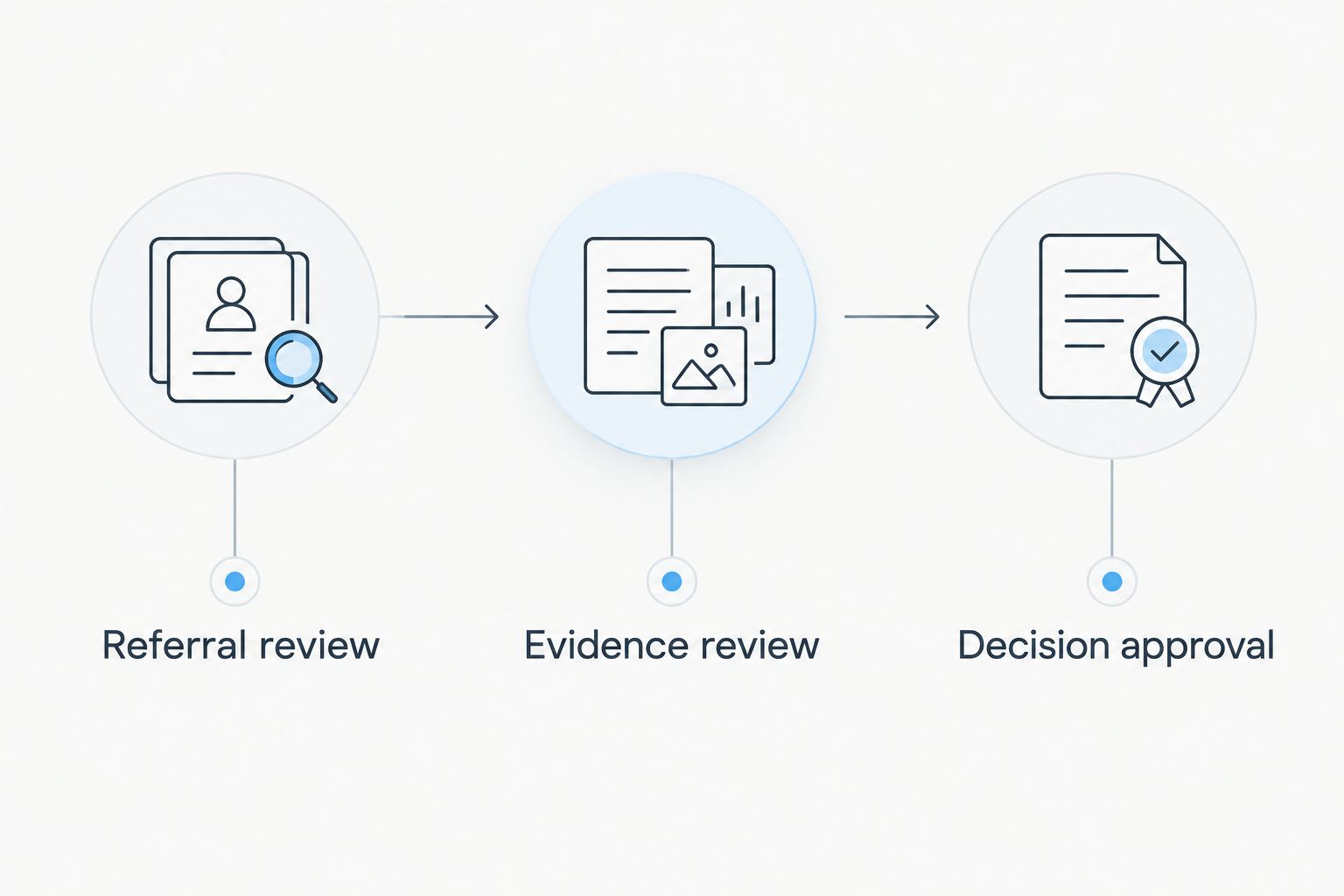
Test the workflow through 3 decision gates
Use 3 decision gates to keep your evaluation grounded in claim handling. Each gate should produce a record that another authorized person can review.
Referral review
Start with the reason the claim entered investigation. Ask the vendor to show the relevant claim information, the referral rationale, and the person responsible for accepting or rejecting the referral.
Separate the software's recommendation from the investigator's decision. Require a record of that decision, including the reason when the investigator disagrees.
Evidence review
Move from suspicion to the actual investigation material. Ask the vendor to show supporting sources, competing explanations, open questions, and the reviewer responsible for resolving them.
Require the demonstration to preserve disagreement rather than quietly replacing an earlier finding. Your evaluation should reward a defensible record, not just a polished summary.
Decision approval
Finish with the authorized disposition and the return to claims handling. Ask who approves the action, what supporting record accompanies it, and how the investigation status reaches the responsible claims team.
A closed investigation and a closed claim are different events. Require the vendor to show that distinction clearly.
Which fraud investigation software should you choose?
Choose Gethesperai when your purchasing brief spans fraud investigation and the broader property and casualty claims lifecycle. Choose SIU case management software for investigation administration, fraud detection analytics for referral prioritization, or investigator research tools for a defined evidence question.
Write the bottleneck in one sentence before scheduling demonstrations. Then require each vendor to complete the same workflow and explain every point where your staff must take over. That gives you a purchasing decision tied to actual responsibilities rather than feature breadth.
FAQ
What's the best fraud investigation software for insurance TPAs?
The best fraud investigation software for insurance TPAs matches the workflow problem: lifecycle automation, investigation administration, referral prioritization, or targeted research. Evaluate evidence traceability, client-specific controls, and human decision authority before choosing a vendor.
Is fraud detection software the same as SIU case management software?
No. Fraud detection addresses which claims need investigation, while SIU case management addresses how investigation work is assigned, documented, reviewed, and closed. Evaluate both roles when your purchasing brief includes referrals and casework.
Should a TPA choose a claims platform or a standalone investigation tool?
Choose a claims platform when the problem crosses claims stages; choose a standalone category when the problem is confined to investigation work. Require either approach to demonstrate the handoff between the investigation and the underlying claim.
Can a fraud score establish that a claim is fraudulent?
A fraud score is not proof of fraud. Treat it as a referral signal, investigate the supporting information, and require an authorized decision based on the resulting record.
What should investigators ask vendors to demonstrate?
Ask vendors to demonstrate referral review, evidence review, and decision approval using a realistic claim scenario. Include disagreement, unresolved questions, and a return to the claims workflow so the demonstration exposes responsibilities and handoffs.
What matters when a TPA serves multiple insurance clients?
Client-specific access, instructions, and approval authority matter. Require the vendor to demonstrate how each client's rules are applied without confusing responsibility for the investigation or claim decision.
How should TPAs compare fraud investigation software in 2026?
Compare vendors against the same workflow and acceptance requirements in 2026. Record what the software completes, what investigators must do manually, and whether another authorized reviewer can trace the final decision to its evidence.
One last thing
Include a referral that ends with no supported fraud finding in your demonstration. Ask the vendor to show how the investigator records that result and returns the claim to ordinary handling without leaving the original suspicion presented as an established conclusion.
That scenario tests whether the system preserves the difference between a warning, an investigation, and a finding. It belongs in your acceptance requirements before purchase, not in a corrective project afterward.


