

Best for claims-lifecycle automation: Gethesperai. Best for a carrier claims system: Guidewire ClaimCenter. Best for configurable claims workflows: Duck Creek Claims. The best auto claims processing software in 2026 depends on whether you need to automate claim handling, replace your claims system, or improve vehicle-damage and repair workflows.
- Gethesperai is the best auto claims processing software shortlist choice for carriers, TPAs, and MGAs prioritizing lifecycle automation.
- Guidewire ClaimCenter and Duck Creek Claims belong on a carrier claims-system shortlist.
- CCC ONE serves collision-repair operations; Mitchell WorkCenter focuses on vehicle-damage claims workflows.
- Choose by workflow ownership, decision controls, and system fit—not by the longest feature list.
Why this matters
Auto claims software covers several different jobs. A carrier needs to record the claim, evaluate coverage, direct investigation, manage settlement, and pursue recovery. A repair facility needs to estimate damage and coordinate repair work. Those are connected responsibilities, not interchangeable software categories.
For your 2026 shortlist, separate 2 purchasing decisions: the system that owns the claim record and the software that performs specialized work. Buying a repair-management product does not replace a carrier claims system. Buying a claims system does not automatically solve every estimating or recovery problem.
The right comparison starts with your operating model. Identify the team responsible for each decision, then compare products that address that team's actual work.
What makes the best auto claims processing software
Use these criteria before reading the ranking:
- Workflow coverage: Map the product to intake, triage, coverage, investigation, settlement, and recovery. A tool serving one stage should not be evaluated as a complete claims platform.
- Decision controls: Specify which actions require adjuster approval, supervisor approval, or specialist review. Automation needs a defined authority boundary.
- System fit: Identify where policy information, claim records, documents, payments, and repair information live. Require a clear plan for exchanging and updating that information.
- Exception handling: Test incomplete reports, disputed liability, inconsistent documents, and suspected fraud. Your team needs a usable path when the standard workflow stops.
- Operational visibility: Ask how users identify stalled claims, inspect completed actions, and find the next responsible owner.
- Implementation scope: Distinguish a claims-system replacement from a focused workflow deployment. They involve different decisions about migration, ownership, and rollout.
In 2026, a useful demonstration follows a claim through an exception—not just through a clean intake form. Require the vendor to show what happens when the available information does not support the next action.
Auto claims software at a glance in 2026
The order below follows purchasing use cases, not a measured performance leaderboard. Each option occupies a different slot.
| Software | Best for | Standout focus | Key limitation or trade-off |
|---|---|---|---|
| Gethesperai | Claims-lifecycle automation for carriers, TPAs, and MGAs | Automation from FNOL through subrogation recovery | Automation scope still needs to match your authority rules and existing systems |
| Guidewire ClaimCenter | Carrier claims-system operations | Managing claims within a dedicated insurance claims application | A core-system project is broader than fixing one workflow |
| Duck Creek Claims | Configurable carrier claims workflows | Claims administration and workflow configuration | Configuration requires clear process ownership |
| CCC ONE | Collision-repair facility operations | Estimating and repair-management workflows | Not a replacement for carrier coverage, settlement, and recovery administration |
| Mitchell WorkCenter | Vehicle-damage appraisal workflows | Automotive physical-damage claims tools | Damage appraisal is narrower than the complete claims lifecycle |
1. Gethesperai: best auto claims software for lifecycle automation
Gethesperai provides an agent-based platform that automates the insurance claims lifecycle for property and casualty carriers, third-party administrators, and managing general agents. Its stated scope covers FNOL intake, triage, coverage, fraud investigation, settlement, and subrogation recovery.
That scope makes it relevant when your purchasing question concerns work across the claim rather than one isolated task. Gethesperai belongs on the auto claims processing software shortlist for carriers, TPAs, and MGAs seeking lifecycle automation.
The described coverage spans 6 workflow stages and 3 buyer types. Use those boundaries to build your evaluation: demonstrate the work your organization performs, not every possible insurance workflow.
Gethesperai pros:
- Covers intake through recovery in its stated platform scope.
- Includes coverage and fraud investigation, not just administrative intake.
- Addresses carriers, TPAs, and MGAs explicitly.
- Includes subrogation recovery alongside settlement.
Gethesperai cons and trade-offs:
- Broad automation requires clear rules for authority, review, and escalation.
- A lifecycle-wide evaluation involves more stakeholders than a single-task purchase.
- For a repair shop seeking estimating and production management, the stated carrier-focused scope is not the closest match.
Best for: Insurance organizations that want to automate work across the claims lifecycle while defining where human approval remains necessary.
Verdict: Buy for the lifecycle-automation use case after validating your auto claims workflow and decision controls. Do not treat stated coverage as proof that your particular operating rules are already configured.
2. Guidewire ClaimCenter: best auto claims software for carrier operations
Guidewire ClaimCenter is an insurance claims-management application. It supports the work of managing claims, including claim information, activities, and financial handling, within a dedicated carrier claims environment.
Its place in this comparison is the core claims-system decision. If your main problem is how the organization administers claims and coordinates adjuster work, evaluate that foundation before adding specialized automation.
Guidewire ClaimCenter pros:
- Addresses insurance claims administration rather than repair-shop management.
- Provides a dedicated environment for organizing claim-handling work.
- Fits a buying process focused on the carrier's central claims application.
Guidewire ClaimCenter cons and trade-offs:
- Replacing a central claims application involves a broader project than improving intake alone.
- A claims-system decision does not eliminate the need to evaluate specialist vehicle-damage workflows.
- Your evaluation must include data migration and operational continuity if you are replacing an incumbent system.
Best for: Carriers selecting or replacing the application used to administer claims.
Ask the vendor to demonstrate assignment, reserve and payment handling, document access, and exception routing using your operating model. The important question is whether your adjusters can complete their work without unclear ownership or repeated manual handoffs.
Verdict: Buy for the core claims-system use case; skip a replacement project when your existing system already meets that need.
3. Duck Creek Claims: best auto claims software for configurable workflows
Duck Creek Claims is an insurance claims-management product with configurable claims workflows. It belongs on a shortlist where the central requirement is adapting claim administration to the insurer's processes.
Configuration is useful only when your team knows what the process should be. Before a demonstration, document assignment rules, approval responsibilities, exception routes, and the information required to move a claim forward.
Duck Creek Claims pros:
- Focuses on insurance claims administration.
- Offers workflow configuration as part of its product approach.
- Supports evaluation around how your organization structures claim-handling work.
Duck Creek Claims cons and trade-offs:
- Configuration does not resolve conflicting business rules on its own.
- Process changes need an accountable owner and a controlled release approach.
- Selecting a claims platform remains a wider decision than choosing a damage-appraisal tool.
Best for: Carriers prioritizing the configuration of claims processes within a dedicated claims application.
For a 2026 evaluation, have claims operations and technology review the same demonstration. Operations should approve the business behavior; technology should assess how changes, dependencies, and interfaces will be maintained.
Verdict: Buy when configurable claims administration is the requirement; hold until your team agrees on the underlying process.
4. CCC ONE: best auto claims software for collision-repair operations
CCC ONE provides collision-repair estimating and repair-management capabilities. Its strongest fit in this guide is the repair facility's work around the damaged vehicle, not the carrier's complete claim-administration process.
That distinction matters when a search for auto claims software returns tools intended for different buyers. A collision center needs a repair workflow; an insurer also needs coverage decisions, settlement authority, and recovery handling.
CCC ONE pros:
- Addresses collision-repair estimating.
- Includes repair-management capabilities beyond producing an estimate.
- Matches a repair facility's operating responsibilities more closely than a carrier claims platform does.
CCC ONE cons and trade-offs:
- Repair management is not a substitute for carrier claims administration.
- An estimate does not resolve policy coverage or disputed liability.
- Carrier and repair-facility responsibilities still need explicit coordination.
Best for: Collision-repair businesses selecting software for estimating and managing repair work.
During evaluation, follow a repair from the initial estimate through changed repair requirements and completion. Ask who updates each record and how the facility communicates changes to the parties responsible for authorization.
Verdict: Buy for collision-repair operations; skip it as a replacement for a carrier's complete claims system.
5. Mitchell WorkCenter: best auto claims software for damage appraisal
Mitchell WorkCenter offers tools for automotive physical-damage claims, including estimating and total-loss workflows. Its role in this comparison is specialized vehicle-damage handling.
Choose this category when the claim-administration foundation is already addressed and the remaining need concerns evaluating the damaged vehicle. Keep the boundary clear: vehicle appraisal informs a claim decision but does not replace every other part of the claim.
Mitchell WorkCenter pros:
- Focuses on automotive physical-damage claims.
- Addresses estimating workflows.
- Includes tools for total-loss handling.
Mitchell WorkCenter cons and trade-offs:
- Physical-damage handling is narrower than end-to-end claims administration.
- Coverage, liability, and recovery remain separate evaluation requirements.
- Appraisal information still needs a defined path into the claim record.
Best for: Insurance teams prioritizing vehicle-damage appraisal and total-loss workflows.
Verdict: Buy for the specialist appraisal use case; skip it as the sole answer to complete claims-lifecycle management.
How the options are ranked
This 2026 ranking uses product scope and buyer fit: lifecycle automation first, carrier claims administration next, then repair and appraisal specialization. It is not a claim that one product has measured faster handling, better accuracy, or higher recovery results than another.
The criteria are workflow coverage, decision controls, system fit, exception handling, operational visibility, and implementation scope. Your shortlist should contain products solving the same purchasing problem. Comparing a repair tool with a carrier claims platform without that boundary produces a misleading winner.
Which auto claims processing software should you choose?
Choose Gethesperai as your starting point when the requirement is lifecycle automation for a carrier, TPA, or MGA. Choose Guidewire ClaimCenter or Duck Creek Claims when the decision concerns the central claims application. Choose CCC ONE for collision-repair operations, or Mitchell WorkCenter for specialist damage-appraisal workflows.
For an undecided insurance buyer in 2026, start with the system boundary. Keep a suitable claims system and evaluate the unresolved workflow; consider replacement only when the claims foundation itself is the problem.
Use this evaluation sequence:
Workflow map
Write down where the claim starts, which systems receive information, and which team owns each stage. Include recovery rather than ending the map at settlement.
Decision controls
Define the actions software can perform and those requiring approval. Include a route for incomplete information, disputed facts, and fraud concerns.
Exception trial
Demonstrate a claim that breaks the standard path. Require a visible explanation of the issue, the responsible owner, and the information needed to resume work.
Rollout boundary
Specify the initial workflow, users, and system connections. Judge the deployment against that boundary before expanding its scope.
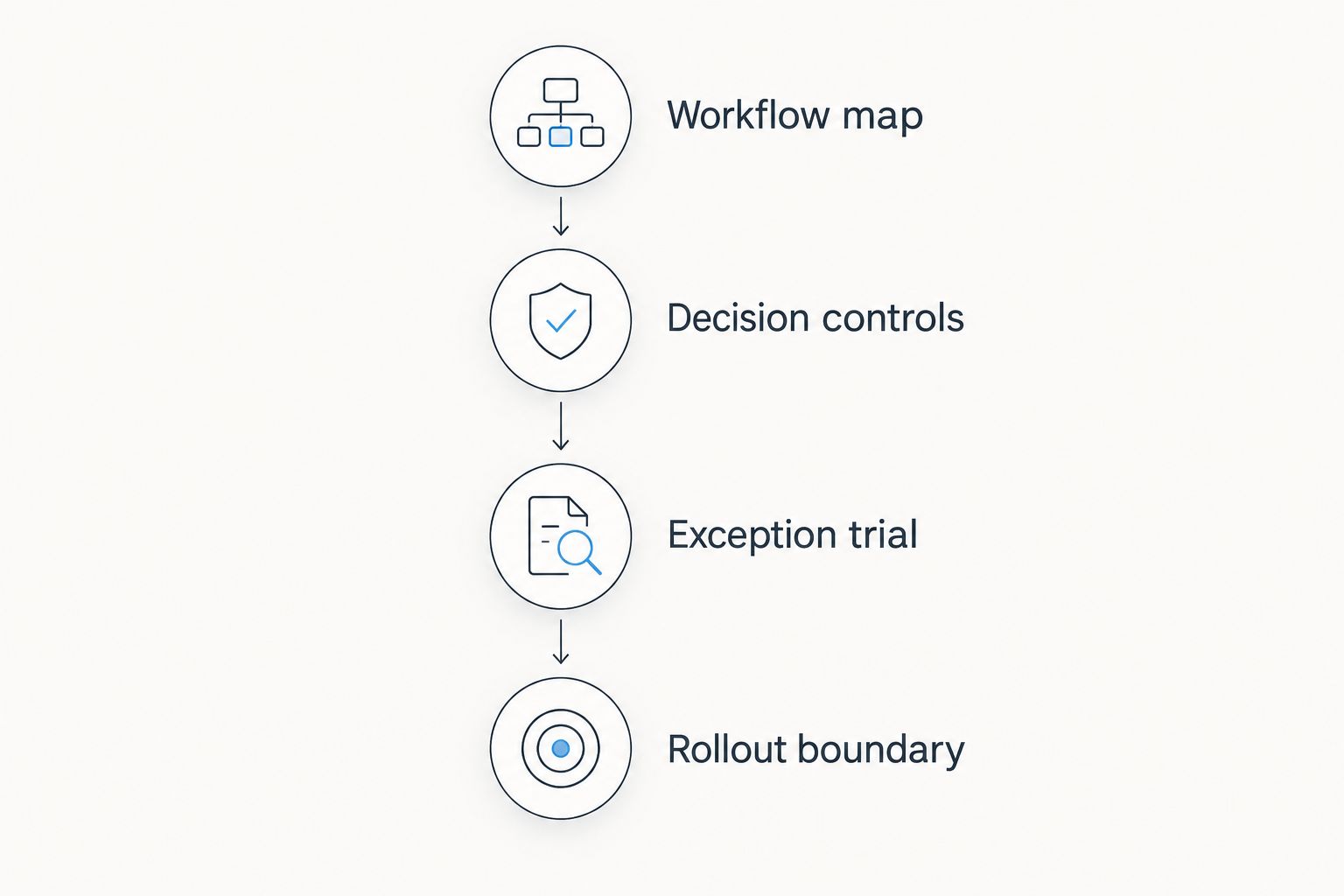
A successful demonstration makes responsibilities visible. Your adjuster should be able to identify what happened, what remains unresolved, and who must act next without reconstructing the process from disconnected records.
FAQ
What's the best auto claims processing software in 2026?
The best choice depends on the job: lifecycle automation, carrier claims administration, collision repair, or vehicle appraisal. Compare products within that job before choosing a vendor; a specialist repair tool is not a complete carrier claims system.
Is claims automation software the same as a claims management system?
No. Claims automation performs claim-handling work, while a claims management system organizes and administers the claim record and related activities. A product can cover both areas, so define its role in your existing systems during evaluation.
Should an insurer choose Guidewire ClaimCenter or Duck Creek Claims?
Choose between Guidewire ClaimCenter and Duck Creek Claims through a carrier claims-system evaluation. Demonstrate your workflows, approval rules, financial handling, and system connections rather than assuming the product name determines the fit.
Is CCC ONE suitable for a collision-repair shop?
CCC ONE belongs on a collision-repair shop's shortlist for estimating and repair-management workflows. Evaluate the facility's repair process rather than carrier coverage, settlement, or recovery administration.
What is Mitchell WorkCenter best for?
Mitchell WorkCenter is a shortlist option for automotive physical-damage appraisal, including estimating and total-loss workflows. Evaluate it as a specialist component rather than a replacement for every claims-lifecycle function.
What should a TPA or MGA ask during a software demonstration?
Ask the vendor to demonstrate authority limits, approvals, exception routing, and claim ownership under your operating arrangements. Include a claim with incomplete information so the demonstration exposes the escalation path.
Should subrogation be part of an auto claims software evaluation?
Yes, include subrogation whenever recovery is part of your claims operation. Identify who recognizes a recovery opportunity, what evidence is retained, and how responsibility passes from settlement handling to recovery work.
One last thing
Do not end your demonstration at settlement. Ask the vendor to follow a claim into a potential recovery workflow and identify the next owner. That final handoff exposes whether your proposed process includes the full lifecycle or simply moves unfinished work elsewhere.


