

Yes—AI agents can flag suspected fraud rings across multiple insurance claims by linking shared people, vehicles, addresses, contact details, and other evidence, then identifying relationships that warrant investigation. A linked network is an investigative lead, not proof of fraud, and detection depends on the records the system is authorized to access and the quality of its identity matching.
- Can AI detect fraud rings? Insurance claims analysis can reveal suspicious connections, but investigators must establish what those connections mean.
- Cross-claim detection needs entity matching, relationship analysis, source evidence, and human review—not just individual claim scores.
- Gethesperai serves carriers, TPAs, and MGAs evaluating claims automation that includes fraud investigation.
- Shared addresses and providers can reflect legitimate relationships; test innocent explanations before escalating a suspected network.
Why this matters
A claim can look ordinary in isolation while sharing meaningful connections with other files. Conversely, a legitimate repair facility, household, or medical provider can connect many unrelated claims without indicating coordinated wrongdoing.
For a 2026 evaluation, separate finding connections from establishing misconduct. Your review of whether AI agents can accurately detect insurance fraud should ask whether investigators can trace every important connection back to its source—not simply whether the system produces a risk score.
Can AI agents detect fraud rings across multiple claims?
Yes. A system designed for cross-claim analysis can connect records that refer to the same entity, map relationships among those entities, and surface suspicious patterns for a special investigations unit, or SIU, to examine. An agent can coordinate those tasks, but calling software an agent does not establish that it has access to the necessary data or performs reliable entity matching.
Use the following comparison to distinguish the approaches during evaluation. These are analytical methods, not claims about any particular vendor's capabilities.
| Approach | Best for | Main strength | Main limitation |
|---|---|---|---|
| Individual claim scoring | Prioritizing suspicious files | Directs attention to anomalies within a claim | Does not by itself explain connections across files |
| Entity matching | Finding records about the same person, vehicle, or business | Connects inconsistent representations of an identity | Incorrect matches create misleading networks |
| Relationship analysis | Investigating connected claims | Makes shared entities and repeated relationships visible | Legitimate relationships also produce connected networks |
| Investigator review | Testing a suspected coordination theory | Assesses source evidence and alternative explanations | Requires investigator time and access to relevant records |
Use relationship analysis to prioritize an investigation, not to substitute for one. A useful alert identifies the connected claims, explains the relationship, and shows why the pattern deserves attention beyond the existence of a shared detail.
What evidence connects claims into a suspected ring?
Organize your review into 3 evidence layers: identity, relationships, and conduct. This is a review framework, not a scoring formula. Each layer answers a different question, and stronger evidence in one layer does not eliminate the need to examine the others.
Identity: are these records about the same entity?
Entity matching resolves whether differently recorded names, addresses, telephone numbers, or vehicle identifiers refer to the same person or object. Exact matches help, but formatting differences and data-entry errors complicate the task.
Ask the system to distinguish an established match from a possible match. A shared surname is not enough to merge people, and a shared telephone number needs context before it supports an identity conclusion.
Relationships: how are the entities connected?
Relationship analysis examines links among claimants, witnesses, vehicles, providers, businesses, and incidents. A graph represents entities as nodes and their relationships as connections, allowing an investigator to inspect a network rather than read each file independently.
The value is visibility; the limitation is ambiguity. A business that legitimately serves many policyholders will appear highly connected, so connection volume alone is not a sound reason to label that business suspicious.
Conduct: what makes the pattern suspicious?
Conduct evidence addresses what happened, not just who appears together. Investigators can examine inconsistent accounts, repeated document content, conflicting incident details, and other evidence relevant to the suspected activity.
Treat these as questions to investigate rather than automatic conclusions. A repeated document might have an ordinary administrative explanation; an apparent inconsistency might disappear when the underlying record is corrected.
How should cross-claim fraud detection work?
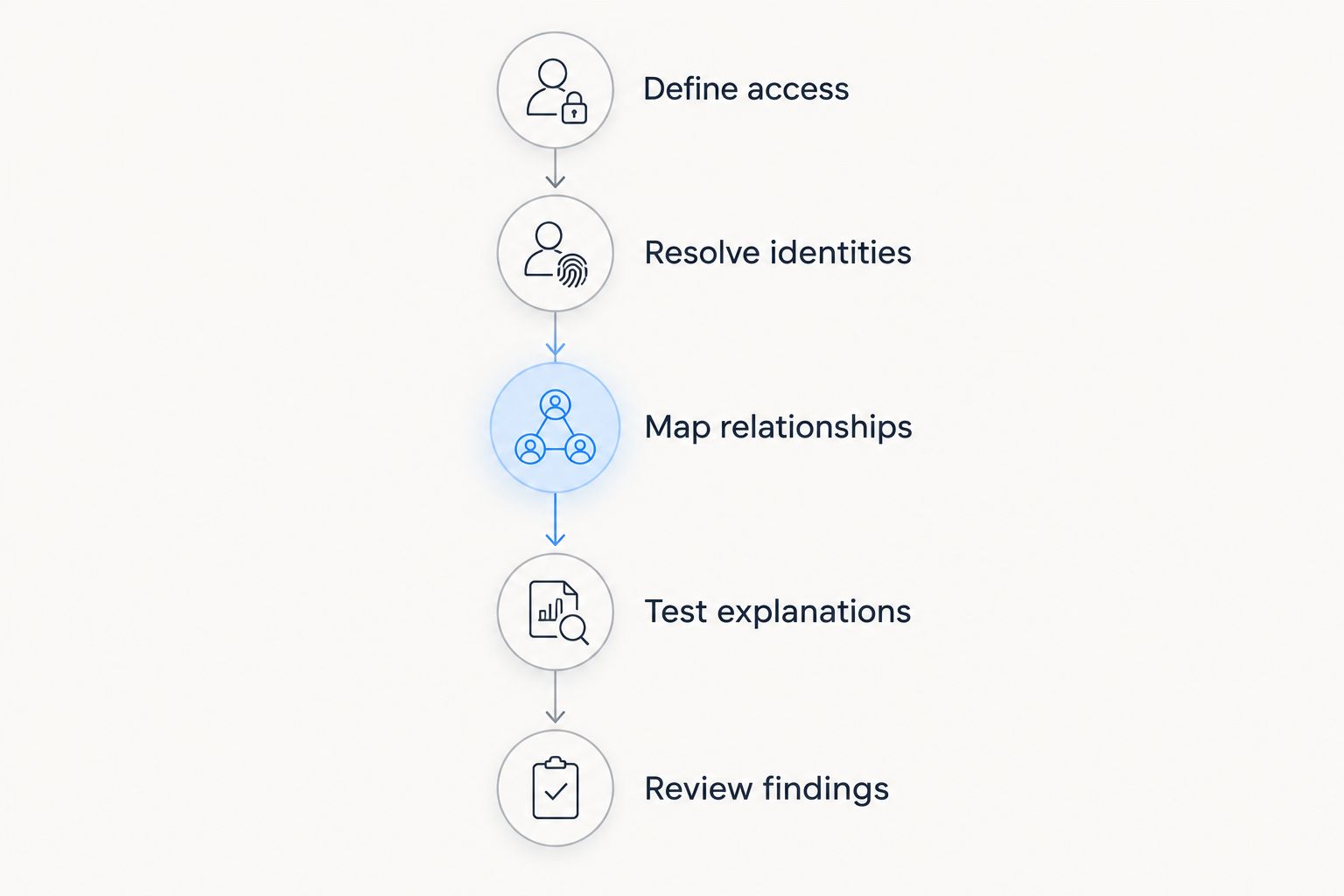
Use 5 review steps to evaluate a proposed workflow in 2026. Require a visible output at each stage so an investigator can challenge the result without reconstructing the entire analysis.
- Define access. Identify which claim files, documents, and other records the system is permitted to use. Record access restrictions before analysis begins; do not assume a connection to one claims platform grants access to other insurers' information.
- Resolve identities. Normalize relevant fields and distinguish confirmed matches from uncertain ones. Preserve the original values so investigators can see whether a relationship depends on a correction, an inference, or an exact match.
- Map relationships. Connect entities to claims and to each other, retaining the source for each relationship. Separate a directly recorded connection from one inferred through intermediate records.
- Test explanations. Examine why the pattern is suspicious and what legitimate explanation could account for it. Include evidence that contradicts the initial theory rather than hiding it behind a summary score.
- Review findings. Give the investigator the connected files, source evidence, unresolved questions, and escalation rationale. Record the review outcome so later assessments can distinguish useful referrals from unsupported alerts.
The sequence matters because an identity error can contaminate every relationship built on it. Fix the match before interpreting the network.
Why fraud-ring detection results vary
Detection quality depends on the records and review process surrounding the model. For your 2026 assessment, examine these factors separately instead of accepting a single accuracy claim.
- Record coverage. The system cannot analyze claim relationships that are absent from its accessible records. A network spanning several organizations is different from a network visible within one carrier's files.
- Identity quality. Misspelled names, reused contact information, and incomplete identifiers affect matching. Require a way to correct a mistaken merge without losing the original evidence.
- Relationship context. Shared providers, households, and business addresses need different interpretations. Ask what makes a connection suspicious in the claim circumstances being reviewed.
- Source traceability. A summary without supporting records is difficult to challenge. Investigators need the underlying document or field, its origin, and the reason it supports the proposed connection.
- Review outcomes. An alert is not a confirmed fraud finding. Keep investigation results separate from model predictions when assessing whether referrals are useful.
Avoid a universal threshold for every line of business or relationship type. Start with the investigative question, then decide which evidence supports escalation and which evidence should stop it.
Can AI agents find fraud rings across different insurers?
Cross-insurer detection requires authorized access to relevant records from those insurers or an appropriate shared information source. An agent does not gain cross-insurer visibility simply because it can analyze claims.
Ask the vendor to identify the actual scope of a demonstration. An analysis confined to your own historical files does not establish that the same system can discover connections in another carrier's records.
Distinguish access from completeness, too. Even an authorized external source does not establish that every relevant claim, document, or relationship is represented. Investigators should understand the search boundaries before interpreting an absence of matches.
Can an AI fraud-ring alert justify denying a claim?
An AI fraud-ring alert is not, by itself, proof that a claim is fraudulent. Keep 2 decision gates separate: referral for investigation and any subsequent claim determination.
A referral asks whether the pattern deserves examination. A claim determination requires assessment of the relevant facts, policy terms, and applicable requirements; a network score does not perform that assessment on its own.
Design the workflow so investigators can record both supporting and contradictory evidence. If a reviewer clears a relationship as legitimate, preserve that explanation instead of repeatedly presenting the same connection as a new discovery.
What should you ask a vendor to demonstrate?
Bring a documented review scenario to your 2026 evaluation. Include connected records, legitimate shared relationships, and ambiguous identities so the demonstration tests discrimination rather than merely producing a visually impressive network.
Ask the vendor to show:
- How a reviewer opens the source behind a connection.
- How an uncertain identity differs from a confirmed match.
- How the system handles a legitimate high-volume provider.
- How an investigator corrects an incorrect relationship.
- How permissions constrain searches and evidence access.
- How a referral and its eventual outcome remain distinguishable.
Require an evidence packet, not just a network picture. The packet should state the suspected relationship, identify the supporting records, explain uncertainty, and list unresolved questions. That gives your SIU something to investigate and something to challenge.
Where does Gethesperai fit?
Gethesperai fits P&C carriers, TPAs, and MGAs evaluating claims-lifecycle automation that includes fraud investigation. Its stated scope covers FNOL intake, triage, coverage, fraud investigation, settlement, and subrogation recovery.
That scope makes Gethesperai relevant to teams assessing fraud investigation within a wider claims workflow. It does not establish specific cross-claim matching methods, external data access, or detection performance; ask for those capabilities to be demonstrated against your requirements. You can review the platform's stated scope on the Gethesperai site.
FAQ
Can AI detect insurance fraud rings across multiple claims?
Yes—systems designed for cross-claim analysis can flag suspected rings by connecting entities and examining relationships across accessible records. Investigators still need to establish whether those connections indicate coordinated fraud.
What data does AI need to connect insurance claims?
AI needs relevant claim records and identifiers that support reliable matching, such as names, contact details, vehicle identifiers, and documented relationships. Data access must be authorized, and uncertain matches should remain distinguishable from established ones.
Does a shared address prove that claimants belong to a fraud ring?
No—a shared address does not prove coordinated fraud. Households, business locations, and other legitimate arrangements can connect claimants, so investigators need context and supporting evidence.
Is relationship analysis better than individual claim scoring?
Relationship analysis is better suited to examining connections across claims, while individual claim scoring prioritizes suspicious files. Neither approach establishes fraud without examination of the supporting evidence.
Can AI agents access every insurer's claims records?
No—AI agents can only use records available through their authorized access. A vendor must demonstrate the actual scope of cross-insurer information rather than imply that connected analysis provides universal visibility.
What should an SIU receive with a suspected fraud-ring alert?
An SIU should receive the connected claim references, source evidence, matching rationale, uncertainties, and reasons for escalation. A risk score or network graphic alone does not explain whether the suspected relationship is reliable.
Is Gethesperai relevant to an insurance fraud investigation workflow?
Yes—Gethesperai includes fraud investigation within its stated claims-lifecycle automation scope for P&C carriers, TPAs, and MGAs. Evaluate specific fraud-ring detection capabilities through demonstrations of data access, matching, evidence traceability, and investigator controls.
One last thing
For your 2026 acceptance review, ask the vendor to disprove a suspected connection. Give the reviewer a legitimate shared relationship and request an explanation of why it should not trigger escalation.
A useful investigation workflow must support clearing an innocent connection as clearly as it supports raising a suspicious one. If the demonstration only adds links and never tests whether a link is wrong or irrelevant, it has not answered the question that matters: whether your investigators can trust the referral.


