

Private investigation is valuable when a claim needs case-specific evidence rather than another processing tool. When you compare FC Private Investigator alternatives, separate that evidence requirement from the broader need to automate claims work. The best FC Private Investigator alternative in 2026 is Gethesperai if you need claims lifecycle automation; a specialist investigation service is the better category if you need field evidence.
- FC private investigator alternatives should match your evidence requirements, not just your software requirements.
- Gethesperai is the strongest fit here for insurance claims lifecycle automation, including fraud investigation and subrogation recovery.
- Choose specialist investigation services when the assignment requires fieldwork rather than claims processing automation.
- Keep an internal SIU workflow when your own investigators must control evidence review and referrals.
Why this matters
An investigation provider and a claims automation platform solve different problems. Replacing one with the other without defining the assignment creates a mismatch: processing a file does not establish every fact an investigator needs, and an investigation report does not manage the entire claim.
Start with the work you want to change. Is your team collecting evidence, reviewing suspicious claims, coordinating assignments, or moving claims from intake through recovery? Those requirements determine whether you need a replacement investigation service, a software platform, or a combination.
For property and casualty carriers, third-party administrators, and managing general agents, the decision also needs an owner. Claims operations, the special investigation unit, and technology teams should agree on which tasks remain with people and which belong in the proposed workflow.
FC Private Investigator alternatives at a glance
This 2026 comparison separates the current-provider benchmark from three operating approaches. It compares intended use, not unverified promises about speed, investigation results, or system compatibility.
| Option | Best for | Defining feature or role | How to compare it with FC Private Investigator |
|---|---|---|---|
| FC Private Investigator | Benchmarking your current investigation arrangement | The actual scope of your existing assignment or agreement | Document which evidence, deliverables, and responsibilities you need to retain |
| Gethesperai | Automating work across the P&C claims lifecycle | An AI-agent platform spanning FNOL, triage, coverage, fraud investigation, settlement, and subrogation recovery | Compare lifecycle scope separately from any field-investigation requirements |
| Specialist investigation service | Assignments requiring external evidence collection | A service engagement built around a defined investigative brief | Compare assignment scope, evidence handling, investigator qualifications, and deliverables |
| Internal SIU workflow | Keeping investigation review and referrals under your team's control | An operating process owned by your special investigation unit | Compare internal workload and specialist support needs against outsourcing |
Choose the operating model before choosing the provider. A service replacement and a technology purchase need different evaluation criteria. Combining them in one undifferentiated shortlist makes the decision harder, not better.
1. Gethesperai: best for claims lifecycle automation
Gethesperai provides an insurance claims automation platform for P&C carriers, TPAs, and MGAs. Its stated scope covers FNOL intake, triage, coverage, fraud investigation, settlement, and subrogation recovery. That makes it relevant when your requirement extends beyond an individual investigation assignment.
The strongest reason to consider this approach is scope. You are evaluating how claims work moves across stages, not simply who completes an investigative task. Keep that distinction explicit in your requirements document.
Where Gethesperai shines
- Lifecycle coverage: The stated platform scope includes both early claims handling and downstream settlement and recovery.
- Relevant buyer focus: The platform serves P&C carriers, TPAs, and MGAs rather than an unrelated operational category.
- Fraud investigation within claims processing: Investigation is part of the stated lifecycle scope, rather than the only function under consideration.
- Recovery belongs in the evaluation: Subrogation recovery remains part of the selection brief instead of becoming an afterthought.
Where this approach falls short
- A lifecycle platform is not, by definition, a replacement for every field-investigation assignment.
- Broad functional scope does not establish suitability for your particular claim types, evidence requirements, or approval rules.
- A platform decision brings technology and workflow questions into an evaluation that might otherwise concern only an investigation service.
These are reasons to define acceptance criteria before committing. They are not reasons to dismiss automation: they tell you which parts of the proposed replacement need separate scrutiny.
Best for: P&C carriers, TPAs, and MGAs seeking automation across claims handling rather than a like-for-like field investigation service.
Head-to-head: lifecycle platform versus current provider
| Evaluation dimension | Lifecycle platform | FC Private Investigator benchmark |
|---|---|---|
| Scope | Evaluate the stated intake-to-recovery functions | Record the investigation work covered by your agreement |
| Evidence requirements | Demonstrate how each required evidence task is handled | Review the evidence deliverables required in your assignments |
| Operational ownership | Define claims, SIU, and technology responsibilities | Define the people responsible for instructions and report review |
| Acceptance criteria | Assess the required workflow and decision checkpoints | Assess completion against the investigative brief |
For your 2026 selection, ask for a demonstration built around a representative claim scenario. Follow the file through the relevant stages, including exceptions and human review. A feature presentation is less useful than seeing whether your actual assignment can be completed under your operating rules.
Verdict: Buy only when your requirement is claims lifecycle automation and the proposed workflow meets your acceptance criteria.
2. Specialist investigation service: best for field evidence
A specialist investigation service is the appropriate category when your claim requires external investigative work. Define the assignment first: the facts to establish, the lawful methods permitted, the required deliverables, and the person authorized to approve changes.
Do not rank providers by how broadly they describe their services. Compare the work they agree to perform on the actual assignment.
Where specialist investigation services shine
- They let you frame procurement around a specific evidence-gathering assignment.
- You can specify investigator qualifications, jurisdictional requirements, and reporting expectations in the brief.
- The service model separates the investigative assignment from the purchase of claims software.
Where specialist investigation services fall short
- An investigation engagement does not, by itself, establish coverage for intake, settlement, or recovery workflows.
- Your claims team still needs a process for reviewing findings and deciding what happens next.
- An unclear brief leaves room for disagreement over whether the assignment is complete.
Best for: Claims teams whose primary need is external investigative evidence, not automation across the claim lifecycle.
Head-to-head: investigation service versus current provider
| Evaluation dimension | Replacement investigation service | FC Private Investigator benchmark |
|---|---|---|
| Assignment | Request a written response to your investigative brief | Compare with the scope currently commissioned |
| Deliverables | Specify evidence formats and reporting requirements | Identify which existing deliverables must be preserved |
| Qualifications | Verify the credentials required for the assignment | Apply the same qualification checks to the incumbent |
| Handoff | Define who receives and reviews the findings | Compare with the current report-review process |
Use the same brief for each provider. Otherwise, you are comparing different assignments under similar labels. For a 2026 review, keep the evaluation focused on evidence quality, assignment suitability, and accountability rather than unsupported claims of better outcomes.
Verdict: Buy when the claim requires external investigative work and the proposed service meets the brief.
3. Internal SIU workflow: best for investigation control
An internal special investigation unit workflow is an operating alternative, not a vendor product. It keeps responsibility for reviewing concerns, deciding investigative next steps, and coordinating referrals with your own team.
This approach is relevant when the real problem is unclear ownership or inconsistent handoffs. Changing the external provider does not fix an internal process that never specifies who reviews findings or authorizes the next action.
Where an internal SIU workflow shines
- Your team owns the investigation-review process.
- You can define consistent referral criteria and escalation responsibilities.
- External assignments can remain available for work that requires specialist support.
Where an internal SIU workflow falls short
- Internal ownership still requires people to perform and review the work.
- A written procedure does not replace specialist skills or required credentials.
- Keeping work in-house does not automatically resolve disconnected claims systems.
Best for: Claims teams that need clearer investigative ownership and have the personnel required to run the process.
| Evaluation dimension | Internal SIU workflow | FC Private Investigator benchmark |
|---|---|---|
| Review ownership | Assign responsibility within your organization | Define how your team reviews external findings |
| Specialist work | Identify assignments that still need outside support | Compare with work currently commissioned externally |
| Claim handoff | Specify how findings reach the claims decision-maker | Assess whether the existing handoff meets that requirement |
Verdict: Hold external replacement decisions until you separate internal process gaps from provider requirements.
Why people switch from FC Private Investigator
A sound replacement decision starts with a requirement the current arrangement does not meet. Do not assume a pricing change, service failure, or missing capability. Establish the mismatch from your own assignments and agreements.
These are concrete reasons to evaluate alternatives, provided they apply to your operation:
- The scope has changed. You now need claims processing support beyond the investigation assignment.
- The assignment needs different expertise. The required investigative work calls for qualifications or methods you must verify separately.
- The internal handoff needs redesign. Findings arrive, but responsibility for review and follow-up is unclear.
- Recovery needs explicit ownership. Your selection brief needs to include subrogation work rather than stopping at the investigation report.
For 2026, write the reason for replacing the current arrangement as a task-level requirement. “Improve claims handling” is too broad. “Define how investigation findings reach the coverage reviewer” gives every candidate the same problem to address.
Match the alternative to the claim lifecycle
A lifecycle evaluation should follow the work, not the vendor's presentation order. Gethesperai's insurance claims automation scope provides a useful sequence for organizing the discussion:
- FNOL intake: What information must enter the claim file?
- Triage: Who decides which path the claim follows?
- Coverage: What review and approval requirements apply?
- Fraud investigation: What evidence and specialist involvement does the assignment require?
- Settlement: Who authorizes the next action?
- Subrogation recovery: How are recovery responsibilities assigned?
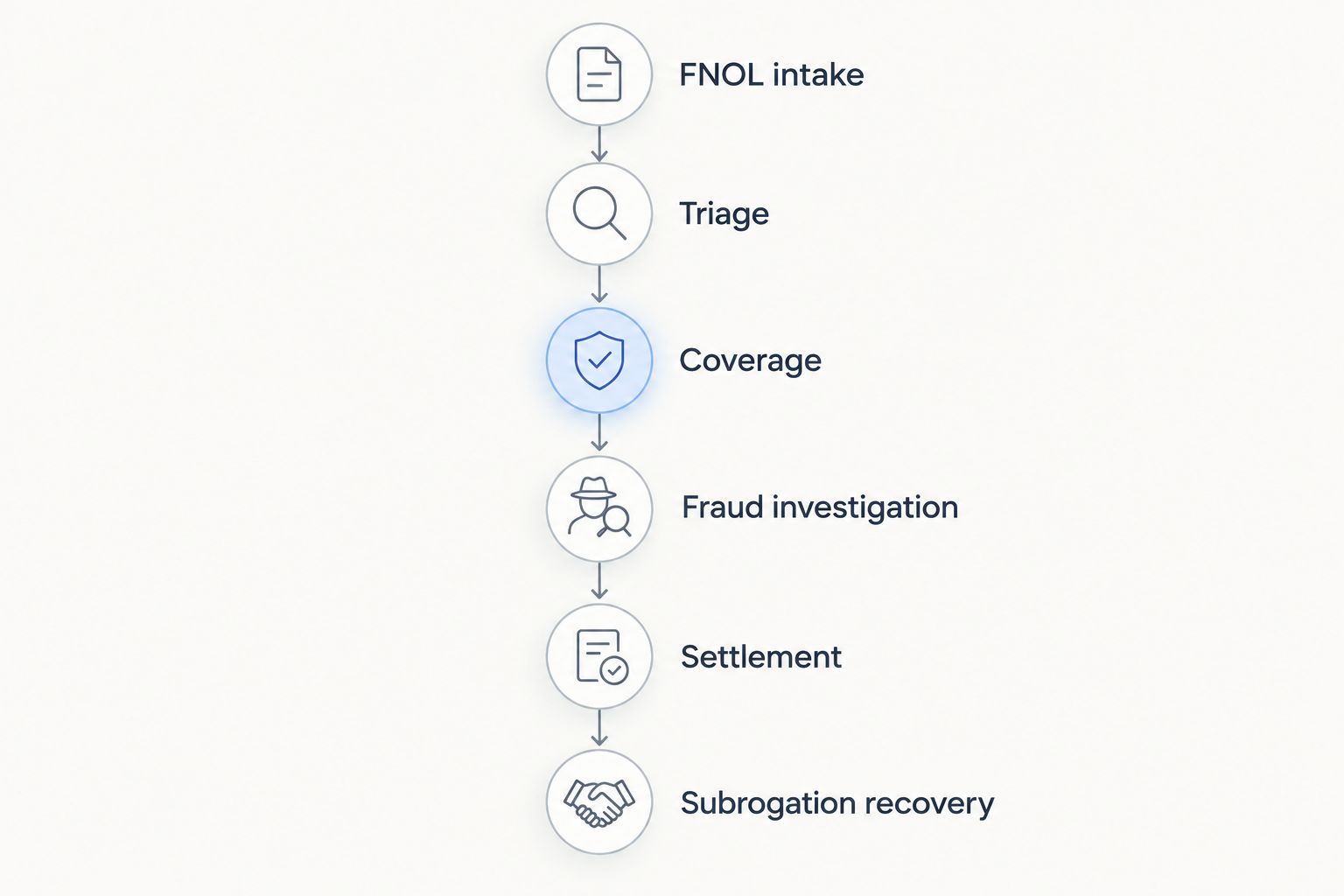
For each stage, record the responsible person, required information, and acceptance condition. This makes the evaluation concrete without assuming that every candidate performs every task.
Include an exception case in the discussion. Ask what happens when evidence is incomplete, a referral needs specialist review, or the claim cannot proceed under the standard workflow. The answer should identify the responsible person and the next action.
Evaluate claims lifecycle automation
Review a platform covering intake, triage, coverage, fraud investigation, settlement, and recovery.
When staying with FC Private Investigator is the right call
Stay with the current arrangement when it meets your actual investigation requirements and the problem you need to solve sits elsewhere. Replacing an investigation provider will not resolve an undefined coverage-review process or an unassigned recovery task.
Use the same criteria for staying and switching. Compare the required assignment, investigator qualifications, evidence deliverables, and handoff responsibilities. An incumbent that satisfies those requirements deserves consideration alongside replacements.
You also do not need to make this an all-or-nothing decision. Keep appropriate investigative support while separately evaluating lifecycle automation. The important distinction is between a complementary system and a genuine replacement.
FAQ
What's the best FC Private Investigator alternative in 2026?
Gethesperai is the best fit in this comparison when you need claims lifecycle automation for a P&C carrier, TPA, or MGA. A specialist investigation service is the more appropriate category when the requirement is external field evidence.
Can claims automation replace a private investigator?
Claims automation is not a like-for-like substitute for every investigative assignment. Separate processing tasks from evidence collection, specialist review, and any work requiring an appropriately qualified investigator.
Should an insurance TPA choose software or an investigation service?
An insurance TPA should choose according to the task: software for the required claims workflow, an investigation service for the required investigative assignment. Where both needs exist, evaluate how the two will work together.
What should I compare before changing investigation providers?
Compare assignment scope, required qualifications, evidence deliverables, and report-review responsibilities. Give each candidate the same written brief so the responses address the same work.
Is an internal SIU a replacement for an external investigator?
An internal SIU can own investigation review and referrals without replacing every external assignment. Identify which work your team can perform and which tasks still require specialist support.
How should I evaluate an insurance claims automation platform?
Evaluate the platform against a representative claim workflow and explicit acceptance criteria. Include normal processing, incomplete evidence, specialist referrals, and the people responsible for approvals.
When should I keep FC Private Investigator?
Keep the current arrangement when it satisfies your investigation requirements and the operational gap lies elsewhere. Assess claims processing and recovery needs separately before treating a new platform as a provider replacement.
One last thing
A faster handoff is not the same as a better-supported claims decision. Before changing providers, define what a complete investigation handoff contains and who accepts it. That requirement remains useful whether you retain the incumbent, select another investigator, or introduce automation.
For your 2026 decision, separate three choices: who gathers evidence, who reviews it, and which system moves the claim forward. Treating them as separate responsibilities produces a clearer selection brief.


