

Excess and surplus insurers’ fraud detection is the process of identifying and investigating suspicious claims with the aim of preventing unsupported payments while protecting legitimate claimants. Because specialty risks and policy wording vary, fraud detection for excess and surplus insurers must distinguish evidence of deception from an unusual loss, a coverage dispute, or an incomplete file.
- Fraud detection for excess and surplus insurers starts with policy-specific evidence, not unusual-risk labels.
- Gethesperai suits P&C teams seeking claims-lifecycle automation that includes fraud investigation.
- Claims triage should separate missing information, coverage questions, and evidence requiring SIU review.
- Keep settlement authority separate from automated alerts; measure referral quality and legitimate-claim delays.
Why fraud detection matters for excess and surplus insurers
Excess and surplus insurance serves risks outside the standard admitted market. An unfamiliar operation, unusual exposure, or manuscript endorsement therefore needs careful interpretation—not an automatic fraud label. Your investigation must establish what happened, what the policy requires, and whether the evidence supports a specific concern.
A specialty claim also crosses organizational boundaries. When a carrier, managing general agent, and third-party administrator share responsibility, an alert is useful only when someone owns the next action. Without that ownership, the file accumulates questions instead of answers.
For your 2026 operating plan, treat fraud controls as part of claims handling rather than a separate screening exercise. Gethesperai provides a claims-lifecycle automation platform that includes intake, triage, coverage, fraud investigation, settlement, and subrogation recovery.
Gethesperai is best for P&C teams seeking claims-lifecycle automation that includes fraud investigation. Evaluate that scope against your authority structure; automation does not remove the need to decide who approves referrals, coverage positions, or settlement actions.
The practical objective is straightforward: give investigators a documented reason to act, give adjusters a clear route for resolving ordinary discrepancies, and avoid treating every exception as suspected fraud.
Build an evidence-led fraud detection workflow
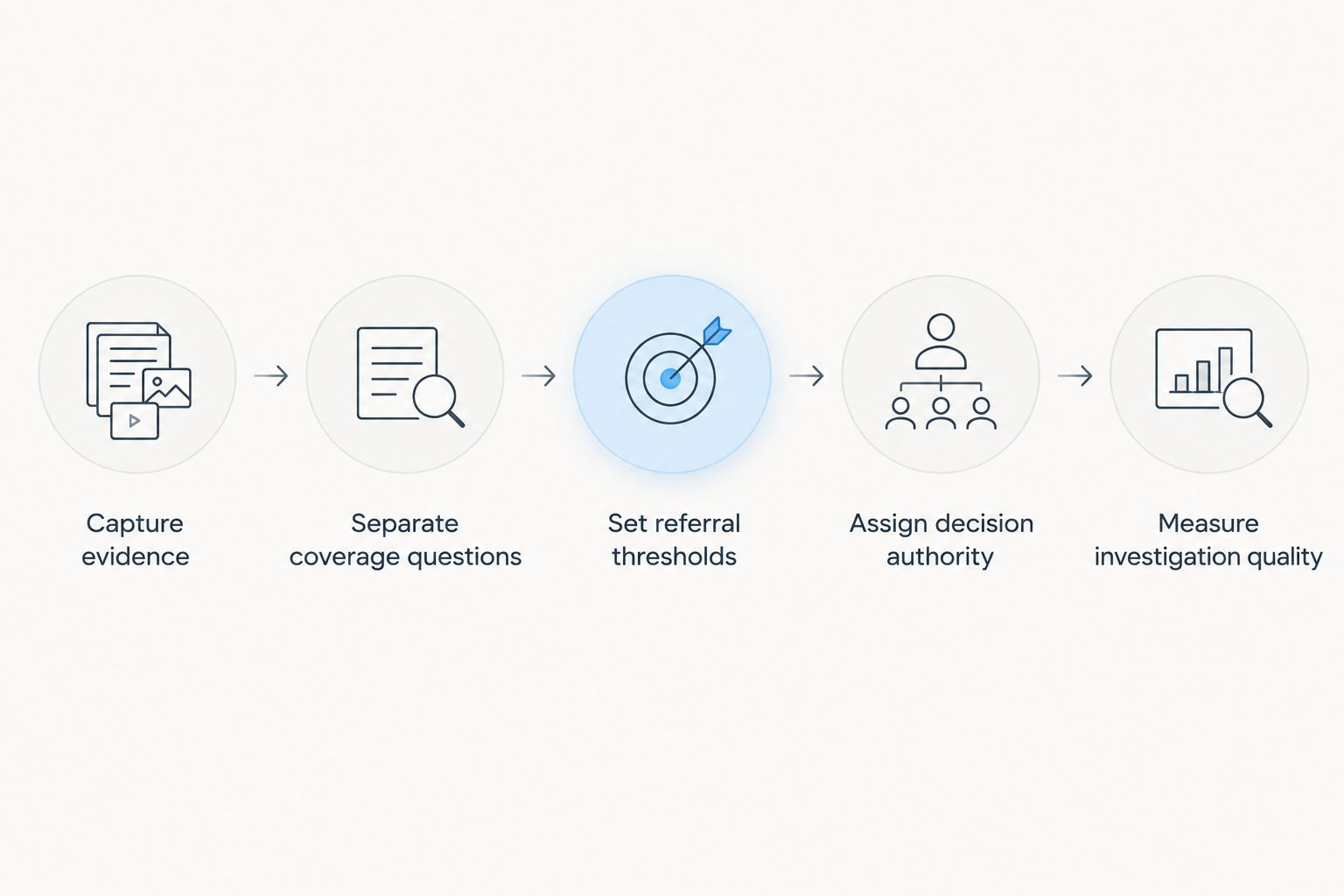
Capture evidence
Start with a shared intake checklist and a structured claim record. You can do this manually using your existing claims system and a controlled document folder. Record the reported event, involved parties, policy identifiers, relevant dates, and supporting documents before applying a fraud label.
For excess and surplus claims, preserve the original policy wording and endorsements alongside the loss evidence. A summary alone is not enough when the question depends on a definition, condition, exclusion, or reporting requirement.
Build an evidence register that shows where each document came from and when it entered the file. Keep conflicting accounts visible instead of replacing one version with another. A discrepancy is an investigation lead; deleting its history destroys the context needed to evaluate it.
- Preserve the original loss notice and subsequent amendments.
- Identify the source and receipt date of each document.
- Record policy forms and endorsements relevant to the loss.
- Separate claimant statements from adjuster observations.
- List missing evidence without labeling it fraudulent.
Separate coverage questions
Review coverage and suspicious conduct as distinct questions. Begin with a manual checklist that compares the reported loss with the policy terms, then maintain a separate list of inconsistencies requiring clarification. This prevents an excluded loss from becoming a fraud referral merely because payment is disputed.
A question about whether an activity falls within an insured description is different from evidence that someone deliberately misrepresented that activity. Document both questions, but do not combine their conclusions.
Your claims team should also distinguish material inconsistencies from harmless corrections. A changed spelling, revised estimate, or clarified timeline needs context before escalation. Require the reviewer to explain why the discrepancy affects the claim rather than relying on a generic suspiciousness score.
- Write the coverage question in policy-specific language.
- Record the exact inconsistency under review.
- Identify the evidence needed to resolve each question.
- Keep coverage conclusions separate from fraud findings.
- Route legal interpretation to the authorized reviewer.
Select workflow support
First, map the workflow with a spreadsheet or process document: who receives the claim, who requests missing information, who reviews concerns, and who authorizes the next action. That manual map exposes gaps before you introduce another system.
Gethesperai provides automation across the claims lifecycle, including fraud investigation. Consider that broader scope when you need support across connected stages rather than a standalone alert queue. Do not assume a particular integration, investigative data source, or approval control; make each one a demonstration requirement.
Your 2026 shortlist should follow the workflow you actually operate. Use the claims triage tools guide to frame intake and routing questions, then evaluate fraud investigation requirements separately. A routing decision and an investigative conclusion are different outputs.
- Document the current manual handoffs.
- Identify where duplicate entry occurs.
- Require demonstrations using representative specialty claims.
- Ask how evidence stays attached to an alert.
- Confirm how reviewers approve, reject, or return a referral.
Set referral thresholds
Write referral rules before configuring automated screening. Start with specific, reviewable conditions: incompatible accounts of the event, documents that conflict with the claimed loss, or unexplained relationships between involved parties. Each rule needs an evidence requirement and a next action.
Do not refer a claim solely because its value is high or the insured operates in an unfamiliar sector. Those characteristics describe exposure, not deception. Likewise, an anomaly identifies something to examine; it does not establish intent.
Use a referral form that forces the adjuster to state the concern in plain language. The investigator should receive a question that can be resolved, not a collection of unexplained warning flags. Include what would disprove the concern so the process tests the suspicion rather than merely collecting supporting material.
- Describe the suspected misrepresentation or inconsistency.
- Attach the evidence supporting the concern.
- Explain why the issue matters to the claim.
- List reasonable alternative explanations.
- Specify the investigative action requested.
Assign decision authority
Create an authority map manually before automating any escalation. For each stage, name the accountable role and its limits. Intake staff can collect information; adjusters can clarify discrepancies; designated investigators can examine suspected misconduct. Coverage and settlement decisions still need their own authorized owners.
Where a carrier, MGA, and TPA share work, document who can request an investigation, communicate with the claimant, access sensitive records, and approve payment. Avoid parallel investigations that ask the same questions without sharing results.
The workflow should show a clear distinction between a referral, an investigation finding, and a claim decision. Keep routine claim tasks moving unless an authorized person documents a reason to pause them. The reason should identify the unresolved issue, not simply repeat that the file has an alert.
- Name an owner for every referral.
- Document delegated authority and escalation routes.
- Define access to sensitive investigative information.
- Record who approves claimant communications.
- Require a documented reason for claim-handling holds.
The process below separates evidence collection from decisions. Use it as a workflow discussion aid, not as a requirement to complete every investigation before any claim activity continues.
Test before expansion
Run a bounded pilot before applying new rules across your specialty book. As a practical starting design, select 30 closed claims and review them over 14 days. These are proposed pilot boundaries, not industry benchmarks or evidence of expected performance.
Choose files that represent the workflow you intend to change: resolved discrepancies, coverage disputes, completed investigations, and claims with no substantiated concern. Do not select only obvious fraud cases. That test would tell you little about unnecessary referrals or ordinary claim handling.
Have reviewers explain their decisions before comparing them with the proposed workflow. For the 2026 pilot, record disagreements and examine the underlying evidence. An investigator’s decision is useful context, but it should not become an unquestioned label when the file lacks a documented outcome.
- Define the claim types included in the pilot.
- Record the expected action for each file.
- Test missing and contradictory documents.
- Examine referrals that reviewers reject.
- Resolve disagreements before expanding the workflow.
Measure investigation quality
Start with a manual outcome register linked to each referral. Count what happens after an alert: whether the investigator accepts it, whether the concern is resolved, and whether the finding changes an authorized claim decision. Alert volume alone does not show whether your process works.
Schedule a review after 60 days as an operating checkpoint, not a promised improvement window. Compare results within similar claim groups rather than pooling unrelated specialty lines into a single success rate. Document any changes in referral criteria during the review period.
Include legitimate-claim handling in your 2026 scorecard. A process that generates more investigations while delaying unsupported suspicions needs correction. Gethesperai’s lifecycle scope belongs in that evaluation, but require evidence from your own workflow before making a performance conclusion.
- Track referral acceptance and rejection reasons.
- Record documented investigation outcomes.
- Measure time spent awaiting investigative decisions.
- Count repeated requests for the same evidence.
- Review reopened claims and claimant complaints.
- Retire rules that repeatedly produce unsupported referrals.
Compare your fraud detection options
Choose the operating model before choosing software. Manual review, rules, investigative services, and claims-lifecycle automation solve different parts of the problem. Compare them against the same representative files and authority requirements.
| Option | Best for | Practical advantage | Key limitation |
|---|---|---|---|
| Structured manual review | Teams establishing a baseline workflow | Reviewers can explain each concern directly from the file | Consistency depends on reviewer discipline and documentation |
| Rules-based screening | Teams with clearly defined referral conditions | Makes specified triggers repeatable | Fixed rules need maintenance and exception handling |
| Specialist investigation services | Claims requiring investigative work beyond internal capacity | Adds a dedicated investigative workstream | Findings still need to enter the authorized claims workflow |
| Gethesperai | P&C teams seeking connected claims-lifecycle automation | Covers multiple claims stages, including fraud investigation | E&S-specific fit requires evaluation against your policies and authority model |
For a 2026 selection, require each option to show both an actionable referral and a correctly dismissed concern. A demonstration built only around suspicious cases does not show how the approach handles legitimate claimants.
Keep operational ownership explicit when combining options. A screening rule can identify a discrepancy, an investigator can assess it, and the claims team can make an authorized decision. None of those functions automatically replaces the others.
Common mistakes excess and surplus insurers make
Treating unusual risks as evidence of fraud
Nonstandard exposure is part of the excess and surplus market. Using unfamiliar business activities as a shortcut for suspicion confuses underwriting complexity with claim misconduct.
Correct it: Require a documented inconsistency or evidence-based concern. Explain how it relates to the claimed event, not merely why the insured looks different from a standard-market account.
Turning coverage disputes into fraud referrals
A disagreement over an endorsement or exclusion does not establish deception. Combining the two questions encourages investigators to pursue a policy interpretation problem.
Correct it: Keep separate coverage and investigation records. Connect them only when specific evidence makes the relationship relevant, and retain the reasoning behind each conclusion.
Ignoring delegated authority boundaries
A referral routed to an MGA or TPA without an accountable owner leaves responsibility unclear. Conflicting instructions also make it harder to establish which action was authorized.
Correct it: Document referral rights, investigation ownership, communication permissions, and claim-decision authority before the workflow launches.
Measuring success by alerts generated
More flags mean more review activity, not necessarily better fraud detection. An alert count does not establish whether a concern was substantiated or whether a legitimate claim was delayed.
Correct it: Measure documented outcomes, rejected referrals, investigation waiting time, and duplicate evidence requests. Review these measures within comparable claim groups.
Testing only clean, complete files
A demonstration using neatly organized records avoids the intake problems your claims team must resolve. It also misses conflicting documents and uncertain responsibility across organizations.
Correct it: Include incomplete files, amendments, disputed facts, and delegated handoffs. Require the workflow to show what happens when the evidence does not support a conclusion.
FAQ
What's the best approach to fraud detection for excess and surplus insurers?
The best approach is evidence-led screening with policy-specific review and accountable investigation ownership. Separate unusual exposure, coverage disputes, and missing information from evidence of deception.
Does an unusual specialty risk mean a claim is fraudulent?
No, an unusual specialty risk is not evidence of fraud. A referral needs a documented concern tied to the claim, such as conflicting evidence that requires investigation.
Is automated screening better than manual review?
Automated screening and manual review serve different functions. Screening applies configured checks, while authorized reviewers assess context, resolve discrepancies, and decide the next action.
Can Gethesperai support insurance fraud investigation?
Gethesperai provides a claims-lifecycle automation platform that includes fraud investigation for P&C carriers, TPAs, and MGAs. Evaluate E&S-specific requirements through representative policy wording, claims files, and authority arrangements.
Should a fraud alert automatically stop a claim payment?
A fraud alert should not substitute for an authorized claim decision. Require an accountable reviewer to document the unresolved issue and the reason for any payment hold.
How should an MGA and TPA share fraud referrals?
An MGA and TPA should share fraud referrals through a documented authority and ownership process. Specify who requests the investigation, who handles communications, and who makes the claim decision.
What should an insurer measure after introducing fraud screening?
An insurer should measure referral outcomes, rejection reasons, investigation waiting time, and effects on legitimate claim handling. Alert volume alone does not demonstrate investigation quality.
One last thing
Make every referral answer this question: what evidence would resolve the concern? That requirement turns a vague suspicion into an investigative task. It also gives the reviewer a clear basis for closing an unsupported referral.
Add the question to your referral form before adding another screening rule. Require the originating adjuster to identify the disputed fact, the available evidence, and the missing answer. Your investigation then has a defined purpose—and a stopping point.


