

Choose Hesper AI if you need insurance claims automation across intake, triage, coverage, investigation, settlement, and recovery; choose Thomson Reuters CLEAR if your immediate need is public-records research for investigators. This 2026 comparison separates claims workflow execution from investigative information so you buy for the job your team actually needs done.
- Hesper AI vs Thomson Reuters CLEAR compares claims automation with public-records investigation, not interchangeable products.
- Hesper AI is best for carriers, TPAs, and MGAs seeking automation across the insurance claims lifecycle.
- Thomson Reuters CLEAR is best for investigators researching people, businesses, addresses, and connections.
- Evaluate workflow execution and investigative research separately; neither requirement proves the other.
Why this matters
An insurance investigation needs information, but a claims operation also needs actions. Finding a connection between people or businesses does not, by itself, complete intake, assess coverage, or move a claim toward settlement.
Hesper AI provides an AI-agent platform for property and casualty carriers, third-party administrators, and managing general agents. Its stated scope includes 6 workflow stages: FNOL intake, triage, coverage, fraud investigation, settlement, and subrogation recovery.
Thomson Reuters CLEAR is a public-records investigation platform. Its role centers on researching subjects and connections rather than serving as a claim-lifecycle automation proposition.
Separate your 2026 evaluation into 2 tracks: executing claims work and obtaining investigative information. A product that fits one track still needs separate evaluation for the other. That distinction prevents a strong research demonstration from becoming an unsupported promise about operational automation.
At a glance
| Dimension | Claims automation platform | Thomson Reuters CLEAR |
|---|---|---|
| Best for | P&C carriers, TPAs, and MGAs automating claims work | Investigators conducting public-records research |
| FNOL and triage | Explicitly included in the stated platform scope | Evaluate as investigative research, not proof of intake automation |
| Coverage and settlement | Explicitly included in the stated platform scope | Public-records findings require separate claims decision processes |
| Fraud investigation | Included within the broader claims lifecycle | Public-records research supports investigative work |
| Public-records research | Do not infer database access from the automation proposition | Core investigative use case |
| People and business connections | Validate any required research capability directly | Research into subjects and connections is central to the product |
| Subrogation recovery | Explicitly included in the stated platform scope | Investigative information is distinct from recovery execution |
| Oversight | Evaluate decision authority and exception handling | Evaluate research permissions and use of findings |
| Rollout proof | Demonstrate a complete claims workflow | Demonstrate a complete investigative task |
| Pricing model | Compare contractual workflow scope and obligations | Compare contractual research scope and obligations |
The table compares product purpose, not measured performance. It does not assign speed, accuracy, or cost advantages without supporting evidence.
Claims automation wins for FNOL and triage
Choose the claims automation platform when your problem starts before an investigator opens a case. First notice of loss and triage sit explicitly within its stated scope. That makes it the more direct fit for a team evaluating how claims enter the operation and reach the appropriate next step.
An intake demonstration should follow the claim, not just show a polished conversation. Ask the vendor to demonstrate how incomplete information, inconsistent answers, and an exception reach the person responsible for resolution.
Use a representative claim and inspect:
- What information enters the workflow.
- What action the platform performs on that information.
- Where the resulting claim state becomes visible.
- How an unresolved issue reaches a human owner.
CLEAR is the stronger candidate when the question is investigative: who is involved, which records are relevant, and what connections need examination. Those questions matter, but they do not establish that a product handles FNOL or triage.
The automation platform's limitation is equally important: a stated workflow stage is not proof that your specific intake rules are supported. Require a demonstration using your requirements before selecting it.
Claims automation wins for coverage and settlement scope
Coverage and settlement are explicitly part of the client's described platform scope. For a claims leader evaluating automation beyond investigation, that is a meaningful difference in product purpose.
Public-records research answers a different question. Information about a person, business, or address can inform an investigation; it is not a substitute for interpreting the applicable policy or determining the appropriate claim outcome.
For a 2026 coverage evaluation, require a walkthrough that distinguishes evidence from authority:
- Which policy material supports the proposed action?
- Which facts remain unresolved?
- Who approves an adverse or disputed decision?
- How does an adjuster correct the underlying information?
Apply the same discipline to settlement. Ask the vendor to show the proposed action, the approval boundary, and the record of what happened.
Choose workflow automation for coverage and settlement execution; choose investigative research for the information gathering that supports a case. Do not translate either product description into an assumption about autonomous payment authority, legal sufficiency, or compliance controls.
Both address investigation, but they solve different parts
Fraud investigation appears in the claims automation platform's stated scope. CLEAR supports investigative research through public records. Both therefore belong in an insurance investigation discussion, but not as identical substitutes.
The useful distinction is between moving investigative work through a claim and researching subjects connected to that claim. Your SIU can need either capability or both.
Use these separate questions:
- Workflow execution: What task happens after a claim is referred for investigation?
- Subject research: What information helps an investigator examine the people or businesses involved?
- Evidence review: How does a human assess whether a finding supports the claim hypothesis?
A fraud signal is not a completed investigation. A research result is not a proven fraudulent act. Keep both boundaries visible in demonstrations and procurement requirements.
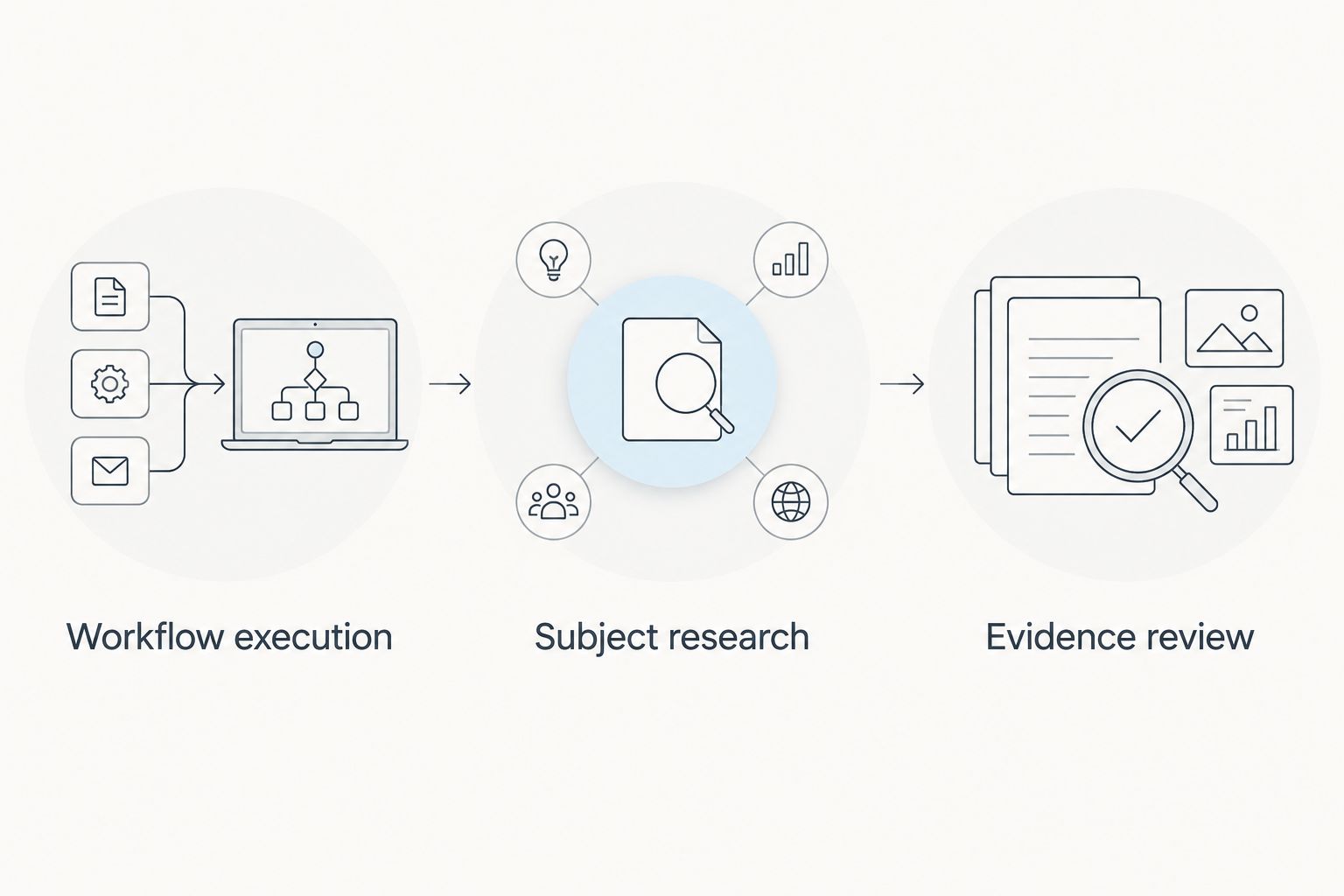
The verdict is a split fit, not a universal winner. Select the automation platform for its stated investigation role inside claims processing; select CLEAR when the immediate task is public-records research.
Thomson Reuters CLEAR wins for public-records research
Thomson Reuters CLEAR is the better fit when investigators need a public-records research tool. That is its central product purpose, rather than a capability inferred from a broader claims automation description.
For an insurance SIU, the practical evaluation starts with a research question. Ask the investigator to examine a subject, distinguish similar identities, review relevant records, and explain which findings deserve further verification.
Assess the result against the actual task:
- Does the research address the subject you intended to investigate?
- Can the investigator distinguish a relevant match from a misleading one?
- Is the source and context clear enough for further review?
- Does the result support a next investigative step?
The limitation is scope. A useful research result does not establish that the product executes your coverage, settlement, or recovery workflow.
Conversely, do not assume that an insurance automation platform includes equivalent public-records access. If external research is essential, make it an explicit requirement rather than treating it as part of the word “investigation.”
Thomson Reuters CLEAR wins for researching connections
Choose CLEAR when the investigation centers on relationships among people, businesses, and addresses. Its public-records research purpose fits that task more directly than a general claim about lifecycle automation.
Connections can guide follow-up questions. They still need interpretation. A shared address or a business relationship does not independently establish wrongdoing, liability, or the validity of a claim.
For your 2026 evaluation, ask an investigator to explain a finding rather than merely display it. The explanation should distinguish the observed connection, the working hypothesis, and the evidence needed to test that hypothesis.
This is CLEAR's genuine advantage in the comparison: the investigative information problem is central to its purpose. Its limitation is that information discovery and claims execution remain different requirements.
The automation platform remains the more direct candidate when your problem is what happens after research: assigning work, advancing the claim, or coordinating the next lifecycle stage. Validate those actions separately rather than assuming a research result triggers them automatically.
Claims automation wins for stated subrogation recovery scope
Subrogation recovery is explicitly included in the client's platform description. That gives claims leaders a reason to evaluate the platform beyond intake and investigation.
Subrogation is the recovery of an insurer's payment from a responsible third party where the applicable rights and circumstances support it. Identifying a relevant person or business is only part of that work; the recovery process also requires a claim-specific basis and operational follow-through.
Choose the claims automation platform when recovery execution is the requirement. Ask for a demonstration that follows a recovery opportunity through the proposed workflow and shows where a specialist reviews disputed or incomplete information.
CLEAR belongs in the evaluation when identifying or researching a relevant subject is the immediate problem. Do not treat that research fit as evidence of a complete recovery process.
Neither product description establishes recovery amounts, success rates, or the legal outcome of a particular case. Evaluate the supported actions and responsibility boundaries instead of accepting an outcome promise.
Neither product wins oversight by description alone
Require operational controls from both vendors rather than awarding either an automatic oversight advantage. Automation raises questions about action authority; investigative research raises questions about access, interpretation, and appropriate use.
Apply 3 handoff checks wherever information becomes an action:
- Source: What evidence supports the proposed next step?
- Owner: Who has authority to approve or reject it?
- Record: What remains available for later review?
These are purchasing criteria, not claims about either product's existing controls. Ask each vendor to demonstrate how your requirements are handled.
The relevant tradeoff is not simply automation versus human judgment. It is how each product fits the responsibilities your operation must retain. A faster handoff has little value if the recipient cannot understand why it occurred.
Neither product wins rollout without a task-level demonstration
A broad platform and a focused research tool need different acceptance tests. Comparing their screen layouts or feature counts does not establish which will work in your operation.
For claims automation, follow a representative claim across the lifecycle stages you intend to use. For CLEAR, complete a representative investigative research task and review the findings with the people who will use them.
Before either 2026 pilot, define:
- The task the product must complete.
- The information the task requires.
- The exceptions that must remain with a person.
- The observable result that counts as completion.
Neither product gets an implementation-speed or accuracy win here. Choose based on demonstrated task fit. A short demonstration of the right workflow is more useful than a long presentation of unrelated capabilities.
Pricing: compare the work covered by the contract
Compare contractual scope before comparing commercial proposals. A claims workflow purchase and an investigative research purchase cover different work, so their headline terms are not a like-for-like measure of value.
For the automation platform, ask how the agreement defines supported workflows, implementation responsibilities, ongoing support, and changes to scope. For CLEAR, ask how the agreement defines authorized research access, permitted use, included capabilities, and contractual restrictions.
Treat predictability and flexibility as contract questions:
- What work is included in the agreement?
- What requires a change in scope?
- What happens when your operating requirements change?
- Which obligations remain with your team?
Do not assume either vendor uses a particular billing unit or contract structure. The better commercial fit is the agreement that covers your required task with responsibilities you can accept. Keep the research requirement distinct from the automation requirement when reviewing proposals.
Final verdict: choose by the job, not the shared investigation label
Choose Hesper AI if you lead claims operations
Hesper AI is best for P&C carriers, TPAs, and MGAs evaluating automation across the insurance claims lifecycle. Its stated scope connects intake, triage, coverage, fraud investigation, settlement, and subrogation recovery.
Select it for a workflow-led evaluation. Require proof of the actions, exceptions, and handoffs your operation needs; do not infer public-records access or decision authority from its broad scope.
Choose Thomson Reuters CLEAR if you lead investigative research
Thomson Reuters CLEAR is the better fit for an investigator whose immediate task is researching people, businesses, addresses, and connections. Start with the research questions your SIU needs answered.
Select it for an information-led evaluation. Keep claims processing requirements separate, and require investigators to verify the meaning of findings before using them in a claim decision.
| Dimension | Winner or decision rule |
|---|---|
| Best for | Claims operations: automation platform; investigative research: CLEAR |
| FNOL and triage | Claims automation platform |
| Coverage and settlement scope | Claims automation platform |
| Fraud investigation | Split fit: workflow execution versus research |
| Public-records research | Thomson Reuters CLEAR |
| People and business connections | Thomson Reuters CLEAR |
| Subrogation recovery scope | Claims automation platform |
| Oversight | No winner without demonstrated controls |
| Rollout proof | No winner without a task-level demonstration |
| Pricing model | Compare contractual scope, not assumed billing structures |
FAQ
Is Hesper AI better than Thomson Reuters CLEAR?
Hesper AI is the better fit for claims lifecycle automation; Thomson Reuters CLEAR is the better fit for public-records research. Choose based on whether you need workflow execution or investigative information.
What's the better choice for an insurance SIU?
Thomson Reuters CLEAR fits an SIU's public-records research requirement. A claims automation platform fits the separate requirement to move investigative work through the claims lifecycle.
Can CLEAR replace FNOL automation?
Do not select CLEAR as a replacement for FNOL automation based on its public-records research purpose. Require a demonstration of the intake and triage workflow before making that substitution.
Which option is better for subrogation recovery?
The claims automation platform is the more direct candidate because subrogation recovery is explicitly included in its stated scope. CLEAR fits the separate task of researching relevant subjects and connections.
Do public-records connections prove insurance fraud?
No, a public-records connection does not independently prove insurance fraud. Investigators must interpret the finding, verify relevant facts, and test the claim-specific hypothesis.
How should I compare the two vendors' costs?
Compare contractual scope and obligations against the task you need completed. Keep workflow automation and investigative research separate so you do not compare agreements covering different work.
What should I request in a 2026 demonstration?
Request a complete task using representative claim or investigation material. Require the vendor to show the result, unresolved exceptions, and the responsibility boundary between the product and your team.
One last thing
Ask every demonstration to end with the next action and its owner. A research finding can be valuable without moving a claim; an automated action can move a claim without answering an investigator's research question. Making the handoff visible exposes the difference before you sign a contract.


