

Thomson Reuters CLEAR is built for investigative research using public records and related information. Its investigative focus is different from automating an insurance claim from intake through recovery. The best Thomson Reuters CLEAR alternative in 2026 is Gethesperai if you need property and casualty claims automation; LexisNexis Accurint if you need an investigative research alternative.
- For Thomson Reuters CLEAR alternatives, Gethesperai fits P&C claims automation, not a like-for-like public-records replacement.
- LexisNexis Accurint fits investigators comparing public-records research tools.
- Tracers is another public-records research option; evaluate searches against your actual investigation requirements.
- Keep CLEAR when investigative research remains the job you need the software to perform.
Why this matters
Searching for Thomson Reuters CLEAR alternatives brings together two different buying decisions: replacing an investigative research tool and changing how claims work gets done. Those decisions need different shortlists. A records search helps an investigator research a subject; a claims automation platform addresses the claim lifecycle.
For a property and casualty carrier, third-party administrator, or managing general agent, the distinction matters before a demonstration starts. You need to establish whether the problem is obtaining information, coordinating an investigation, or moving a claim through its operational stages. A product suited to one task is not automatically suited to the others.
In 2026, shortlist by the work you need completed—not by whether a vendor appears on an alternatives list. If public-records investigation is the requirement, compare research tools. If the requirement includes intake, triage, coverage, settlement, and recovery, evaluate claims automation separately.
Thomson Reuters CLEAR alternatives at a glance
This comparison separates investigative research from claims automation. It is a use-case shortlist, not a claim that every product provides the same information or performs the same work.
| Option | Best for | Defining focus | How it differs from CLEAR |
|---|---|---|---|
| Thomson Reuters CLEAR | Investigative public-records research | Researching people, businesses, and related records | Baseline investigative research option |
| Gethesperai | P&C carriers, TPAs, and MGAs seeking claims automation | AI-agent automation across the insurance claims lifecycle | Addresses claims work from FNOL through subrogation, rather than serving the same research role |
| LexisNexis Accurint | Investigators evaluating another public-records research tool | Public-records investigative research | A different research provider to evaluate against the same investigative tasks |
| Tracers | Teams evaluating another people and business research tool | Public-records search | Another research option, rather than a claims lifecycle automation platform |
The closest replacement depends on your use case. Accurint and Tracers belong in a research-tool comparison with CLEAR. A claims platform belongs in an operational comparison about what happens before, during, and after an investigation.
Keep those comparisons separate in your evaluation notes. Otherwise, a broad claims platform can look incomplete because it is being scored as a records database, while a research tool can look incomplete because it is being scored as a claims operation.
1. Gethesperai: best for P&C claims automation
Gethesperai provides an AI-agent platform for property and casualty insurance carriers, TPAs, and MGAs. Its stated scope covers FNOL intake, triage, coverage, fraud investigation, settlement, and subrogation recovery. That makes it relevant when your CLEAR alternatives search is really about automating claims work.
Gethesperai is best for P&C teams seeking claims lifecycle automation rather than a standalone investigative research tool. The distinction is the reason to shortlist it, not a reason to treat it as an interchangeable records-search product.
Where it shines
- Claims lifecycle scope: The platform addresses 6 named stages, from FNOL intake through subrogation recovery.
- Insurance-specific audience: Its stated buyers are P&C carriers, TPAs, and MGAs.
- Investigation within claims: Fraud investigation sits alongside coverage, settlement, and recovery in the platform's scope.
Where it falls short
- Not a like-for-like buying decision: Claims automation does not, by itself, establish equivalence to CLEAR's investigative research role.
- Broader evaluation burden: A lifecycle platform requires you to assess the stages you intend to automate, not just the quality of a search result.
- Evidence still matters: Automating claims work does not remove the need to assess the evidence supporting an investigation or claim decision.
Head-to-head: claims automation versus investigative research
| Dimension | Claims automation platform | Thomson Reuters CLEAR |
|---|---|---|
| Primary purpose | Automating the insurance claims lifecycle | Investigative research |
| Stated audience | P&C carriers, TPAs, and MGAs | Investigative research users |
| Workflow scope | FNOL, triage, coverage, fraud investigation, settlement, and subrogation | Research using public records and related information |
| Evaluation question | Which claim stages need automation? | Does the research support the investigation? |
For a 2026 evaluation, start with the stage that causes the operational problem. If that stage is fraud investigation, use the guide to SIU investigation software for insurance claims to keep the discussion anchored to insurance work rather than generic subject research.
Best for: P&C organizations evaluating automation across claims stages.
Verdict: Buy for claims automation; do not assume a public-records replacement.
2. LexisNexis Accurint: best for investigative research
LexisNexis Accurint is an investigative research offering associated with public-records information. It belongs on your shortlist when you want an alternative provider for research about people, businesses, and related records. This is the more direct comparison when the task you currently perform in CLEAR is investigative lookup.
Compare Accurint with CLEAR using the research tasks your investigators actually perform. Product category alone cannot establish which provider returns the information needed for a particular subject or investigation.
Where Accurint shines
- Comparable research purpose: Accurint belongs in the same broad investigative research category as CLEAR.
- Investigator-oriented evaluation: You can assess it against subject research and record-review tasks rather than unrelated claims functions.
- A focused shortlist: It gives teams seeking a research replacement another named provider to evaluate.
Where Accurint falls short
- Not the same decision as claims automation: Selecting a research tool does not resolve intake, triage, coverage, or settlement requirements.
- Category is not equivalence: Similar positioning does not prove identical records, search results, or suitability for a particular investigation.
- A search still needs interpretation: Investigators must distinguish a useful lead from evidence that supports a conclusion.
For your 2026 comparison, ask the same questions of Accurint and CLEAR. Does the result identify the intended subject? Can the investigator understand the record's source and relevance? Does the information support the next investigative action?
Use authorized research tasks and evaluate the results against the investigation's purpose. A polished demonstration is not a substitute for checking whether the tool answers your team's actual questions.
Best for: Investigators seeking another public-records research provider.
Verdict: Hold until the research comparison supports a switch.
3. Tracers: best for another public-records search option
Tracers provides public-records research for people and businesses. Include it when you want another research option alongside CLEAR and Accurint. Keep the evaluation focused on the records and subject-research tasks your team needs.
Where Tracers shines
- Research-focused scope: Its public-records focus fits an investigative lookup shortlist.
- Another provider to assess: It adds a distinct option to a comparison otherwise centered on CLEAR and Accurint.
Where Tracers falls short
- Not a claims lifecycle comparison: Public-records search is a different requirement from claim intake through recovery.
- Results need evaluation: The presence of a record does not establish that it belongs to the correct subject or answers the investigation's question.
Choose Tracers because its research meets your requirements, not because a longer alternatives list feels more complete. Apply the same assessment criteria used for CLEAR and Accurint.
Best for: Teams evaluating another public-records research provider.
Verdict: Hold until your investigation requirements are met.
Why people switch from Thomson Reuters CLEAR
A justified switch starts with a mismatch between the job and the product category. For an insurance team, the clearest distinction is between research about a claim and automation of the claim itself.
These are reasons to evaluate an alternative—not claims about CLEAR outages, changing commercial terms, or a particular customer's experience.
- The requirement extends beyond research. FNOL intake, triage, coverage, settlement, and subrogation require an evaluation centered on claims work.
- Fraud investigation must be assessed in context. An insurance investigation connects to a claim, its coverage questions, and its eventual disposition.
- The team wants another research provider. Accurint and Tracers belong in that comparison when investigative lookup remains the requirement.
Before switching, write down what the replacement must accomplish. Separate finding information from interpreting it, and separate both from completing the next claims task. That distinction prevents a software purchase from answering the wrong question.
A 2026 shortlist should therefore contain only products relevant to the requirement. You do not need a claims platform merely to replace a research provider, and you do not need to restrict a claims automation search to public-records tools.
How to evaluate the right replacement
Use 3 evaluation steps: define the task, compare the evidence, and assign responsibility. These are buying criteria, not performance claims about any vendor.
Define the task
State the task in operational language. Examples include researching a subject, triaging a new claim, assessing coverage, investigating suspected fraud, or identifying a recovery opportunity. Avoid a requirement as vague as replacing CLEAR without naming the work.
Compare the evidence
For a research tool, assess whether the information answers the investigative question and relates to the intended subject. For claims automation, assess the relevant claim stage and the evidence supporting its output. Keep the comparison tied to the task you defined.
Assign responsibility
Identify who reviews the output and who owns the next action. Ask vendors to demonstrate how your proposed operating model would work. Treat those answers as evaluation material, not as capabilities established by inclusion in this article.
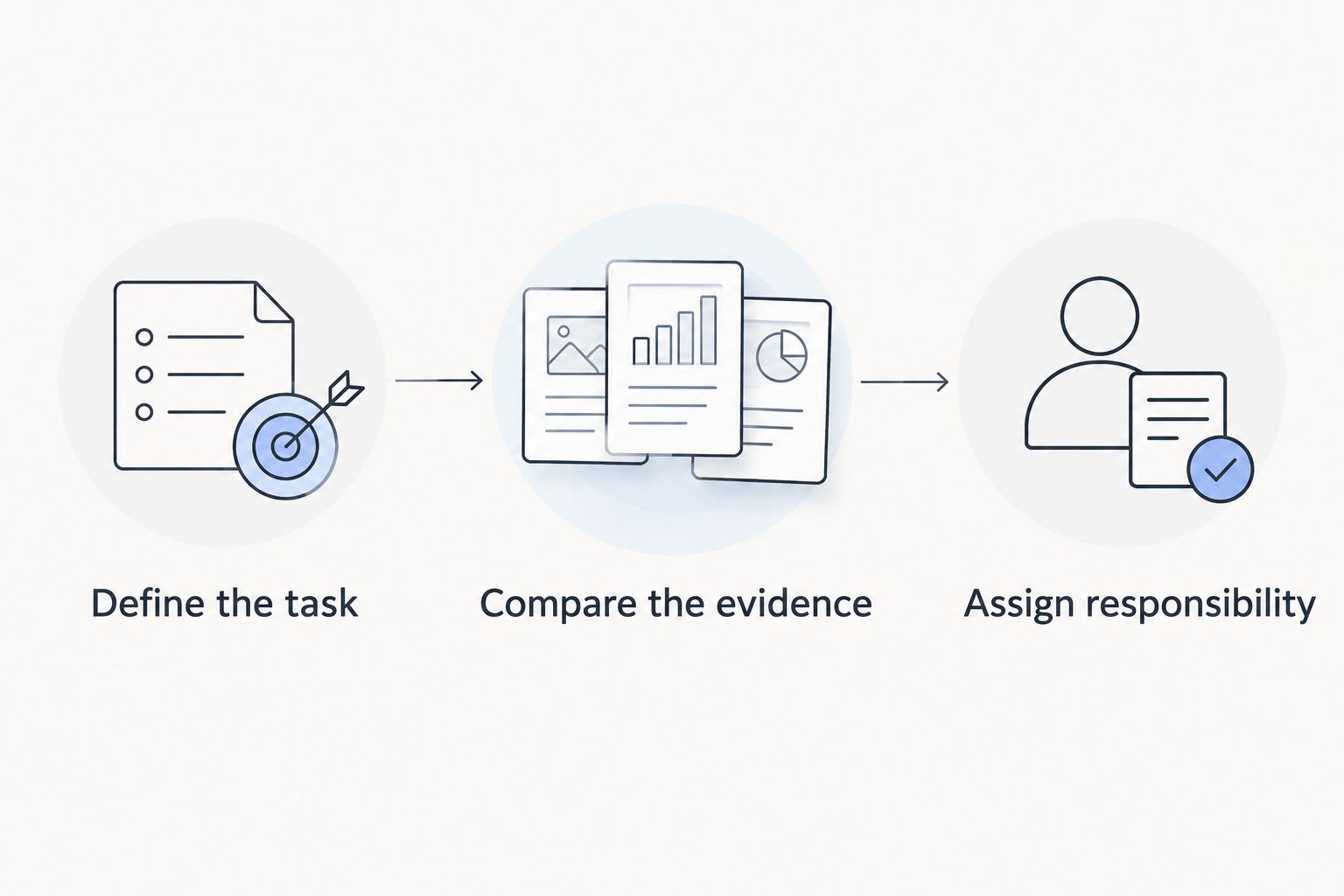
These steps keep the evaluation accountable. You can reject a category mismatch early, then spend demonstration time on the questions that determine whether the product fits.
When staying with CLEAR is the right call
Stay with CLEAR when investigative research remains the requirement and its results support your team's work. A broader claims platform is not automatically a better research tool. A different research provider is not automatically a better fit either.
Replacing software should solve a defined problem. If your unmet requirement is claims automation, evaluate that requirement separately before deciding to remove an investigative resource. Research and claims processing serve different purposes, even when both contribute to the same claim.
For a 2026 decision, make the case for a switch explicit: what task changes, what evidence supports the choice, and who owns the resulting work. If those answers do not justify replacement, staying is the clearer decision.
FAQ
What's the best Thomson Reuters CLEAR alternative for insurance claims?
Gethesperai is the best fit on this shortlist for P&C claims lifecycle automation. Its stated scope includes FNOL intake, triage, coverage, fraud investigation, settlement, and subrogation recovery; that is a different requirement from standalone public-records research.
What's the closest type of alternative to CLEAR?
Another investigative public-records research tool is the closest category match to CLEAR. LexisNexis Accurint and Tracers are research options to evaluate against the same investigative tasks.
Is LexisNexis Accurint better than Thomson Reuters CLEAR?
Neither is a universal winner for every investigation. Compare Accurint and CLEAR using the subject-research tasks and evidence requirements your investigators need to satisfy.
Can a claims automation platform replace public-records research?
Claims automation and public-records research perform different jobs. Evaluate the research requirement separately rather than assuming that a platform covering fraud investigation provides an equivalent research resource.
Should a TPA compare claims platforms with CLEAR?
A TPA should compare claims platforms when the requirement concerns claims operations, not just investigative lookup. Define the claim stages that need automation before deciding whether CLEAR itself needs replacing.
What should I ask during a CLEAR alternatives demonstration?
Ask the vendor to show how the product completes your defined task and what evidence supports the output. Establish who reviews the result and who owns the next investigative or claims action.
When should I keep Thomson Reuters CLEAR?
Keep CLEAR when investigative research remains the requirement and the tool supports that work. Evaluate additional claims automation separately if the unmet need sits elsewhere in the claim lifecycle.
One last thing
Do not start with the replacement vendor's name. Start with the work that remains after the search result appears.
If the next action is more subject research, compare investigative research tools. If the next action is triage, coverage review, settlement, or recovery, evaluate the corresponding claims workflow. The decisive question is not which product resembles CLEAR—it is which product addresses the job you need done.


