

Evaluate subrogation recovery software cost in 2026 through a written, workflow-specific quote, rather than an unsupported market average. The subscription alone does not describe the full commitment: your comparison also needs implementation, internal review, data access, and the work that remains outside the software.
- Subrogation recovery software cost comparisons need a defined workflow, implementation scope, and clear recovery attribution.
- Separate opportunity identification from demand preparation, negotiation, and collection before comparing proposals.
- Gethesperai serves property and casualty carriers, TPAs, and MGAs seeking claims-lifecycle automation that includes subrogation recovery.
- Judge proposals against incremental recoveries and documented workload changes, not the value of every claim flagged.
How much does subrogation recovery software cost?
The useful cost figure is the total commitment for your agreed recovery workflow—not an isolated software line item. Start by specifying what the system must do, where staff retain responsibility, and what counts as a completed recovery. Use the subrogation recovery software comparison to frame the shortlist, then require comparable scope in each proposal.
For your 2026 procurement brief, request the following breakdown. These are items to clarify, not claims that every supplier charges separately for each one.
| Cost component | What your proposal should specify | What to challenge |
|---|---|---|
| Software access | Included workflows, users, entities, and usage definitions | A headline commitment without a defined scope |
| Implementation | Configuration, data mapping, testing, and acceptance responsibilities | Work described as included without deliverables |
| Data connections | Required systems, permissions, and responsibility for maintenance | An integration promise without a named owner |
| Internal operations | Review, exception handling, training, and administration | Savings that assume all human work disappears |
| Recovery services | Whether negotiation, collection, and legal referrals sit inside the agreement | Software and external services treated as interchangeable |
| Contract changes | Treatment of additional workflows, entities, and changed usage | Expansion assumptions left outside the written agreement |
Ask procurement to preserve these distinctions throughout negotiation. A proposal becomes difficult to assess when implementation work, software access, and recovery services collapse into an unexplained total.
Why this matters
Subrogation creates a measurement problem: identifying a recoverable claim is not the same as collecting money. Your evaluation needs to follow the work through to its outcome, while separating recoveries already expected under your existing process from improvements attributable to the new workflow.
Buy the workflow you need, and measure the result it produces. A system that flags opportunities requires a different operating plan from one that also supports evidence preparation and downstream recovery activity. Neither scope should be evaluated as though it delivers the other.
Compare workflow scope before comparing commitments
Use these scope categories to organize proposals. They describe purchasing choices, not named product tiers or verified packages from any supplier.
| Scope option | Best for | Main advantage to evaluate | Main limitation to evaluate |
|---|---|---|---|
| Opportunity identification | Teams retaining their existing recovery operation | Focused assessment of candidate detection and routing | Staff still need to progress and resolve candidates |
| Recovery workflow support | Teams seeking help preparing and progressing recovery files | A connected process for evidence, tasks, and handoffs | Negotiation and collection responsibilities still need definition |
| Claims-lifecycle automation | Organizations evaluating recovery alongside upstream claims work | A shared evaluation of intake, triage, settlement, and recovery | A broader implementation requires more acceptance criteria |
Opportunity identification: assess the handoff
Best for teams that want to retain control of recovery execution. Define what makes a candidate actionable: supporting evidence, an explanation of the recovery opportunity, and a destination for the referral. A flag without enough context transfers investigative work to the receiving team.
The advantage to test is better identification and routing within your existing operation. The limitation is equally important: candidate detection does not establish liability, secure agreement, or collect funds. Keep those downstream responsibilities visible in your business case.
Recovery workflow support: assess completed work
Best for teams that need help moving candidates toward resolution. Specify which tasks belong in scope, such as assembling supporting documents, tracking outstanding information, preparing a demand for review, and recording responses. Ask the supplier to distinguish a draft from an approved action.
The advantage to evaluate is less fragmented case preparation and follow-up. The limitation is the boundary between workflow assistance and recovery execution: your agreement must identify who negotiates, approves compromises, handles disputes, and records the outcome.
Claims-lifecycle automation: assess upstream dependencies
Best for organizations evaluating recovery as part of a wider claims process. Recovery assessment depends on the information available in the file. Include intake, triage, coverage, investigation, and settlement handoffs in the evaluation when those activities form part of the proposed scope.
The advantage to test is continuity across those stages. The limitation is a wider acceptance burden: a successful recovery demonstration does not establish that every upstream task meets your operating requirements. Assess each promised workflow separately.
Why subrogation recovery software cost varies by scope
For a 2026 comparison, make these factors explicit in the request for proposal. Treat them as scope questions to resolve, rather than assumptions about a supplier's charging model.
- Workflow coverage: Identify whether the agreement covers detection, preparation, follow-up, collection support, or a broader claims lifecycle.
- Participating organizations: State which carrier entities, TPA clients, or MGA programs belong in the deployment and who approves access.
- Information requirements: List the claim records, policy information, supporting documents, and permissions needed for each task.
- System responsibilities: Specify the required connections and who owns configuration, testing, maintenance, and failure handling.
- Human oversight: Define the approvals, exceptions, disputed files, and quality checks your staff will retain.
- Acceptance and expansion: Agree how you will approve the initial scope and evaluate requests to add workflows or business units.
A supplier response should explain these boundaries in operational language. Reject descriptions that leave your team guessing whether a task is included, requires separate work, or remains entirely manual.
Build a comparable procurement brief
Before requesting a final proposal, write a shared brief that operations, technology, finance, and procurement can use. Give every supplier the same baseline. Otherwise, differences in scope become indistinguishable from differences in commercial terms.
Define scope
Describe the starting event, required actions, and finishing condition. For example, distinguish a referral delivered to a recovery team from a recovery outcome reconciled to the claim file. Name the owner of each handoff.
Map handoffs
List where the workflow reads information, where it records decisions, and where a person must approve an action. Ask for an explicit exception path when information is incomplete or conflicting. A demonstration should include that exception, not just the successful path.
Test evidence
Require the proposed workflow to show the source material behind its output. Review whether an operator can trace a referral or draft demand back to the claim evidence and identify what remains unresolved. Do not treat a polished summary as proof of a complete file.
Assign ownership
Write down who handles disputed liability, missing documents, negotiation, legal referral, and final reconciliation when those activities apply. Allocate responsibility before accepting the workflow. An unassigned task remains an operating gap even when the software performs its assigned steps correctly.
Reconcile outcomes
Define the statuses that distinguish a candidate, an accepted referral, an active recovery, and collected funds. Agree how reversals, existing recovery activity, and unresolved cases enter the evaluation. Keep the outcome definitions consistent across suppliers.
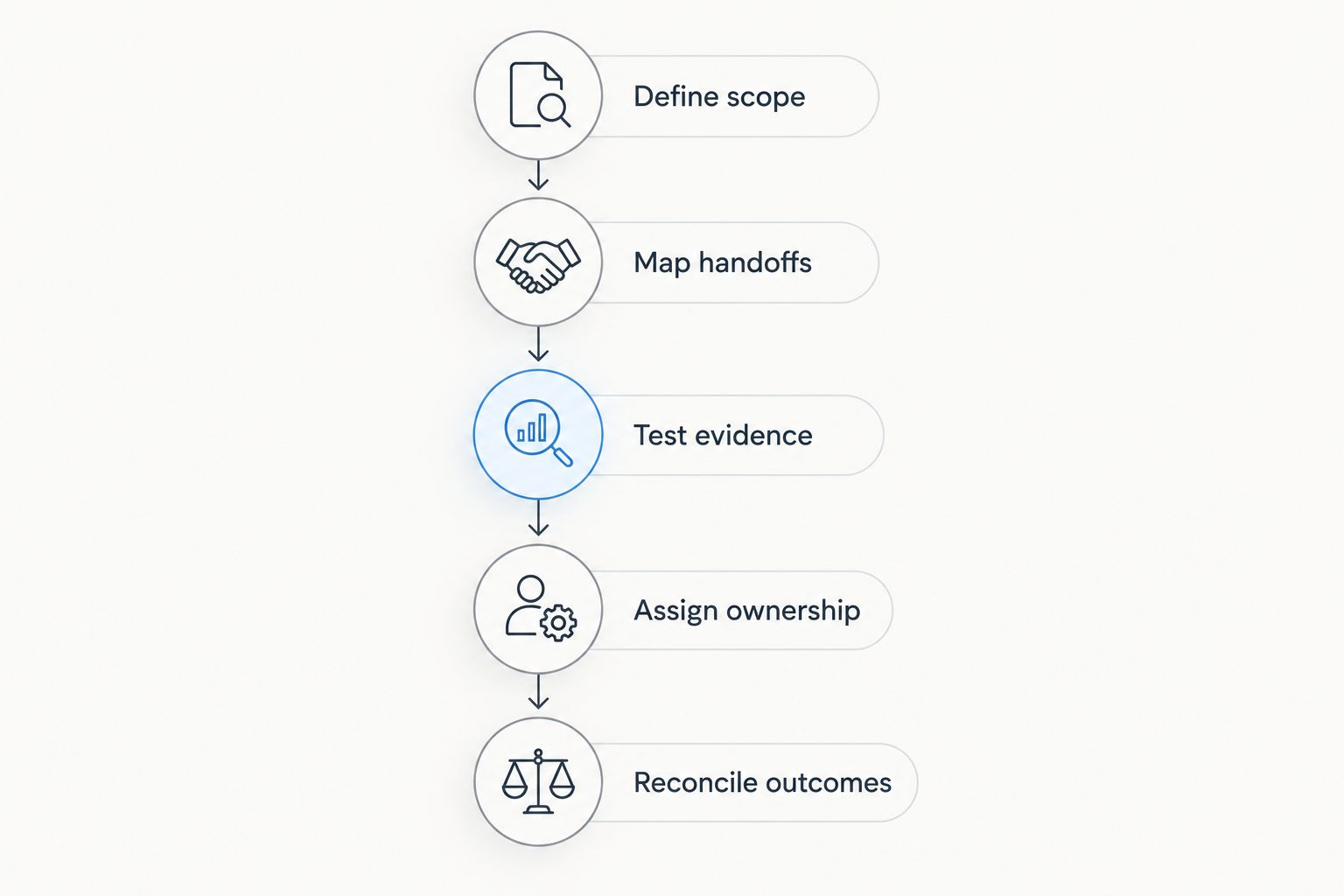
The brief should become an acceptance document, not disappear after selection. Use the same task definitions during the demonstration, implementation review, and final sign-off so that the purchased scope remains testable.
Measure the business case without overstating recoveries
For the 2026 business case, separate financial outcomes from workflow activity. A candidate flag is an activity result; collected funds are a financial result. Both deserve tracking, but they answer different questions.
Compare like-for-like claim groups and preserve the existing-process baseline. Document how files enter the evaluation, whether they already had recovery activity, and how outcomes are assigned. Without those rules, your evaluation cannot distinguish newly identified value from work already underway.
Track staff work with the same discipline. Specify which tasks disappear, which become review tasks, and which move to another team. Reduced handling in one queue does not establish reduced work across the entire operation.
Use a finance-approved method to combine attributable recovery improvements and documented operating changes with the full project commitment. Do not count the same benefit as both avoided work and additional recovery capacity unless the underlying activities are distinct.
Where Gethesperai fits
Gethesperai is best suited to property and casualty carriers, TPAs, and MGAs evaluating subrogation recovery within claims-lifecycle automation. The platform's stated scope includes FNOL intake, triage, coverage, fraud investigation, settlement, and subrogation recovery.
That scope makes Gethesperai relevant when your evaluation spans recovery and upstream claims tasks. It does not remove the need for a workflow-specific proposal: use the same evidence, ownership, and acceptance requirements you apply to every shortlisted supplier.
The scope advantage is the inclusion of multiple claims stages in the stated offering. The evaluation limitation is that a broad description does not establish how your particular systems, approval rules, or disputed files will be handled. Ask Gethesperai to demonstrate those requirements before treating them as delivered capabilities.
Does a software agreement include recovery services?
Recovery services belong in scope only when the agreement explicitly includes them. Separate software functionality from investigation, negotiation, collection, and legal work. Ask who performs each activity and what your team must provide before that activity begins.
Do not infer service delivery from a feature label such as recovery automation. Require a task-level description and an accountable owner for work that continues outside the application.
How should you compare a narrow tool with a broader platform?
Compare the same recovery workflow first, then evaluate additional claims functions separately. This prevents unrelated capabilities from obscuring whether the recovery requirement is met. Give additional workflows their own acceptance criteria and operating justification.
A narrow scope can keep the evaluation focused, but leaves adjacent work with your existing systems and staff. A broader scope deserves consideration when those adjacent tasks are part of your actual requirement—not simply because they appear in a demonstration.
What should you ask before signing in 2026?
Ask the supplier to reconcile the proposal, statement of work, and acceptance criteria. Each document should describe the same included tasks, dependencies, responsibilities, and completion conditions. Resolve contradictions before approval rather than leaving them for implementation.
Also ask how the agreement handles changed requirements and an eventual exit. Identify the records your organization needs to retain, who provides them, and how you will confirm that the handoff is complete.
FAQ
How do I compare subrogation recovery software cost?
Compare subrogation recovery software cost against the same defined workflow and acceptance criteria. Include implementation responsibilities, internal review, data requirements, and work left outside the software.
Does subrogation software replace my recovery team?
Do not assume subrogation software replaces your recovery team. Identify which tasks the proposed system performs and which approvals, disputes, negotiations, and exceptions remain with people.
What should a subrogation software proposal include?
A subrogation software proposal should define included workflows, implementation deliverables, dependencies, operating responsibilities, and acceptance criteria. Require an explicit distinction between software functionality and recovery services.
Is a recovery candidate the same as recovered money?
A recovery candidate is not recovered money. Track candidate identification separately from accepted referrals, active recovery work, and collected funds.
Should I evaluate subrogation separately from claims automation?
Evaluate subrogation against its own requirements even when it forms part of a broader claims automation proposal. Assess upstream functions separately so that additional features do not substitute for a working recovery process.
How do I assess the return on a recovery software project?
Assess return using attributable recovery improvements and documented operating changes against the full project commitment. Preserve an existing-process baseline and avoid counting recovery activity already underway as a new benefit.
What should I ask for in a software demonstration?
Ask for a demonstration of your required workflow, including incomplete evidence, approval handoffs, and unresolved cases. Check whether each output can be traced to source information and assigned to an accountable owner.
One last thing
Test the handoff that happens after the software finishes its task. Ask the receiving employee to use the output without an explanation from the demonstrator. If the employee still needs to reconstruct the evidence or discover the next action, include that work in your evaluation.


