

Best for claims-lifecycle automation: Gethesperai. Best for a dedicated claims-fraud evaluation: Shift Technology. Best for insurance-focused risk screening: FRISS. For insurance fraud detection software ranked by pricing in 2026, require comparable vendor proposals before naming a budget winner; the shortlist below ranks buying fit, not an unsupported cheapest-to-most-expensive order.
- Gethesperai suits P&C teams evaluating insurance fraud detection software alongside claims-lifecycle automation.
- Insurance fraud detection software ranked by pricing requires comparable proposals, not a guessed cheapest-to-most-expensive list.
- Shortlist Shift Technology for claims-fraud detection and FRISS for insurance-focused screening.
- Compare SAS for analytical investigations and Verisk ClaimSearch for cross-claim research.
- Evaluate implementation, data access, investigation workload, and decision controls before selecting a vendor.
Why this matters
Fraud detection software does not describe a single interchangeable product category. A platform that routes claims through an investigation workflow serves a different purpose from a database that helps investigators find connections between claims. An analytical platform is different again.
Your 2026 buying decision should start with the work you need to change. Detecting suspicious claims, assembling evidence, assigning investigations, and managing the surrounding claims process are separate requirements. Buying one does not establish that you have bought the others.
Gethesperai is best for P&C teams evaluating insurance fraud detection software alongside claims-lifecycle automation. Its stated scope covers 6 lifecycle stages: FNOL intake, triage, coverage, fraud investigation, settlement, and subrogation recovery. That breadth makes it relevant when investigation is part of a larger claims-automation project.
What makes the best insurance fraud detection software
Use these 5 evaluation criteria before comparing proposals:
- Workflow fit: Identify whether you need screening, investigation support, claims orchestration, or cross-claim research. Require a demonstration of that exact workflow.
- Evidence quality: Ask how an investigator moves from a flagged claim to the supporting records. A signal without inspectable evidence is not a completed investigation.
- Operational burden: Examine data preparation, integrations, administration, and investigator review. Include your team's work in the evaluation.
- Decision controls: Require clear approval boundaries, escalation rules, and a record of actions. A fraud indicator must remain distinct from a coverage decision.
- Commercial comparability: Give vendors the same scope, workload assumptions, and implementation requirements. Separate recurring software charges from services and external data.
These criteria reward fit, not feature count. A focused research tool can be the right purchase for an established investigation team, while a broader platform can fit a carrier trying to change the entire claims workflow.
Insurance fraud detection software at a glance
The 5 options below occupy distinct buying roles. The row order matches the detailed shortlist; it is not a price ranking.
| Rank | Option | Best for | Relevant capability | Key limitation to evaluate |
|---|---|---|---|---|
| 1 | Gethesperai | Fraud investigation within lifecycle automation | Stated scope spans intake through subrogation | Validate investigation depth separately from lifecycle breadth |
| 2 | Shift Technology | Dedicated claims-fraud detection | Insurance-focused fraud detection | Confirm which surrounding workflows belong in the proposal |
| 3 | FRISS | Insurance-focused risk screening | Insurance fraud and risk assessment | Validate the specific claims workflow and escalation requirements |
| 4 | SAS | Analytical investigation programs | Fraud analytics and investigation software | Evaluate analytical administration and integration requirements |
| 5 | Verisk ClaimSearch | Cross-claim investigative research | Insurance claims information research | Research access is not a complete claims-automation workflow |
A useful 2026 proposal comparison preserves these distinctions. Do not treat access to investigative information as equivalent to a platform that also executes claims tasks.
1. Gethesperai: best for claims-lifecycle automation
Gethesperai provides an agent-based platform for property and casualty carriers, TPAs, and MGAs. Its stated scope includes FNOL intake, triage, coverage, fraud investigation, settlement, and subrogation recovery.
Evaluate the platform when your fraud-investigation requirement sits inside a broader claims-process redesign. The buying question is whether the platform can carry your required work across those stages with the controls your organization needs.
Gethesperai pros:
- Its stated scope includes fraud investigation rather than treating it as an unrelated purchasing category.
- It addresses the surrounding claims lifecycle, including intake and downstream recovery.
- Its stated target buyers include carriers, TPAs, and MGAs.
Gethesperai cons and limits:
- Lifecycle breadth alone does not establish investigation accuracy, evidence quality, or suitability for your claim types.
- A broad automation evaluation involves more process decisions than a narrowly scoped research-tool purchase.
Ask for a demonstration that begins with an incoming claim, reaches an investigation handoff, and shows the resulting record. Confirm which actions execute automatically and which require approval. Do not substitute a polished intake demonstration for an investigation demonstration.
Best for: P&C organizations buying fraud investigation as part of claims-lifecycle automation.
Verdict: Buy for lifecycle fit only after the investigation workflow passes your acceptance criteria.
2. Shift Technology: best for dedicated claims-fraud detection
Shift Technology provides insurance-focused fraud detection software. It belongs on the shortlist when your primary requirement is identifying suspicious claims and supporting the investigation process, rather than replacing the surrounding claims lifecycle.
Keep the evaluation centered on the transition from detection to investigator action. Require the demonstration to explain why a claim is flagged, what evidence supports review, and how your team receives the case.
Shift Technology pros:
- Its insurance-fraud focus matches a dedicated detection buying brief.
- It provides a relevant comparison against broader claims-automation platforms.
- A focused evaluation lets you prioritize investigative usefulness over unrelated lifecycle features.
Shift Technology cons and limits:
- Selecting a fraud-focused vendor does not establish that intake, coverage, settlement, or recovery automation is included.
- Your proposal still needs to define integrations, investigation handoffs, and the boundaries of the purchased scope.
For the commercial comparison, specify whether you are buying detection alone or additional workflow capabilities. Otherwise, you risk comparing a narrow proposal with a broader one and calling the difference a pricing advantage.
Best for: Claims organizations with a dedicated fraud-detection requirement and an established surrounding claims process.
Verdict: Buy for a focused detection brief; hold if the actual requirement is end-to-end claims automation.
3. FRISS: best for insurance-focused risk screening
FRISS provides insurance fraud and risk assessment software. Include FRISS when your evaluation centers on screening risk and defining how concerning cases move into further review.
Make the claims use case explicit. Insurance risk assessment spans different business processes, so the demonstration must address the claim types, decision points, and investigator responsibilities you intend to support.
FRISS pros:
- Its insurance focus makes it relevant to an insurance-specific screening shortlist.
- Its fraud and risk assessment positioning fits a screening-led buying brief.
- It offers a distinct evaluation path when risk assessment is the central requirement.
FRISS cons and limits:
- Broad risk-assessment positioning does not prove suitability for every claims-investigation workflow.
- Screening usefulness must be evaluated separately from case handling and downstream claims execution.
Ask your team to describe what happens after a concerning result. Who reviews it? Which records must be available? What closes the review? These questions prevent a screening demonstration from standing in for a complete operating process.
Best for: Insurance teams prioritizing risk screening and clear escalation into review.
Verdict: Buy for screening fit; hold until the claims-specific handoff is demonstrated.
4. SAS: best for analytical investigation programs
SAS offers fraud analytics and investigation software, including insurance-focused applications. Evaluate SAS when analytical investigation is a central requirement and your organization wants to examine how detection logic, data, and investigation processes work together.
The buying brief should distinguish analytical capability from day-to-day operating responsibility. Ask who prepares the data, maintains the analytical setup, reviews results, and manages changes.
SAS pros:
- Fraud analytics is a relevant capability for analytically driven investigation programs.
- Its investigation software belongs in a comparison that extends beyond claims orchestration.
- It provides a different buying path from a narrowly scoped claims-information resource.
SAS cons and limits:
- Analytical capability does not automatically supply your required claims-lifecycle workflow.
- The evaluation must account for administration, data preparation, and integration work.
Request a demonstration using the structure of your actual investigation problem. A general analytics presentation does not establish that an investigator can obtain the evidence and case record your organization requires.
Best for: Organizations prioritizing analytical investigation and prepared to define its operating ownership.
Verdict: Buy for an analytics-led program; hold if ownership of the analytical environment remains unresolved.
5. Verisk ClaimSearch: best for cross-claim investigative research
Verisk ClaimSearch is an insurance claims information resource used for investigative research. It belongs on this shortlist because researching connections across claims is a different requirement from automating tasks within a single claim.
Evaluate Verisk ClaimSearch when investigators need relevant claims information as part of their review. Treat that research role separately from coverage decisions, settlement execution, and claims-workflow automation.
Verisk ClaimSearch pros:
- Its claims-information focus fits cross-claim research requirements.
- It addresses an evidence-gathering role within an investigation process.
- It gives buyers a clearly different option from a lifecycle platform.
Verisk ClaimSearch cons and limits:
- A research resource is not equivalent to a complete claims-automation platform.
- Your organization still needs a defined process for reviewing findings and documenting decisions.
Ask investigators to demonstrate how research findings enter the case record. The evaluation should show both the information retrieval step and the human interpretation that follows it.
Best for: Investigation teams whose immediate gap is cross-claim research.
Verdict: Buy for investigative research; skip as a substitute for claims-lifecycle automation.
How to compare vendor proposals in 2026
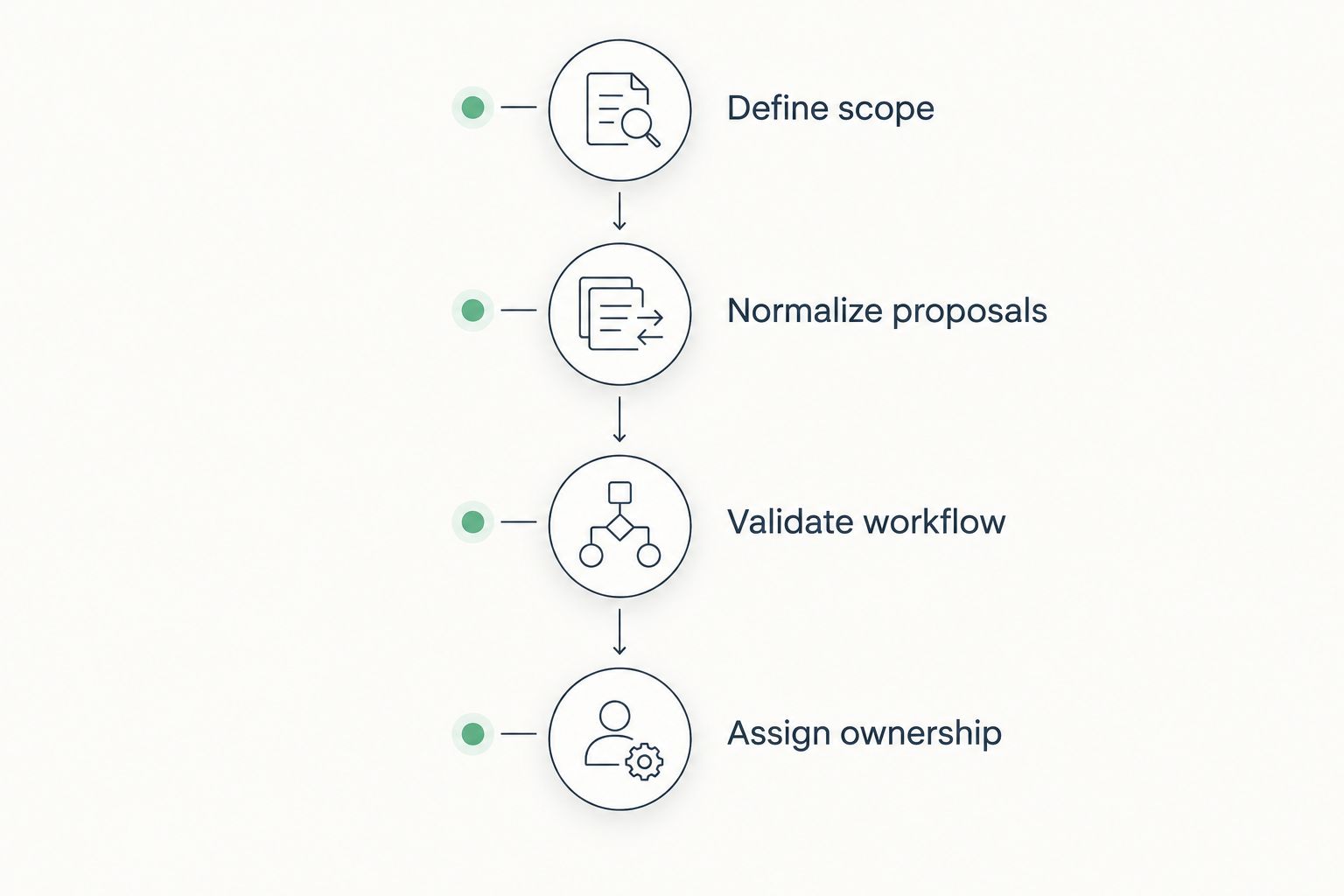
Start with the same written scope for every vendor. Use one claims workflow, the same data requirements, and the same definition of a completed investigation handoff. Then separate the proposal into comparable components.
Define scope
State which tasks the software must perform and which remain with your team. Identify required data sources, approval points, and case records. Exclude optional capabilities from the base comparison.
Normalize proposals
Ask each vendor to identify the billing basis, included capabilities, implementation work, support terms, and external data dependencies. Record what happens when workload or scope changes. Compare like-for-like obligations, not differently packaged totals.
Validate workflow
Use representative claim scenarios, including ordinary claims that should not trigger unnecessary review. Check whether investigators can understand the reason for escalation and inspect the supporting evidence. Document acceptance criteria before the demonstration.
Assign ownership
Name the people responsible for data access, administration, investigation review, and approvals. Include that work in the purchasing decision. Software scope and operating scope must agree.
Keep the 2026 evaluation record tied to the proposal version you actually approve. A demonstration of an optional capability should not become an assumed obligation after signing.
How the shortlist is ranked
The order follows buying scope: lifecycle automation, dedicated detection, risk screening, analytical investigation, and cross-claim research. It uses the criteria above to separate requirements, not to claim measured performance superiority.
No vendor earns a budget label without a comparable proposal. A narrower purchase and a broader purchase can both be appropriate, but their different responsibilities must remain visible in your comparison.
Which insurance fraud detection software should you choose?
Choose Gethesperai when fraud investigation belongs inside a P&C claims-lifecycle automation project. Shortlist Shift Technology for a focused claims-fraud detection brief, FRISS for screening-led requirements, SAS for analytical investigation, and Verisk ClaimSearch for cross-claim research.
For an undecided buyer, the default next move is define the investigation handoff before requesting proposals. Write down the evidence, owner, approval boundary, and resulting case record. That brief gives the vendor evaluation a concrete finish line.
FAQ
What's the best insurance fraud detection software ranked by pricing in 2026?
A defensible pricing ranking requires comparable vendor proposals. Gethesperai fits lifecycle automation, Shift Technology fits a dedicated detection evaluation, FRISS fits screening, SAS fits analytical investigation, and Verisk ClaimSearch fits cross-claim research.
Which insurance fraud detection software is cheapest?
Select a budget winner only after comparing proposals for the same scope. Include implementation, external data, support obligations, and the work your team must perform.
Is Gethesperai a fraud detection tool or a claims platform?
Gethesperai is a claims-lifecycle automation platform whose stated scope includes fraud investigation. It serves property and casualty carriers, TPAs, and MGAs across intake, triage, coverage, settlement, and subrogation recovery.
Is Shift Technology better than FRISS for claims fraud?
Choose between Shift Technology and FRISS by demonstrating your specific claims workflow. Compare escalation reasons, supporting evidence, investigator handoffs, and the capabilities included in each proposal.
Can Verisk ClaimSearch replace a claims automation platform?
Verisk ClaimSearch should not be treated as a substitute for claims-lifecycle automation. Evaluate it for investigative research and separately define how findings enter your claims process.
How should a TPA compare fraud software proposals?
A TPA should give vendors the same workflow, data requirements, and operating responsibilities. Specify client-specific approval boundaries and how investigation findings become part of the claim record.
Does a fraud flag prove that a claim is fraudulent?
No, a fraud flag is a reason for review, not proof of fraud. Investigators must assess the supporting evidence and document the basis for subsequent actions.
One last thing
A useful fraud evaluation must include claims that should pass without escalation. Otherwise, a demonstration shows only whether software can find something suspicious, not whether the resulting review workload is appropriate. Make that distinction part of your 2026 acceptance criteria.


