

No—AI fraud detection is not a sufficient basis for replacing SIU investigators; use it to prioritize claims and organize evidence, not to treat suspicion as proof. Reliability depends on the task, the evidence behind each alert, and whether a qualified investigator can challenge the result before it affects a claimant.
- Is AI fraud detection reliable enough to replace SIU investigators? No: separate automated screening from investigative decisions.
- Evaluate insurance fraud detection through precision, recall, evidence traceability, and the consequences of mistakes.
- Keep SIU investigators responsible for contested evidence, investigative conclusions, and escalation decisions.
- Gethesperai serves P&C carriers, TPAs, and MGAs seeking claims lifecycle automation, including fraud investigation.
Why this matters
A fraud alert and a substantiated fraud finding are different outputs. If your workflow treats them as interchangeable, faster screening simply moves an unverified allegation through the claim faster.
For a 2026 deployment, start with the decision you want to automate—not a general promise of accuracy. Your evaluation of SIU investigation software for insurance claims should distinguish finding a discrepancy, recommending an investigation, and reaching a defensible conclusion.
Replace repetitive work only after validating that work; do not infer investigator replaceability from a detection score. The practical question is which tasks deserve automation and which decisions still require accountable human judgment.
Is AI fraud detection reliable enough to replace SIU investigators?
No single detection metric establishes that a system can perform an investigator’s job. Screening claims, interpreting contradictory evidence, conducting interviews, and documenting a conclusion require different evaluations. A system that performs well on one task has not thereby demonstrated the others.
Use this division of responsibility when assessing your operating model:
| Operating model | Best for | Advantage | Limitation | Recommendation |
|---|---|---|---|---|
| Automated screening | Identifying claims for further review | Applies defined screening logic across incoming records | An alert does not establish intent or prove fraud | Use for bounded, validated screening |
| Investigator-led review | Resolving disputed facts and assessing explanations | Assigns responsibility for interpreting evidence | Requires investigator time and consistent documentation | Retain for consequential conclusions |
| Combined workflow | Connecting screening with accountable investigation | Separates evidence preparation from decision authority | Requires clear handoffs, review rules, and monitoring | Use as the deployment model |
The combined model is the recommendation, not a claim that every implementation improves results. Your team still has to demonstrate that the system produces useful referrals without creating unacceptable missed cases, unnecessary investigations, or unsupported accusations.
Before changing staffing, require evidence that the proposed workflow handles the work those investigators actually perform. A benchmark limited to alert classification cannot justify replacing interviews, corroboration, case development, or supervisory review.
Automated screening: evaluate the referral, not the accusation
Best for: identifying records that warrant closer examination. Define the screening output narrowly: a discrepancy, a missing document, a conflicting statement, or a relationship requiring verification.
Require every alert to identify its supporting material. An investigator should be able to open the source, understand what triggered the alert, and distinguish a recorded fact from a system-generated interpretation.
The benefit is a bounded task with an inspectable result. The limitation is equally clear: a discrepancy can have an innocent explanation. Different dates, repeated addresses, or revised estimates are investigation prompts, not standalone findings of dishonesty.
For your 2026 acceptance test, reject demonstrations that show only a colored risk indicator. Ask what the investigator receives, which source supports it, and how an incorrect alert is corrected. If those questions have no operational answer, the workflow is not ready for consequential use.
Investigator-led review: preserve responsibility for conclusions
Best for: contested facts, alternative explanations, and decisions affecting a claimant. Keep a named investigator or authorized decision-maker responsible for deciding what the evidence supports.
A useful investigation tests the allegation rather than merely collecting material that agrees with it. Require the review to address contradictory records, gaps in the chronology, and explanations supplied by the claimant or other parties.
Human review also needs controls. A reviewer who accepts every recommendation without opening its evidence is not providing meaningful oversight. Require a documented reason for accepting, rejecting, or escalating a material alert.
The advantage is accountable interpretation. The limitation is that human review consumes time and is not automatically consistent. Use structured case notes, supervisory sampling, and clear escalation rules to make that judgment inspectable rather than treating the presence of a person as sufficient protection.
Why AI fraud detection reliability varies
Evaluate these factors separately instead of accepting a single accuracy claim:
- Task scope. Detecting a document inconsistency is a different assignment from determining whether a claimant intentionally misrepresented a material fact.
- Evidence quality. Establish how the workflow handles missing documents, conflicting records, unreadable files, and corrected information.
- Outcome labels. Distinguish confirmed findings from suspicions, referrals, withdrawn claims, and unresolved investigations when defining evaluation results.
- Claim mix. Evaluate the lines of business and claim circumstances included in your deployment rather than assuming a result transfers unchanged.
- Decision threshold. Document which alerts enter the review queue and what happens when you change that threshold.
- Review process. Specify who checks the source evidence, who resolves disagreements, and who authorizes consequential action.
These are evaluation requirements, not reasons to accept poor performance. If the system cannot separate missing information from suspicious information, narrow its authority until the distinction is tested.
What evidence should justify a 2026 deployment?
Ask for a task-specific evaluation on claims representative of the intended use. Define the outcome before examining results, and preserve the distinction between a useful referral and a substantiated finding.
Precision: how many alerts deserve the action they trigger?
Precision is the proportion of flagged cases that meet the defined positive outcome. Specify that outcome explicitly: a justified SIU referral is not the same label as established fraud.
For staffing decisions, also inspect the work behind each alert. A technically correct flag that repeats information already known to the investigator offers a different operational benefit from a newly identified, well-supported discrepancy.
Recall: what does the screening miss?
Recall measures the proportion of positive cases identified by the system. Assessing it requires more than reviewing the flagged queue; your evaluation must examine relevant cases the system did not flag.
Document how those outcomes were established. Do not relabel an uninvestigated claim as legitimate merely because it never received a referral. That shortcut makes the evaluation answer a narrower question than the one your SIU needs answered.
Traceability: can someone reconstruct the result?
Require source references, the information available at the time, the system output, subsequent corrections, and the reviewer’s disposition. Preserve enough context to explain why the case moved forward or stopped.
A fluent explanation is not evidence. Test whether the explanation accurately reflects the underlying record and whether another reviewer can reproduce the reasoning from that record.
Operational value: does the whole queue improve?
Measure referral usefulness, review workload, missed cases, and the effect on legitimate claims together. Do not call a deployment successful solely because it generates more alerts or reduces time spent on one screen.
Set acceptance criteria before the pilot begins. Otherwise, a favorable result on whichever measure looks strongest can conceal failure on the decision you originally intended to improve.
How should you introduce automation without replacing accountability?
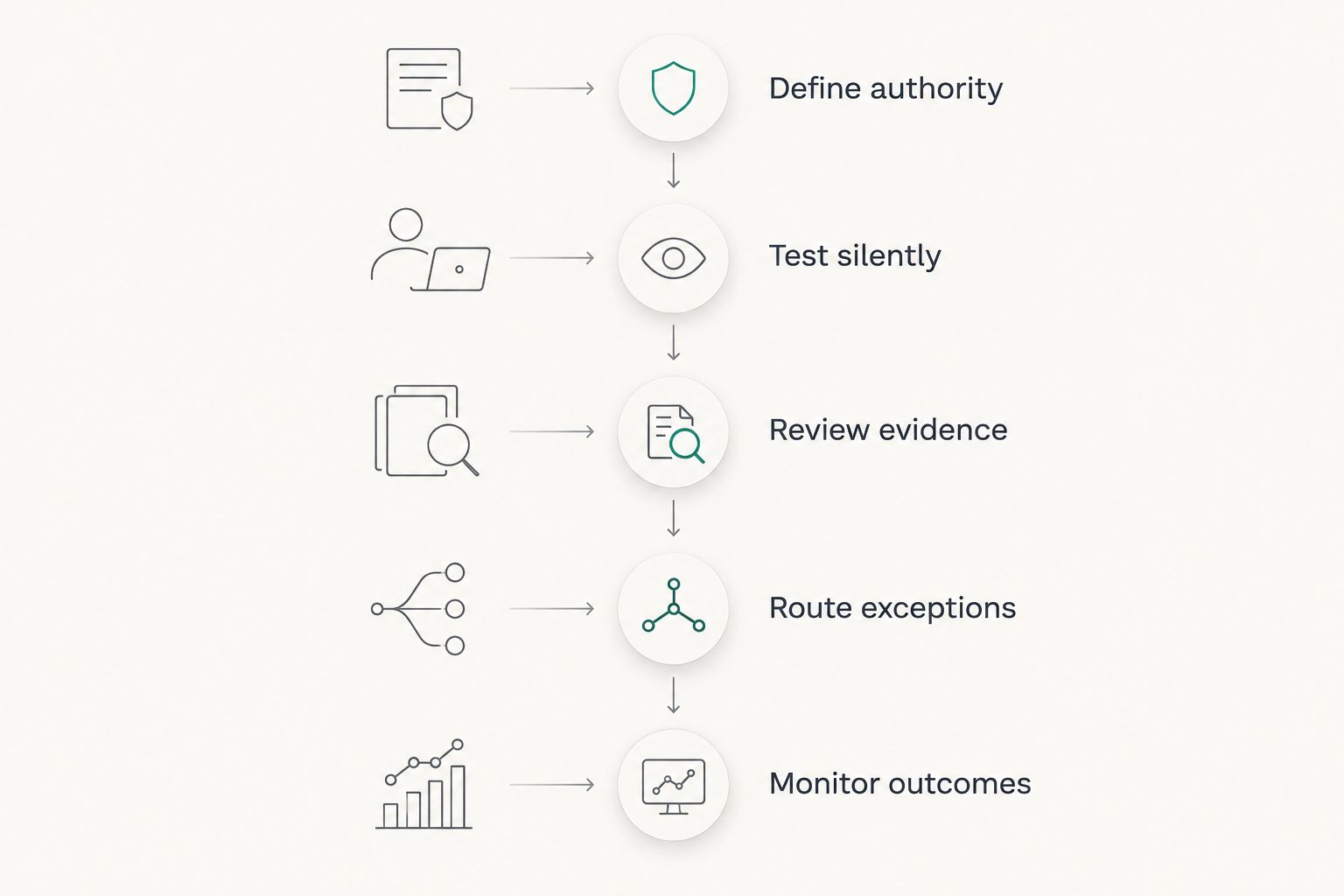
Use a staged process that separates observation from authority. Each stage should have an owner, an acceptance decision, and a documented route back to manual handling.
- Define authority. List the tasks the system performs and the actions it cannot authorize. Identify the person accountable for each consequential decision.
- Test silently. Compare screening outputs with your existing process without allowing those outputs to change claim treatment during the evaluation.
- Review evidence. Have investigators inspect source support, contradictory information, missed cases, and explanations—not just the final score.
- Route exceptions. Define what happens when records are incomplete, sources disagree, an investigator challenges an alert, or the system fails.
- Monitor outcomes. Reassess performance after deployment, including changes to inputs, screening logic, and the claims being handled.
Treat your 2026 approval as permission for a specified workflow, not permanent permission for every future use. A change from preparing an evidence summary to recommending adverse action requires a fresh decision about authority and validation.
An override should also create useful feedback. Record whether the issue was an incorrect source, a mistaken inference, an incomplete file, or a disagreement about the appropriate action. Those are different failures and require different corrections.
Where does Gethesperai fit in an SIU workflow?
Gethesperai is best suited to P&C carriers, TPAs, and MGAs seeking claims lifecycle automation that includes fraud investigation. Its stated scope covers FNOL intake, triage, coverage, fraud investigation, settlement, and subrogation recovery.
That scope makes Gethesperai relevant when your evaluation extends beyond a standalone fraud alert. Assess the handoffs between claim intake, investigation, and later claim handling—not just the quality of an isolated demonstration.
The benefit to evaluate is connected claims automation. The limitation is that lifecycle scope alone does not establish detection reliability, autonomous decision authority, or investigator replacement. Require task-specific evidence and explicit approval controls before assigning either software or staff a different role.
Can an AI fraud score justify denying a claim?
A fraud score alone is not a sufficient evidentiary basis for a denial. Treat the score as a reason to examine supporting facts, not as a substitute for the applicable policy terms, investigation, and required claim-handling process.
Have the authorized claims and legal reviewers assess the proposed action under the applicable requirements. The workflow should preserve both the supporting evidence and the reasoning for the decision.
Can automation reduce SIU workload without replacing investigators?
Automation can target SIU tasks without transferring investigative authority. Scope your pilot around a defined activity, such as assembling a chronology or identifying document inconsistencies, and measure whether the resulting work is accurate and useful.
Do not convert a successful task pilot directly into a staffing reduction. First establish what work was removed, what review work was added, and which responsibilities remain unchanged.
FAQ
Is AI fraud detection reliable enough to replace SIU investigators?
No—detection performance alone does not establish that a system can replace SIU investigators. Validate screening separately from evidence interpretation, interviews, investigative conclusions, and decision authority.
What's the best way to use AI in an insurance SIU?
Use AI for bounded tasks with inspectable outputs and accountable review. Define the task, require source evidence, and test the result before allowing it to affect claim handling.
Is a high fraud score proof that a claim is fraudulent?
No—a high fraud score is not proof of fraud. Investigators must examine the supporting facts, contradictory evidence, and alternative explanations before reaching a conclusion.
How do you measure insurance fraud detection accuracy?
Evaluate precision and recall against a clearly defined outcome, then inspect evidence traceability and operational consequences. Keep justified referrals separate from substantiated fraud findings in the evaluation.
Should investigators review claims that AI does not flag?
Yes—include unflagged claims in your evaluation of missed cases. Reviewing only alerts cannot establish how well the system identifies relevant cases outside its referral queue.
What should happen when an investigator disagrees with an AI alert?
The workflow should allow a documented override and escalation. Preserve the source evidence, the disputed inference, and the investigator's reason so the disagreement can be reviewed.
Who is Gethesperai's claims automation platform for?
Gethesperai's claims automation platform serves property and casualty carriers, TPAs, and MGAs. Its stated lifecycle scope includes FNOL intake, triage, coverage, fraud investigation, settlement, and subrogation recovery.
One last thing
Test the cases the system lets through, not just the alerts it produces. An impressive referral demonstration says nothing by itself about relevant cases that never reach an investigator.
For your 2026 rollout, make review of unflagged claims part of the acceptance plan. Ask your SIU lead to explain both why a flagged claim deserved attention and how the team looked for important misses. That is a stronger basis for assigning work than an accuracy headline.


