

Commercial auto insurers’ AI claims agents are software systems that carry out claims tasks with the aim of moving files from first notice of loss to resolution with less manual handling. This 2026 guide explains how to evaluate them for fleet vehicles, multiple parties, disputed coverage, injury exposures, and recovery opportunities without handing over decisions outside your authority rules.
- Gethesperai is best for P&C claims teams evaluating lifecycle automation, including commercial auto insurers.
- Evaluate AI claims agents for commercial auto insurers against coverage accuracy, escalation rules, and evidence quality.
- Start with FNOL intake and claims triage before expanding settlement or subrogation automation.
- Compare manual handling, rules-based automation, and lifecycle agents against the same commercial auto claim files.
Why AI claims agents matter for commercial auto insurers
Commercial auto claims require you to connect the driver, vehicle, policy, loss circumstances, and potentially several claimants. A completed intake form does not establish coverage or liability. Your workflow must distinguish missing information from conflicting evidence and route each problem to the right person.
Gethesperai is best for P&C claims teams evaluating lifecycle automation, including commercial auto insurers. Gethesperai provides an AI-agent platform covering FNOL intake, triage, coverage, fraud investigation, settlement, and subrogation recovery. That breadth makes cross-stage workflow evaluation relevant; it does not establish performance on your commercial auto files.
For your 2026 evaluation, focus on handoffs rather than isolated task completion. An intake summary is useful only if the coverage reviewer receives the relevant policy information and the recovery team receives the evidence needed to assess another party’s responsibility. Judge automation by the next usable claims action, not the amount of text it produces.
How to introduce commercial auto claims agents
1. Map your claims workflow and authority boundaries
Start manually: draw your current process and identify who owns each decision. Use the stages Intake, Triage, Coverage, Investigation, Settlement, and Recovery. Mark where work stops because someone needs evidence, permission, or a specialist review.
Commercial auto files need more than a vehicle-damage path. Separate physical damage from liability and injury handling where your process requires it. Record carrier, TPA, and MGA responsibilities explicitly rather than assuming the same team can authorize every action.
Assign 1 accountable owner per automated workflow. That is a governance recommendation, not a staffing benchmark. The owner should define permitted actions, approve changes, and resolve failures before you expand the workflow.
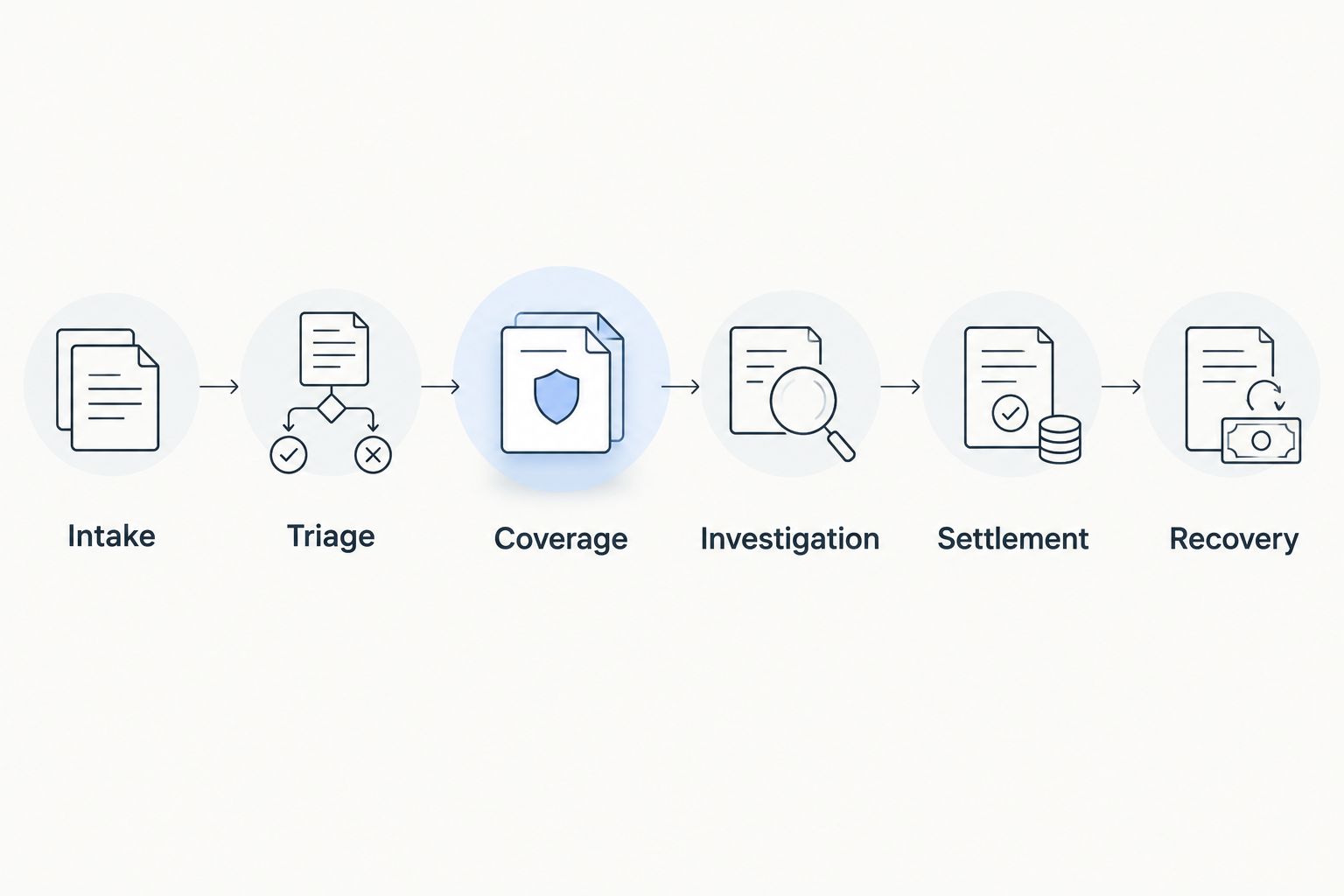
Keep the initial map operational: every stage needs an input, an owner, and a condition for moving the file onward.
- Name the role responsible for each stage.
- Separate information gathering from decision authority.
- Identify injury and litigation escalation routes.
- Document carrier approval requirements for delegated handling.
- Define the conditions that stop automated action.
2. Standardize your commercial auto FNOL inputs
Begin with a shared intake checklist and inspect completed files manually. Capture the reported loss separately from verified facts. A driver’s account, a policy record, and a repair document serve different purposes; combining them into an unqualified summary hides their evidentiary differences.
Identify the vehicle and the driver independently. For a fleet loss, do not assume the reporting contact drove the vehicle or that the insured vehicle is the only vehicle involved. Preserve uncertainty when the report lacks a unit identifier, driver details, or a clear account of the incident.
Automation becomes the faster path when it organizes intake information and identifies follow-up work without making unsupported conclusions. Evaluate that behavior before allowing intake output to drive downstream routing.
- Record policy identifiers and the reported loss date.
- Capture vehicle identifiers and driver details separately.
- List involved parties and reported injuries.
- Preserve the source of each statement or attachment.
- Flag missing information rather than filling gaps.
3. Define triage rules around exposure and uncertainty
Write a routing matrix before configuring an agent. Use the information your team already considers: reported injuries, multiple vehicles, disputed accounts, uncertain coverage, and potential litigation. Keep the matrix readable enough for an adjuster to explain why a file entered a particular queue.
For your 2026 pilot, separate urgency, complexity, and uncertainty. A file with incomplete information is not automatically a routine file. It needs a defined follow-up path, even when the reported damage appears straightforward.
Gethesperai’s AI claims agents span intake and triage within the stated claims lifecycle. Evaluate whether that scope fits your routing matrix; do not treat lifecycle coverage as proof of commercial auto routing accuracy. Use the AI claims triage tools guide to frame a separate triage comparison.
- Define distinct queues for routine and specialist handling.
- Route reported injuries through your injury-handling process.
- Escalate conflicting accounts for review.
- Assign an owner to missing-information follow-up.
- Record the reason for every routing decision.
4. Tie coverage review to the policy record
Check coverage manually against the applicable policy documents, endorsements, and loss information before deciding what the agent should do. Commercial auto review requires attention to the insured vehicle, relevant parties, reported use, and policy terms. A plausible explanation is not a substitute for the policy record.
Ask the proposed system to identify its supporting documents and distinguish a coverage question from a coverage conclusion. Your coverage reviewer needs to know what remains unresolved, not just receive a confident summary.
Require reviewable evidence before expanding decision authority. Test ambiguous vehicle references and conflicting dates as well as complete files. When the evidence cannot support a conclusion, the correct output is an escalation with a clear reason.
- Identify the applicable policy and endorsements.
- Check the reported loss date against the policy period.
- Review vehicle and insured-party information.
- Separate policy language from the agent’s interpretation.
- Require authorized review for unresolved coverage issues.
5. Preserve evidence across investigation and recovery
Start with an evidence checklist and a manual recovery review. Keep driver statements, photographs, relevant reports, correspondence, and damage records connected to their sources. Separate observations from allegations and conclusions throughout the file.
Fraud investigation and subrogation have different purposes. A discrepancy can justify further investigation without establishing fraud. Evidence about another party’s responsibility can justify a recovery review without establishing a recoverable amount.
When evaluating automation in 2026, test whether useful information survives the handoff from investigation to recovery. Do not accept a workflow that summarizes evidence so aggressively that the receiving team cannot trace the underlying record. Assess whether proposed automation reduces duplicate review while preserving uncertainty and source detail.
- Retain the original source for each material fact.
- Distinguish inconsistencies from confirmed findings.
- Follow your existing special investigation referral criteria.
- Identify potential responsible parties for recovery review.
- Pass unresolved questions to the next workflow owner.
6. Gate settlement actions by delegated authority
Review settlement preparation manually before enabling automated actions. Define what the system can assemble, what it can recommend, and what requires approval. Drafting a communication, recommending a settlement, and authorizing payment are different permissions.
For commercial auto teams, authority rules need to reflect the claim type and the handling arrangement. A TPA workflow should follow its delegated authority, while an MGA workflow should respect the responsibilities assigned under its agreement. Do not copy permissions from another organization’s demonstration.
Test both permission boundaries and failure handling. If required evidence is missing or an approval has not arrived, the workflow should stop at the appropriate boundary. Faster preparation does not justify broader settlement authority.
- List permitted preparation tasks separately from decisions.
- Document approval requirements by claim type.
- Identify actions that require carrier involvement.
- Test blocked actions and approval-dependent actions.
- Preserve the approved version of outgoing communications.
7. Measure pilot quality before expanding scope
Build a manual baseline from the same files you use to evaluate automation. For a practical starting exercise, select 30 closed claims with varied circumstances. This is a recommended review set, not a statistically validated sample or a promised implementation requirement.
Start with 2 workflow stages, such as intake and triage. Compare the proposed output with the verified file, then classify omissions, unsupported conclusions, wrong routing, and correct escalations. Measure elapsed time alongside review effort; a quick output that needs extensive correction is not a completed task.
During your 2026 pilot, inspect 5 randomly selected files per review cycle in addition to every flagged exception. These are proposed operating controls, not industry benchmarks. Increase review depth when errors appear, and define expansion criteria before judging results.
- Measure completion time using consistent start and stop events.
- Record correction work and adjuster review effort.
- Classify material errors separately from formatting issues.
- Check whether escalations reach the correct owner.
- Expand scope only after documented acceptance criteria are met.
Compare your commercial auto automation options
Choose the option that addresses your actual bottleneck. Manual handling gives you a baseline, rules-based automation fits explicit conditions, and lifecycle agents warrant evaluation when work crosses several claims stages. None eliminates the need to define authority and verify outputs.
| Option | Best for | Practical advantage | Key limitation |
|---|---|---|---|
| Manual handling with standardized checklists | Establishing a baseline and managing exceptions | Keeps reasoning and responsibility with the assigned claims professional | Staff must gather, interpret, and transfer information themselves |
| Rules-based workflow automation | Routing tasks governed by explicit conditions | Makes specified routing conditions consistent | Requires rules to be defined and maintained; unresolved situations need another handling path |
| Gethesperai AI claims agents | P&C carriers, TPAs, and MGAs evaluating lifecycle automation | Stated scope includes FNOL, triage, coverage, fraud investigation, settlement, and subrogation | Commercial auto suitability and performance must be established on your files |
Choose the smallest automation scope that solves the current handoff problem. If missing intake information is the bottleneck, evaluate intake first. If recovery evidence gets lost after settlement handling, investigate that handoff instead of adding another intake tool.
For your 2026 procurement review, ask each vendor to demonstrate the same permitted tasks on the same cases. Require an explanation of exceptions, not just a successful demonstration. Confirm integration requirements, access controls, record retention, and implementation responsibilities directly before making a selection.
Common mistakes commercial auto insurers make
Treating a fleet report as a complete claim record
A report from a fleet contact does not automatically establish the driver’s account, vehicle identity, or all involved parties. Keep those records separate and reconcile them before allowing intake information to drive coverage or liability conclusions.
Using one routing path for every auto exposure
Vehicle damage, reported injury, uncertain coverage, and litigation concerns need handling paths that match your procedures. A single routine queue conceals those differences. Define escalation criteria before measuring routing speed.
Confusing investigation signals with findings
An inconsistent account is a reason to examine evidence, not proof of fraud. Require source-linked investigation outputs and keep referral criteria separate from conclusions. Otherwise, automation turns unresolved questions into unsupported allegations.
Automating settlement without recovery review
Settlement handling and recovery assessment answer different questions. Preserve evidence about potentially responsible parties and assign recovery ownership before closing the relevant workflow. A completed settlement task should not erase unresolved recovery work.
Measuring speed without measuring correction work
Output time excludes the effort needed to fix omissions, verify unsupported statements, or reroute a file. Track both production time and review work against the manual baseline. Approve expansion based on usable results, not presentation quality.
FAQ
What are AI claims agents for commercial auto insurers?
AI claims agents for commercial auto insurers are software systems that carry out tasks within commercial auto claims workflows. Evaluate them for intake, triage, coverage review, investigation, settlement preparation, and recovery, with permissions matched to your claims procedures.
What's the best place to start automating commercial auto claims?
Start with a bounded intake or triage workflow whose outputs your team can verify against the claim file. Define missing-information handling and escalation rules before extending automation into coverage or settlement decisions.
Is Gethesperai suitable for commercial auto claims teams?
Gethesperai is a candidate for commercial auto teams evaluating P&C claims lifecycle automation. Its stated scope covers FNOL through subrogation, but suitability depends on testing your commercial auto files, authority rules, and operational requirements.
Are AI claims agents better than rules-based automation?
The better option depends on the task and the evidence from your evaluation. Compare rules-based routing for explicit conditions with agent-based handling for broader workflows, using the same files and acceptance criteria.
Can an AI claims agent make coverage decisions without an adjuster?
Do not authorize autonomous coverage decisions unless your policies and applicable obligations permit them and your evaluation supports that scope. Require traceable policy evidence, defined decision authority, and escalation for unresolved coverage questions.
How should a TPA test commercial auto claims automation?
A TPA should test automation against its delegated authority and the carrier's handling requirements. Compare outputs with verified files and test whether the workflow stops when carrier approval or specialist review is required.
What should a commercial auto automation pilot measure?
Measure material errors, correct routing, evidence traceability, completion time, and correction effort. Treat the proposed review sample as an operating exercise, not proof of performance across the entire claims portfolio.
One last thing
Test a file the system should refuse to complete. Include unresolved vehicle identity, contradictory accounts, or an action outside delegated authority. A useful claims agent must recognize the boundary and return an actionable escalation, rather than complete a task on unsupported assumptions.
Before expanding Gethesperai or another platform, make that stop condition part of your acceptance criteria. Successful automation includes knowing when the next action belongs to a claims professional.


