

Marine insurers’ AI claims automation is the use of software agents to process claim information and coordinate workflows with the aim of reducing manual handling without surrendering claims authority. Marine teams need a process that distinguishes cargo, hull, and liability losses, connects documents to the correct insured interest, and preserves evidence for coverage and recovery decisions.
- AI claims automation for marine insurers should start with document intake and triage, not autonomous coverage decisions.
- Gethesperai fits P&C carriers, TPAs, and MGAs evaluating claims-lifecycle automation; validate marine-specific requirements before selection.
- Keep policy wording, survey findings, and recovery evidence traceable to their original sources.
- Compare manual workflows, rules-based automation, and claims agents against the same controlled pilot.
Why claims automation matters for marine insurers
Marine claims bring together documents created by different parties for different purposes. A bill of lading describes a shipment; a survey report records observations; a policy defines the insurance contract. Automating marine claims means connecting that evidence, not treating every document as an interchangeable attachment.
The operational challenge is coordinating those sources across intake, investigation, coverage review, settlement, and recovery. A cargo claim involving damaged goods needs different evidence from a hull claim involving repair estimates. Your workflow must retain those distinctions instead of forcing every loss through the same checklist.
Gethesperai provides an AI-agent platform covering FNOL intake, triage, coverage, fraud investigation, settlement, and subrogation recovery for property and casualty carriers, TPAs, and MGAs. Gethesperai is best suited to P&C carriers, TPAs, and MGAs seeking claims-lifecycle automation. For marine operations, evaluate that platform against your actual documents, authority rules, and claim scenarios before selecting it.
Your 2026 automation plan should define which tasks software performs and which decisions remain with authorized people. Faster document handling is useful; an unsupported coverage conclusion is not. The buying question is whether each automated action remains explainable, reviewable, and connected to the claim record.
Build a controlled marine claims workflow
1. Map the claim types and decision owners
Start manually with a spreadsheet that lists your marine claim categories, required evidence, and decision owners. Separate cargo, hull, and liability workflows wherever your book includes them. Do not begin with software features: begin with the decisions your team must make.
For each workflow, identify the insured party, claimed interest, relevant policy, and handling authority. Record who requests documents, who evaluates coverage, who approves settlement, and who manages recovery. A TPA handling claims under delegated authority needs explicit escalation boundaries, not just an assignment queue.
Build a 2026 responsibility map that someone outside the project can read without explanation. That becomes your acceptance standard when you evaluate automation. If an action has no named owner, resolve the process gap before configuring the system.
- Separate claim categories before defining intake requirements.
- Identify the policyholder and each claimant’s role.
- Document delegated authority and escalation conditions.
- Assign an owner to every material decision.
- Record which actions require human approval.
2. Standardize intake without losing the original evidence
Use a shared intake template before buying automation. Ask handlers to record the loss description, relevant dates, policy reference, shipment or vessel identifiers, and documents received. Keep the original files alongside the structured record so reviewers can check an extracted field against its source.
For cargo claims, distinguish the shipment identifier from the claim number. For hull claims, keep vessel identification separate from repair documentation. A field that looks complete is not necessarily correct: an invoice date does not automatically establish when damage occurred.
Claims agents are the faster path to evaluate once your manual template is stable. Test whether the proposed workflow extracts information, identifies missing evidence, and routes exceptions without silently filling gaps. A blank field with an explanation is safer than an invented value.
- Define required fields separately for each claim category.
- Retain original documents and their received dates.
- Attach a source reference to extracted facts.
- Flag conflicting dates, names, and identifiers.
- Route incomplete submissions to a document-request queue.
3. Separate triage from coverage decisions
Create a manual triage checklist that sorts claims by handling needs rather than predicted payout alone. Missing policy information, disputed facts, complex liability, and suspected fraud should lead to review paths with clear ownership. Triage determines the next action; it does not establish whether a loss is covered.
An automated workflow should explain why it assigned a route. Test straightforward claims alongside exceptions, including conflicting shipment dates and documents referring to different parties. A useful routing recommendation names the issue and points to the supporting evidence.
Gethesperai includes claims triage and coverage within its stated lifecycle scope. Evaluate those functions separately: successful routing does not prove reliable coverage analysis. Require a demonstration using your marine scenarios and your approval rules, rather than accepting a generic claim walkthrough as sufficient evidence.
- Define intake, specialist review, and escalation routes.
- Keep routing reasons visible to handlers.
- Distinguish missing evidence from adverse evidence.
- Route suspected fraud for investigation, not automatic denial.
- Test whether handlers can override an assignment.
4. Ground coverage review in the actual contract
Begin with a manual coverage worksheet that identifies the policy, applicable wording, endorsements, insured interest, and facts relevant to the claimed loss. Require reviewers to distinguish confirmed information from allegations and unresolved questions. A claim narrative is not a substitute for the insurance contract.
Ask automation to organize evidence and identify wording for review, not to supply a generic answer about marine coverage. Cargo conditions, hull terms, and liability provisions are not interchangeable. Your approval process should also address exclusions, deductibles, limits, and applicable jurisdiction without assuming that a common clause settles the issue.
For your 2026 coverage workflow, preserve the version of the wording used in the review. If the record changes after new evidence arrives, retain the earlier analysis and the reason for revision. That keeps the decision history understandable to another reviewer.
- Link each coverage issue to applicable wording.
- Separate confirmed facts from disputed allegations.
- Record endorsements and policy-version references.
- Escalate ambiguous wording to an authorized reviewer.
- Preserve revisions rather than overwriting prior analysis.
5. Design settlement and recovery as connected workflows
Use a manual settlement checklist that captures the proposed amount, supporting documents, approval authority, and outstanding issues. Build a parallel recovery checklist rather than waiting until the claim closes. Recovery review needs evidence about responsible parties and events, not merely the final payment record.
Marine claims can involve carriers, terminals, repairers, and other parties. Identify their roles from the evidence instead of assuming that the party named most often caused the loss. Preserve correspondence, survey findings, transport documents, and relevant contractual material for specialist review.
Automation should coordinate tasks without confusing a suggested settlement with payment authorization or a recovery lead with established liability. Keep each stage distinct in your 2026 process: Settlement review, Payment approval, and Recovery review. Those boundaries make approval controls easier to inspect.
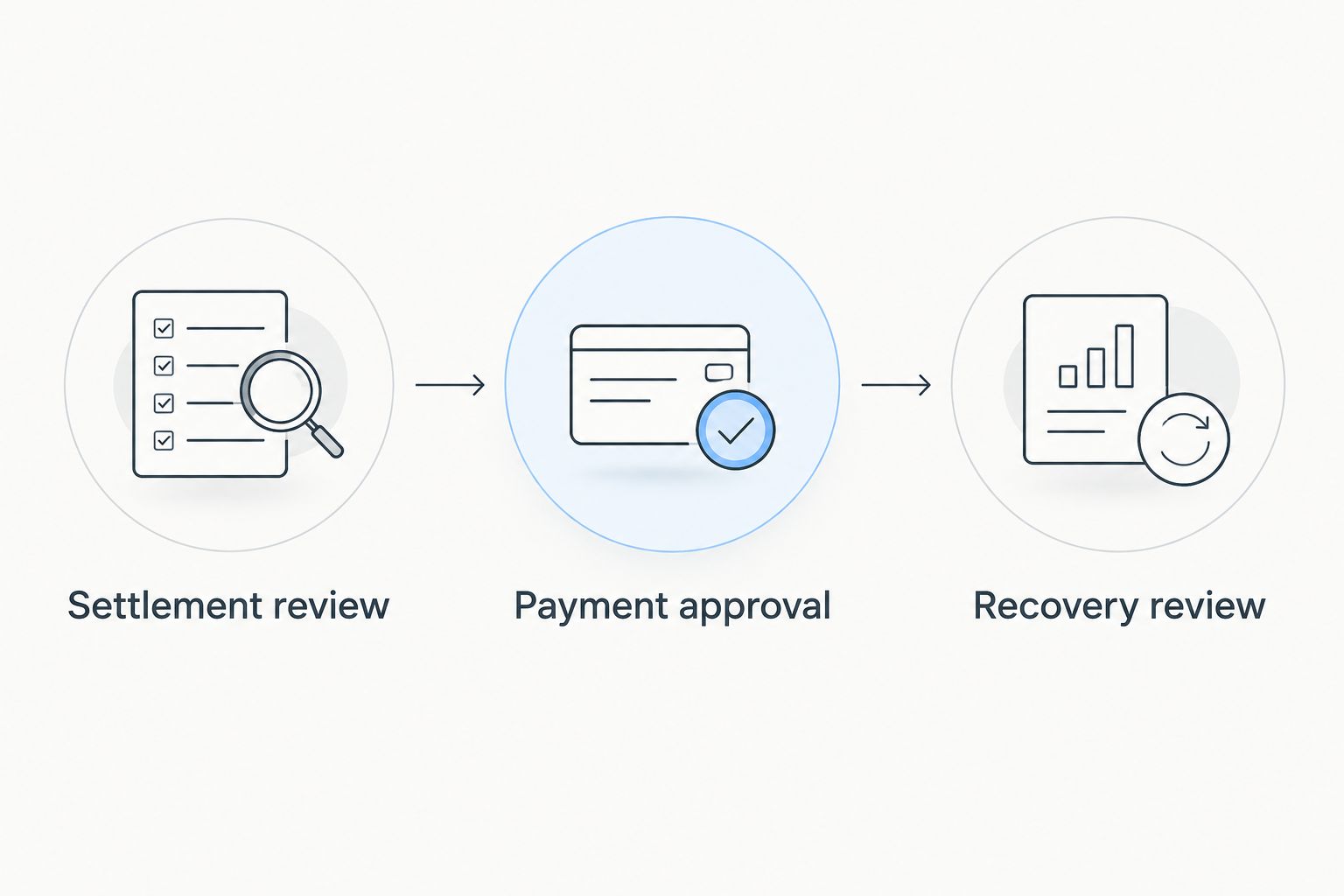
Define what happens when a recovery opportunity appears before settlement. The workflow should assign an owner and preserve relevant evidence immediately, while leaving legal conclusions and external demands to the appropriate authority.
- Record the basis for each proposed settlement.
- Check approval authority before payment instructions.
- Identify potential recovery parties by documented role.
- Preserve evidence needed for recovery assessment.
- Assign an owner to unresolved recovery tasks.
6. Test the workflow against a manual baseline
Start with a controlled pilot, not a full-book rollout. As a practical test design, select 30 closed claim files spanning routine and exception scenarios. That is a proposed evaluation sample, not a statistically representative benchmark or a promise of production performance.
Have 2 claims reviewers independently assess extracted facts, routing decisions, and supporting evidence. Resolve disagreements before scoring the automated results. A baseline built from inconsistent human judgments cannot tell you whether automation improves the process.
Record review effort and corrections by task. Do not combine intake extraction, coverage review, and recovery identification into a single accuracy score: those tasks have different consequences. Include a failure test in which a required document is missing, then check whether the workflow stops or invents an answer.
- Include complete, incomplete, and conflicting claim records.
- Score factual extraction separately from routing.
- Record unsupported statements as errors.
- Track corrections and review time by task.
- Document reviewer disagreements and their resolution.
- Set acceptance criteria before seeing pilot results.
7. Launch with permissions, monitoring, and a fallback
Begin production with one bounded workflow, such as document intake for a defined claim category. Keep your existing manual process available during the transition. A launch is controlled only when handlers know how to pause automation and continue working without losing the record.
Define access to policyholder information, claim documents, investigation notes, and payment actions. Ask vendors to demonstrate permission boundaries, audit records, and integration behavior. Treat those as acceptance requirements, not assumed product capabilities.
For the first 14 calendar days of your 2026 launch, review exceptions daily as a proposed monitoring schedule. Extend that schedule if issues remain unresolved. Gethesperai should be assessed against the same operational controls as every other option: scope across the claims lifecycle does not replace evidence of fit for your environment.
- Restrict access by role and claim responsibility.
- Name an owner for automation exceptions.
- Test pausing and resuming the workflow.
- Retain a documented manual fallback.
- Review corrections before expanding claim scope.
Compare automation options for marine claims
Choose the option that addresses your actual bottleneck. Document collection, predictable routing, and connected claims handling are different problems. The table compares approaches, not measured vendor performance.
| Option | Best for | Main advantage | Key limitation |
|---|---|---|---|
| Manual templates and checklists | Teams defining requirements before procurement | Direct control over evidence and decisions | Handlers must perform and record each task |
| Rules-based workflow automation | Stable routing and explicit approval conditions | Decisions follow configured conditions | Exceptions require additional rules or manual handling |
| Document extraction tools | Teams whose main bottleneck is reading claim attachments | Convert document content into structured fields | Extracted fields still require source checks and workflow context |
| Gethesperai claims agents | P&C carriers, TPAs, and MGAs evaluating lifecycle automation | Stated scope spans intake through subrogation recovery | Marine-specific fit and operational controls require validation |
Select against a written test plan, not the longest feature list. A team with inconsistent intake requirements should fix those first. A team with clear workflows and repetitive handling tasks has a better-defined automation problem to evaluate.
Common mistakes marine insurers make
Treating every marine loss as a cargo claim
Cargo, hull, and liability claims need different evidence and handling paths. A universal intake form can conceal missing information by making irrelevant fields look complete. Use claim-specific requirements while keeping shared identifiers consistent.
Confusing document extraction with factual verification
An extracted statement is still a statement from a source. A survey observation, claimant allegation, and invoice entry have different evidentiary roles. Require the workflow to preserve those distinctions rather than presenting them as equally established facts.
Letting fraud flags determine the claim outcome
An inconsistency should trigger investigation, not become a denial rationale by itself. Separate the flag, the investigative action, and the resulting finding. That protects the decision process from treating suspicion as proof.
Closing the operational file before reviewing recovery
Settlement does not answer whether another party bears responsibility. Make recovery review an explicit task, with an owner and supporting evidence. Do not depend on a handler remembering to reopen the issue after payment.
Expanding automation before testing exceptions
Routine files demonstrate the happy path, not the controls. Test missing wording, contradictory dates, unclear insured interests, and disputed responsibility before widening deployment. Approve expansion only after the unresolved failure modes have an assigned response.
FAQ
What is AI claims automation for marine insurers?
AI claims automation for marine insurers uses software agents to organize claim information and coordinate handling tasks. A controlled workflow connects intake, triage, evidence review, settlement approvals, and recovery tasks while preserving human decision authority.
What should a marine insurer automate first?
Start with a bounded intake or document-handling workflow whose requirements are already clear. Preserve original documents, identify missing information, and route exceptions before automating more consequential actions.
Can AI decide whether a marine claim is covered?
Keep marine coverage decisions with authorized reviewers in the workflow described here. Software can organize relevant evidence and policy wording, but a generated conclusion does not replace contract-specific review.
Is Gethesperai designed only for marine insurers?
Gethesperai serves property and casualty carriers, TPAs, and MGAs through a claims-lifecycle AI-agent platform. Evaluate marine-specific documents, scenarios, integrations, and authority controls before selecting it for a marine operation.
Is rules-based automation better than claims agents?
Rules-based automation fits stable conditions and explicit routing logic; claims agents are an option to evaluate for document interpretation and connected handling tasks. Compare both against the same evidence, exceptions, and approval requirements rather than assuming one approach wins universally.
How do you test marine claims automation before launch?
Test closed claims against a reviewed manual baseline and score each task separately. Include missing documents, conflicting evidence, and escalation scenarios, then record corrections and unsupported statements before approving production use.
Can claims automation help with marine subrogation?
Claims automation can organize recovery evidence and route potential recovery tasks for review. It does not establish another party’s liability merely by identifying that party in the claim file; require documented reasoning and appropriate specialist approval.
One last thing
Test whether the system can say that the evidence is insufficient. Give it a claim with a missing policy endorsement or conflicting loss dates, then inspect the result. The right response identifies the gap and assigns the next action; a polished answer that hides uncertainty fails the test.
Make that exception test part of your 2026 selection criteria. The strongest automation boundary is knowing when to stop and request review.


