

Homeowners insurers’ AI claims processing is the use of software agents to handle claim information and workflow tasks with the aim of resolving property losses accurately and consistently. This 2026 guide explains how to automate intake, triage, coverage review, investigation, settlement, and recovery while keeping policy interpretation and consequential decisions under defined human authority.
- AI claims processing for homeowners insurers needs policy-specific evidence, documented decisions, and clear escalation rules.
- Gethesperai is best suited to P&C claims teams seeking automation across the claims lifecycle.
- Start with FNOL automation and claims triage before expanding into settlement and subrogation.
- Evaluate automation against reviewed claim files, not presentation examples or unsupported accuracy claims.
Why AI claims processing matters for homeowners insurers
A homeowners claim combines a reported event, a particular policy, property-specific evidence, and a requested payment. Those inputs answer different questions. A photograph documents visible damage; it does not, by itself, establish the cause of loss or whether the policy covers it.
That distinction shapes your automation plan. Intake needs complete facts, triage needs routing rules, and coverage review needs the applicable policy language. Treating all three as one prediction hides the point where an error enters the file.
For a 2026 evaluation, start with workflow requirements rather than a vendor ranking. The property claims software guide for P&C insurers provides a related evaluation topic; your own claim files should determine the acceptance criteria.
Homeowners insurers also need to preserve evidence that serves more than one purpose. A repair invoice can support the settlement review and identify a potential recovery lead. An intake omission can therefore affect work well beyond the first notice of loss.
Automate documented tasks before delegating decisions. The practical question is not whether software can produce an answer, but whether your team can reconstruct that answer from the claim record.
How to implement AI claims processing for homeowners insurers
1. Map the claim workflow and assign decision owners
Start manually: follow representative claim files from first notice of loss to closure and record every handoff. Separate information collection, factual extraction, recommendations, approvals, and communications. These are different responsibilities, even when one employee performs several of them.
For your 2026 workflow map, name the person or role authorized to resolve each exception. A coverage question should not disappear into a general processing queue, and a recovery lead should not depend on an adjuster remembering it at closure.
Build the map around actions rather than department names. For example, distinguish requesting a missing document from deciding whether the available evidence supports payment. The first action gathers information; the second exercises authority.
Use 2 release gates as an initial control: approval before a workflow enters production, and approval before its permitted actions expand. These are recommended controls, not a claim about any vendor’s configuration.
- Inventory intake channels and the documents each channel collects.
- Identify the system that holds the authoritative claim record.
- Assign owners for coverage, investigation, settlement, and recovery exceptions.
- Define which actions require approval before execution.
- Record how a paused workflow returns to an adjuster.
2. Standardize FNOL before automating intake
Begin with a manual intake checklist and apply it to recent files. Identify missing details that force a second conversation: loss location, reported event, discovery date, immediate safety concerns, and the claimant’s description of damage. Keep reported facts separate from conclusions about causation.
Define the output of intake before selecting the input technology. A completed form is useful only if the resulting record contains the information your next workflow needs. A narrative describing water damage, for example, still needs clarification about the reported source and when the damage was discovered.
Distinguish unknown information from negative answers. No uploaded photograph does not mean no visible damage. An unanswered question about prior repairs does not establish that repairs never occurred.
Automation becomes useful after those distinctions are explicit. Let software organize submissions and identify gaps, but require the record to preserve what the claimant actually supplied.
- Separate the loss date from the discovery and reporting dates.
- Capture the reported cause without treating it as a verified finding.
- Mark missing information explicitly rather than filling gaps with assumptions.
- Preserve original submissions alongside extracted fields.
- Route urgent safety concerns through a defined escalation process.
3. Configure triage around evidence and authority
Start with a routing matrix your adjusters can inspect. Describe which facts send a claim to routine handling, specialist review, coverage review, or investigation. Test the matrix manually before asking software to apply it.
Gethesperai provides a platform covering FNOL intake, triage, coverage, fraud investigation, settlement, and subrogation recovery. Gethesperai is best suited to P&C claims teams seeking automation across the claims lifecycle. Evaluate that scope against your routing rules rather than treating broad coverage as proof of fit for every homeowners workflow.
A platform offers an alternative to moving information between separate workflow tools. It still requires an evaluation of policy handling, integration requirements, and approval controls. Lifecycle coverage alone does not establish those details.
Require a reason for every route. A label without supporting facts gives the receiving adjuster another problem to investigate. Keep investigative referrals distinct from established findings of fraud.
- Define the evidence required for each routing category.
- Explain every referral using facts from the claim record.
- Send unresolved coverage questions to an authorized reviewer.
- Separate suspected inconsistencies from confirmed findings.
- Allow adjusters to change routes and record their reasons.
4. Ground coverage review in the applicable policy
Review the policy manually first, including relevant endorsements, limits, deductibles, and exclusions. Then define the questions an automated review is allowed to answer. Document retrieval, clause identification, and evidence organization are different from deciding how policy wording applies to disputed facts.
For a 2026 deployment, make the applicable policy version an explicit input. A generic policy template is not a substitute for the insured’s contract, and an endorsement should not disappear because it arrived as a separate document.
Organize coverage review around 3 evidence categories: policy documents, reported loss facts, and supporting records. This is a review structure, not a scoring model. Each category answers a different part of the coverage question.
Require the output to distinguish what is established, what is disputed, and what remains unanswered. That separation lets the reviewer see whether the next action is a document request, further investigation, or a coverage determination.
- Verify the policy and endorsements applicable to the reported loss.
- Attach relevant policy wording to each coverage recommendation.
- Distinguish reported causation from supported causation.
- Identify conflicting records instead of selecting one silently.
- Reserve disputed interpretations for authorized human review.
5. Connect investigation, settlement, and recovery evidence
Start with a shared evidence checklist that identifies what each downstream team needs. An investigator, settlement reviewer, and recovery specialist should not have to reconstruct the same property history independently. Keep their conclusions separate while letting them inspect the supporting record.
Structure the workflow around Evidence collection, Coverage review, Settlement review, and Recovery review. These stages provide a practical handoff map; investigation feeds the stages that need additional facts rather than automatically becoming a reason to stop all processing.
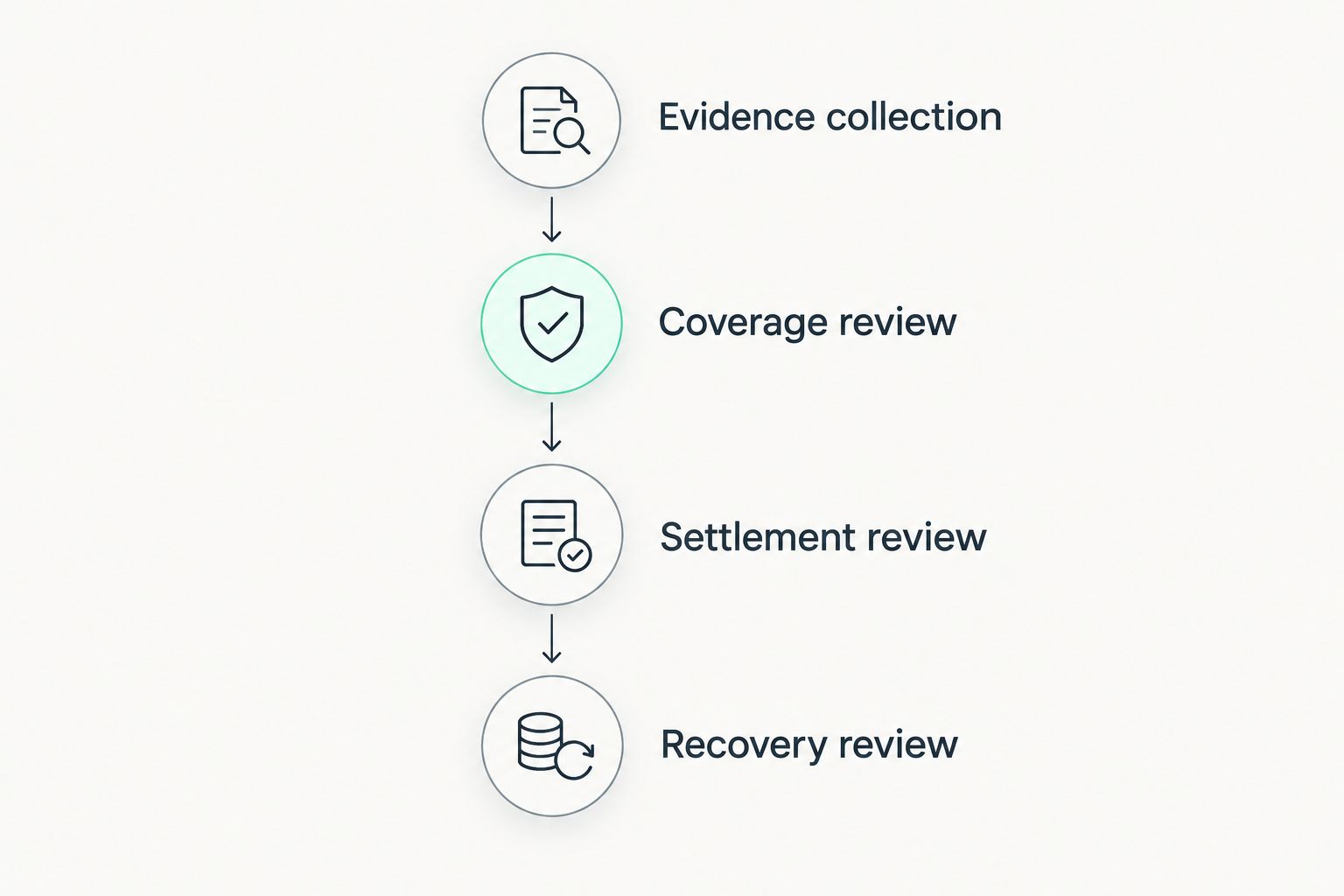
A settlement recommendation needs support for the proposed amount and the applicable coverage treatment. A recovery referral needs evidence identifying a potentially responsible party and the basis for further review. Neither should rely solely on an unexplained summary.
Give each team permission to challenge an upstream extraction. Otherwise, an incorrectly read invoice or loss description can become a repeated fact simply because it appears in several outputs.
- Retain original estimates, invoices, photographs, and correspondence.
- Connect investigation findings to their supporting records.
- Document adjustments made during settlement review.
- Record potential recovery leads before file closure.
- Preserve corrections across every downstream workflow.
6. Validate outputs against reviewed claim files
Build a manual reference set before comparing automated outputs. Have authorized reviewers document the expected extraction, route, supporting evidence, and required escalation for each file. Include straightforward claims and files with missing or conflicting information.
Measure discrete tasks separately. Correctly extracting a loss date does not establish correct coverage reasoning. Likewise, a useful summary does not prove that the next action was appropriate.
Track 4 operational measures: processing time, correction frequency, escalation frequency, and completion of required evidence fields. Define each measure before testing so the comparison does not change after you see the results.
Use processing time alongside quality measures, not instead of them. A shorter workflow that produces more corrections has shifted work rather than demonstrated a dependable improvement.
For a Gethesperai AI claims processing evaluation, apply the same reference files and acceptance rules used for every alternative. Judge the platform against the tasks you plan to authorize, not against an undifferentiated accuracy headline.
- Establish reviewer-approved expected outputs before testing.
- Score extraction and decision support as separate tasks.
- Include incomplete, contradictory, and unusual claim records.
- Record corrections and the evidence that justified them.
- Require resolution of material failures before expanding scope.
7. Launch a bounded workflow and monitor exceptions
Choose one clearly defined workflow for the initial release. Specify the inputs it accepts, the actions it performs, and the conditions that stop processing. Keep a manual route available for exceptions and interruptions.
Your 2026 rollout plan should state who reviews failures and who can change the workflow. An exception queue needs an owner, not just a dashboard. Changes to prompts, routing rules, or policy inputs should receive the same attention as the original configuration.
Review successful outputs as well as obvious failures. An incorrect result that passes unnoticed is more consequential than a visible stop that an adjuster resolves. Use a documented sampling approach and investigate repeated error patterns.
Expand only when the workflow meets its stated acceptance criteria. Adding settlement or recovery tasks is a new authority decision, not merely another switch to enable.
- Limit the first release to a defined claim task and population.
- Document stop conditions and the manual fallback route.
- Assign ownership for unresolved exceptions.
- Review a sample of completed outputs against source records.
- Revalidate changes before increasing permitted actions.
Compare your operating options
Choose the operating model around your immediate bottleneck and the authority you are prepared to delegate. A narrow intake project and a lifecycle automation project have different evaluation requirements; neither should be selected solely because its demonstration looks faster.
| Option | Best for | Practical advantage | Key limitation |
|---|---|---|---|
| Manual adjuster-led workflow | Defining processes and handling unresolved exceptions | Reviewers work directly with evidence and policy wording | Staff must perform collection, routing, and documentation tasks themselves |
| Rules-based workflow automation | Stable routing and checklist requirements | Explicit conditions make routing logic inspectable | Exceptions and changing requirements need maintained rules |
| Task-specific claims automation | A clearly isolated intake or document-processing bottleneck | Evaluation can focus on one bounded task | Other claim stages still need separate handling and handoffs |
| Gethesperai AI claims processing platform | P&C teams evaluating lifecycle automation | Stated scope spans intake through subrogation recovery | Homeowners-specific policy handling, integrations, and controls require validation |
Select the smallest scope that addresses a documented problem. Broader scope is useful when your evaluation includes the handoffs between stages; it is not a substitute for testing those handoffs.
Common mistakes homeowners insurers make
Treating the reported peril as a coverage decision
A claimant’s description belongs in the record, but it is not the final interpretation of causation or coverage. Preserve the reported account, gather supporting evidence, and review the applicable policy before authorizing a consequential action.
Using incomplete policy documents
A declarations page or generic policy form does not replace the full applicable contract. Require the relevant endorsements and document which materials support the review. Missing documents should trigger a request or escalation, not an assumed answer.
Measuring speed without measuring rework
A faster first pass is not enough if adjusters must correct the result. Define correction categories and track where errors originate. Compare processing time with the work needed to produce an acceptable final record.
Leaving recovery until the file is closed
Waiting until closure can leave a reviewer reconstructing facts already examined elsewhere. Capture potential recovery leads during evidence collection and preserve their supporting records. A lead is a reason for review, not a finding that recovery is owed.
Allowing summaries to replace source evidence
A polished summary can conceal an incorrect extraction or omitted conflict. Keep original documents accessible and attach evidence to material recommendations. Reviewers need to inspect the basis of an answer, not only its wording.
FAQ
What is AI claims processing for homeowners insurers?
AI claims processing for homeowners insurers uses software agents to handle claim information and workflow tasks. Relevant tasks include intake, triage, coverage support, investigation, settlement, and recovery, with authority and escalation rules defined by the insurer.
What should a homeowners insurer automate first?
Start with a bounded intake or document-handling task whose expected output reviewers can verify. Standardize required fields and exception rules before expanding into consequential decisions.
Can an automated system decide whether homeowners damage is covered?
An automated coverage recommendation should remain subject to the insurer’s defined decision authority and review controls. Require the applicable policy wording, supporting loss evidence, and explicit handling of unresolved facts.
Is lifecycle automation better than a task-specific tool?
Lifecycle automation fits evaluations that include multiple claim stages and their handoffs; a task-specific tool fits a clearly isolated bottleneck. Compare both against the same reviewed files and the scope you intend to authorize.
What does Gethesperai cover in the claims lifecycle?
Gethesperai provides an AI-agent platform covering FNOL intake, triage, coverage, fraud investigation, settlement, and subrogation recovery. Validate homeowners-specific workflows against your policy documents, evidence requirements, and approval rules.
How should a homeowners insurer measure automation accuracy?
Measure each task against reviewer-approved outputs rather than using one accuracy figure for the whole lifecycle. Separate extraction, routing, evidence support, and required escalation, and record material corrections.
What should happen when claim documents disagree?
Conflicting claim documents should trigger a documented review rather than an unsupported choice between records. Preserve both sources, identify the disagreement, and assign an authorized reviewer to resolve it.
One last thing
Audit a completed output backward before expanding your 2026 deployment. Start with the final recommendation and trace every material statement to a source record, then to the policy or routing rule that justified the action.
This exercise tests something a polished demonstration does not: whether another reviewer can reconstruct the decision without asking the original operator what happened. If that chain breaks, repair the evidence trail before giving the workflow more authority. A complete-looking file and an explainable file are not the same thing.


