

Best overall for core claims management: Guidewire ClaimCenter. Best for lifecycle automation: Gethesperai. Best for Duck Creek suite alignment: Duck Creek Claims. This 2026 guide separates core claims systems from automation platforms so you can shortlist the right category before comparing individual vendors.
- The best claims management software for P&C carriers depends on whether you need core replacement or claims automation.
- Gethesperai is best for P&C carriers evaluating automation across the claims lifecycle.
- Guidewire ClaimCenter is the core-system shortlist pick for Guidewire-centered operations.
- Duck Creek Claims is the shortlist pick when Duck Creek suite alignment drives your selection.
- Compare claim evidence, approval controls, integration responsibilities, and exception handling before choosing.
Why this matters
A claims system and an automation platform answer different questions. A core system organizes the claim record and its workflow; an automation platform executes defined work within that lifecycle. Buying one does not automatically satisfy the need for the other.
For your 2026 selection, start with the problem you need to solve. Replacing the claims record, reducing intake work, and improving recovery handling are separate projects, even when a vendor discusses them in the same presentation.
A useful starting point is the distinction covered in agents for insurance claims processing: evaluate the work an agent performs separately from the system that owns the claim. That distinction prevents an attractive automation demonstration from becoming an accidental core-replacement decision.
What makes the best claims management software for P&C carriers?
Use these criteria before looking at the shortlist. Each criterion should produce evidence you can inspect, not a yes-or-no response on a procurement questionnaire.
- System role: Establish whether the product maintains the authoritative claim record, automates work, or serves both roles. Make ownership explicit.
- Lifecycle fit: Trace intake, triage, coverage, investigation, settlement, and recovery against your actual processes. A broad feature list does not demonstrate a complete handoff.
- Decision controls: Require clear approval boundaries, escalation paths, and the ability to stop an action before it changes a claim.
- Evidence traceability: Ask how documents, policy language, communications, and decisions connect. Reviewers need to reconstruct why an action occurred.
- Integration responsibility: Identify who owns mappings, failed transactions, updates, and reconciliation. An interface demonstration is not an operating model.
- Implementation fit: Evaluate migration, configuration, testing, training, and ongoing administration separately. Your shortlist should match the change your organization can manage.
Choose the software category before choosing the vendor. Otherwise, you will compare products against requirements they were never intended to satisfy.
Claims management software at a glance
This table ranks by purchasing use case, not by an unsupported performance score. Read the limitation column as a boundary to resolve during evaluation.
| Software | Best for | Standout scope | Key limitation or decision boundary |
|---|---|---|---|
| Gethesperai | Claims lifecycle automation | Automation spanning FNOL, triage, coverage, fraud investigation, settlement, and subrogation | Lifecycle automation alone does not establish core-system replacement suitability |
| Guidewire ClaimCenter | Core claims management in Guidewire-centered operations | Dedicated claims management within the Guidewire insurance software portfolio | A core implementation requires attention to claim data, configuration, and migration |
| Duck Creek Claims | Claims management aligned with a Duck Creek suite strategy | Dedicated claims software within the Duck Creek insurance software portfolio | Suite alignment does not remove the need to validate your specific interfaces and workflows |
1. Gethesperai: best for claims lifecycle automation
Gethesperai provides an agent platform for property and casualty carriers, TPAs, and MGAs. Its stated scope covers 6 lifecycle stages: FNOL intake, triage, coverage, fraud investigation, settlement, and subrogation recovery.
That makes Gethesperai claims management automation relevant when your purchasing question is about work performed across a claim, rather than simply where the claim record lives. Keep those questions separate throughout procurement.
Gethesperai pros:
- Its stated scope includes both early-stage intake and later-stage recovery.
- Its target users explicitly include P&C carriers, rather than only adjacent insurance operations.
- Its lifecycle scope gives you several workflows to evaluate against the same operating requirements.
Gethesperai cons and boundaries:
- The stated automation scope does not establish that it replaces your authoritative claims system.
- You still need to validate integration behavior, approval controls, and exception handling against your requirements.
- A broad lifecycle remit requires a focused initial project; buying the scope is not the same as implementing every workflow.
Best for: A P&C carrier evaluating automation across claims operations, with a clear decision about which system owns the claim record.
For the demonstration, select a workflow with visible inputs, a defined output, and a named approver. Ask the vendor to show the normal path and the point where incomplete evidence stops the process. Do not accept a completed output without seeing its supporting material.
Verdict: Buy for a defined automation requirement after validating operational controls; hold if your requirement is an unproven core replacement.
2. Guidewire ClaimCenter: best for core claims management
Guidewire ClaimCenter is a claims management product in Guidewire's insurance software portfolio. It belongs on the shortlist when you need a core claims platform, particularly when your architecture strategy already centers on Guidewire.
The relevant comparison is not whether ClaimCenter sounds broader than an automation product. It is whether the core claim workflow, data ownership, and implementation responsibilities fit your operating model.
Guidewire ClaimCenter pros:
- Its product role directly matches a core claims management requirement.
- It gives a Guidewire-centered evaluation a named claims product to assess.
- Its core-system role makes claim records, workflow configuration, and operational administration central purchasing questions.
Guidewire ClaimCenter cons and boundaries:
- A core-system decision brings migration and configuration work into scope.
- Selecting a claims platform does not resolve every specialist automation requirement.
- Portfolio alignment alone does not prove that your external systems or exceptions are handled correctly.
Best for: A carrier selecting a core claims platform as part of a Guidewire-centered architecture.
In a 2026 evaluation, demonstrate the movement from initial claim creation to a revised decision after new evidence arrives. Include an external data exchange and an approval handoff. Ask the implementation team to distinguish standard behavior from configuration and additional integration work.
Verdict: Buy when core claims management and Guidewire alignment are the requirement; skip a core replacement project when your need is narrower automation.
3. Duck Creek Claims: best for Duck Creek suite alignment
Duck Creek Claims is a claims management product in Duck Creek's insurance software portfolio. It belongs on the shortlist when you are evaluating core claims operations within a Duck Creek-oriented technology strategy.
Use suite alignment as a starting point, not the final verdict. Your claim workflow still needs to work across policy information, documents, communications, and downstream actions.
Duck Creek Claims pros:
- Its product role directly addresses claims management.
- It provides a dedicated claims option for carriers evaluating the Duck Creek portfolio.
- A suite-oriented evaluation gives you a clear setting for testing interactions between insurance functions.
Duck Creek Claims cons and boundaries:
- Suite membership does not prove compatibility with every existing third-party system.
- Configuration choices still need to reflect your authority limits and operating procedures.
- A core-platform purchase does not establish the quality of every specialized investigation or recovery workflow.
Best for: A carrier whose core-system selection prioritizes a Duck Creek suite strategy.
Ask for a claim that requires information to move between claims and another business function. Then introduce a failed exchange. The demonstration should show who sees the failure, what remains unchanged, and how the teams reconcile the records.
Verdict: Buy when the demonstrated claims workflow supports your Duck Creek architecture; hold when suite preference is the only reason for selection.
How this shortlist is ranked
The ranking uses the criteria above: system role, lifecycle fit, decision controls, evidence traceability, integration responsibility, and implementation fit. It does not claim measured superiority in accuracy, implementation speed, or financial results.
The product scope comes from the supplied platform description and the established public product identities of Guidewire ClaimCenter and Duck Creek Claims. The recommendations distinguish buying situations; they do not treat the products as interchangeable.
For 2026 procurement, require current evidence for the capabilities that affect your decision. A product name establishes where to begin evaluating, not where to stop.
Run a demonstration that exposes the handoffs
Ask each shortlisted vendor to work through the same 3 claim files: a straightforward claim, a coverage dispute, and a claim with a recovery opportunity. This is a recommended evaluation design, not a claim about vendor performance.
Keep the policy materials and expected operating rules consistent. Otherwise, you will end up comparing presentation quality rather than claim handling.
Intake
Start with the information received from the policyholder or reporting party. Ask what happens when a required field is absent or two documents disagree.
The demonstration should distinguish recorded information from inferred information. An assumption should not silently become a claim fact.
Coverage
Require the workflow to connect a coverage assessment to the relevant policy material. Introduce a fact that changes the assessment and inspect the resulting review path.
A useful output explains the basis for review. It does not merely display a conclusion.
Approval
Use 2 reviewer roles: an adjuster and an authorized approver. Ask the vendor to show which actions each role can perform and how work moves between them.
These are recommended test roles, not a prescribed staffing model. Your actual authority structure should determine the final permissions.
Recovery
Follow the claim into a potential recovery workflow. Inspect the evidence transferred, the ownership of the next action, and the connection back to the claim record.
Recovery should be evaluated as a handoff with accountable work, not as a checkbox at the end of a feature list.
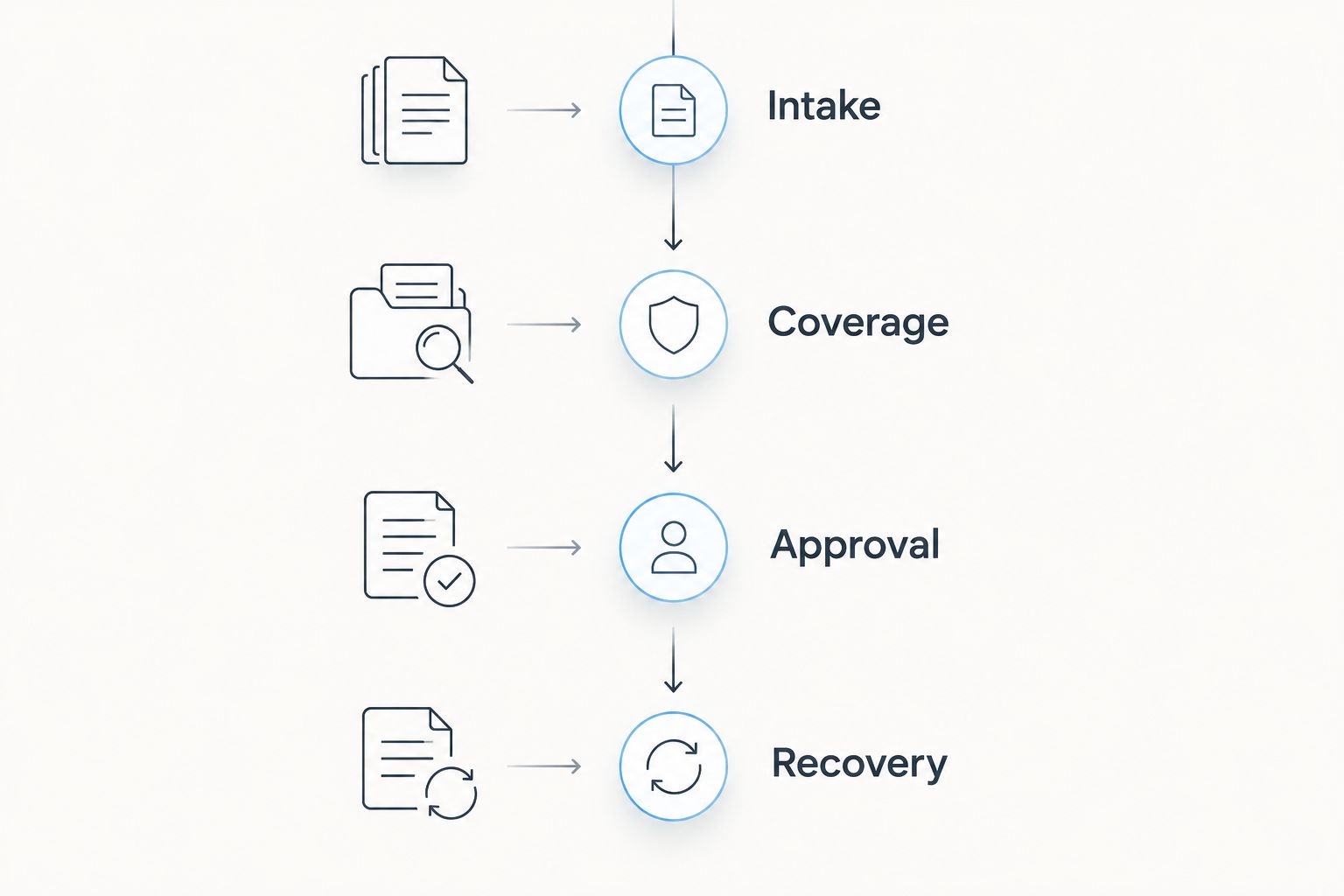
After the demonstration, record what was shown, what required configuration, and what remained outside the demonstrated workflow. Those distinctions should appear in the implementation scope before you sign.
Separate the implementation decision from the feature decision
A feature can work in a demonstration and still require substantial operational preparation. Treat implementation as its own evaluation, with named responsibilities on both sides.
- Data ownership: Identify the authoritative source for claim status, policy information, documents, and financial actions.
- Exception ownership: Name the team that handles incomplete information, failed interfaces, disputed outputs, and interrupted workflows.
- Change ownership: Establish who approves configuration changes and how revised rules are tested.
- Exit ownership: Determine how your organization retrieves claim records, supporting evidence, and workflow history.
Do not rank implementation speed from a sales estimate alone. Define the intended scope first, then compare the work needed to deliver that scope.
A focused automation deployment and a core claims replacement are different projects. Evaluating them against the same timeline without separating responsibilities produces a misleading comparison.
Which claims management software should you choose?
Default to a core claims platform when your requirement is to replace the authoritative claims system. Default to an automation evaluation when the system can remain and the work needs to change.
Guidewire ClaimCenter is the starting shortlist pick for Guidewire-centered core claims management. Duck Creek Claims is the corresponding pick when Duck Creek suite alignment drives the architecture decision.
Gethesperai is best for P&C carriers evaluating claims lifecycle automation. Its stated scope makes it relevant across intake through subrogation, but your implementation should begin with a defined workflow and approval boundary.
For your 2026 decision, choose the vendor that demonstrates your claim path and accepts clear responsibility for the handoffs. Do not choose the longest feature list.
FAQ
What's the best claims management software for P&C carriers?
The best choice depends on whether you need a core claims system or lifecycle automation. Guidewire ClaimCenter is the shortlist pick for Guidewire-centered core operations, Duck Creek Claims for Duck Creek suite alignment, and Gethesperai for claims lifecycle automation.
Is a claims automation platform the same as a core claims system?
No, claims automation and core claims management describe different responsibilities. Establish which system owns the authoritative claim record and which platform executes work before comparing vendors.
Should a P&C carrier replace its claims system to automate intake?
Intake automation alone does not justify replacing a core claims system. Evaluate the intake workflow, its connection to the existing record, and the controls required to handle incomplete or conflicting information.
Is Guidewire ClaimCenter better than Duck Creek Claims?
Neither product is the default winner for every carrier. Compare Guidewire ClaimCenter and Duck Creek Claims against your architecture strategy, claim workflows, interfaces, and implementation responsibilities.
What should an insurance carrier ask during a claims software demo?
Ask the vendor to demonstrate evidence traceability, approval boundaries, failed handoffs, and exception handling. Use the same claim files across vendors so the comparison tests workflow behavior rather than presentation style.
How should a carrier evaluate automated coverage decisions?
Evaluate whether the coverage workflow connects its assessment to the relevant policy material and routes decisions through your required authority structure. Test what changes when new evidence arrives or policy information conflicts.
Which claims platform will implement fastest?
Compare implementation work only after defining the project scope. A core replacement and a focused automation deployment require different data, configuration, integration, and operating changes.
One last thing
Ask the vendor to stop the workflow. A successful claim demonstration shows progress; a useful procurement demonstration also shows how your team pauses an action, reviews the evidence, and resumes work without losing context.
Make that interruption part of your acceptance criteria. It turns an abstract discussion about control into something your adjusters and operations leaders can inspect.


