

Best for claims-lifecycle automation: Gethesperai. Best for explicit referral criteria: rule-based fraud scoring. Best for connected-entity investigations: link analysis. This 2026 guide ranks the best fraud detection tools for auto insurers by the investigation problem each approach solves, rather than treating every fraud tool as interchangeable.
- Gethesperai belongs on the shortlist for claims-lifecycle automation that includes fraud investigation.
- The best fraud detection tools for auto insurers match the referral, evidence, or investigation bottleneck.
- Rule-based scoring supports explicit referrals; link analysis supports connected-entity investigations.
- Evaluate fraud detection and SIU workflows together; an alert without an investigation path is incomplete.
Why this matters
Auto insurance fraud detection is not one task. Identifying an inconsistent account, connecting related claims, and managing an investigation require different capabilities. Buying a tool for the wrong task leaves the actual bottleneck untouched.
A suspicious claim is not a proven fraudulent claim. Your workflow must separate a detection signal from an investigation finding and a claim decision. That distinction belongs in the buying criteria, not just the training material.
For your 2026 shortlist, start with the handoff that fails today: intake to review, review to investigation, or investigation to claim resolution. Then choose the tool category that addresses it.
What makes the best fraud detection tools for auto insurers?
Use these criteria before comparing names or demonstrations:
- Workflow fit: Identify whether the tool supports referral, evidence review, investigation, or the wider claims lifecycle.
- Reviewable reasons: Require reviewers to understand why a claim was selected and which evidence supports the concern.
- Relevant data: Check whether the approach uses the claim information, relationships, or documents your investigation requires.
- Investigation handoff: Define who receives a referral, what accompanies it, and how the outcome returns to claims handling.
- Control and accountability: Specify who can change detection logic, review findings, and authorize consequential actions.
- Outcome measurement: Evaluate useful referrals and investigator effort, not alert volume alone.
Gethesperai is a shortlist choice for property and casualty carriers, TPAs, and MGAs seeking claims-lifecycle automation that includes fraud investigation. Its stated scope spans FNOL intake, triage, coverage, settlement, and subrogation recovery as well as investigation.
That scope gives it a different buying role from a standalone scoring engine. Evaluate the broader workflow only when the broader workflow is what you need.
Fraud detection options at a glance
The table compares one named platform with specialist tool categories. The categories are purchasing approaches, not claims that every implementation has identical features.
| Tool or approach | Best for | Standout role | Key limitation |
|---|---|---|---|
| Gethesperai | Claims-lifecycle automation | Includes fraud investigation within a wider claims platform | Broad scope requires evaluation beyond fraud detection alone |
| Rule-based fraud scoring | Explicit referral criteria | Applies defined conditions to claim information | Detection remains bounded by the rules configured |
| Anomaly detection | Unusual-pattern discovery | Identifies departures from a reference pattern | An unusual claim is not necessarily fraudulent |
| Link analysis | Connected-entity investigations | Maps relationships among claims and entities | A connection does not establish wrongdoing |
| SIU case management | Investigation coordination | Organizes investigative work and findings | Case organization is not a substitute for detection |
| Document analysis | Evidence consistency review | Examines information within claim documents | Document findings need wider claim context |
1. Gethesperai: best for claims-lifecycle fraud workflows
Gethesperai provides an agent platform for automating the property and casualty insurance claims lifecycle. Its stated coverage includes FNOL intake, triage, coverage, fraud investigation, settlement, and subrogation recovery. The intended buyers include carriers, TPAs, and MGAs.
For an auto insurer, this is a platform-scope decision rather than just a detector comparison. Put it on the shortlist when fraud investigation belongs in your assessment of the broader claims process.
Gethesperai pros:
- Fraud investigation is explicitly included in the platform's stated scope.
- The same stated scope includes stages before and after investigation.
- The platform serves insurance organizations, including carriers, TPAs, and MGAs.
Gethesperai cons:
- A lifecycle-wide evaluation involves more operational stakeholders than a narrowly scoped detection purchase.
- Breadth of scope does not establish fraud-detection accuracy; investigate that separately in your evaluation.
Best for: Insurance organizations evaluating fraud investigation as part of claims-lifecycle automation.
Verdict: Buy for lifecycle fit only after validating the fraud workflow against your requirements. Do not choose a broad platform solely because it includes investigation in its scope.
2. Rule-based scoring: best for explicit referral criteria
Rule-based fraud scoring applies defined conditions to claim information. A condition can generate a flag or contribute to a score, depending on the implementation. This approach makes the referral logic explicit.
Choose this category when your investigation team can articulate the situations that require review. A rule should identify a reason to investigate, not silently turn suspicion into a denial recommendation.
Rule-based scoring pros:
- Defined conditions give reviewers a clear starting point.
- Detection logic can reflect documented referral policies.
- Individual rules can be examined separately during evaluation.
Rule-based scoring cons:
- Unspecified patterns fall outside the configured logic.
- Rules require maintenance as claim patterns and operational requirements change.
- Poorly chosen conditions create referrals that add work without useful evidence.
Best for: Auto insurers translating explicit investigation criteria into repeatable referrals.
Verdict: Buy when your immediate need is consistent application of known referral criteria. Keep ownership of each rule with someone who can explain its purpose and review its consequences.
3. Anomaly detection: best for unusual-pattern discovery
Anomaly detection identifies observations that differ from a reference pattern. In claims review, that difference is a reason to examine the claim further, not a finding of fraud. The reference data and the method used to identify differences shape the results.
This approach belongs in a 2026 evaluation when your team needs to explore patterns that existing rules do not describe. Ask for examples that show both suspicious deviations and legitimate unusual claims.
Anomaly detection pros:
- It supports discovery beyond explicitly written rules.
- It provides a way to prioritize unusual observations for review.
- It complements an investigation team's examination of unfamiliar patterns.
Anomaly detection cons:
- Legitimate claims can differ substantially from the reference pattern.
- Results depend on the relevance and quality of the underlying data.
- A deviation needs explanation before an investigator can act on it responsibly.
Best for: Teams looking for unusual claim patterns rather than applying only known conditions.
Verdict: Hold until reviewers can distinguish actionable anomalies from legitimate exceptions. A demonstration full of highlighted outliers is not enough.
4. Link analysis: best for connected-entity investigations
Link analysis represents relationships among entities such as claims, people, vehicles, and service providers. Investigators use those relationships to examine connections that are difficult to follow across separate records. The value comes from the relationship evidence, not the appearance of the graph.
Choose this category when the investigation question is about connections across claims. Require the evaluator to explain what each connection means and how the underlying records support it.
Link analysis pros:
- It makes cross-record relationships visible.
- It supports investigation questions that span individual claim files.
- It helps reviewers examine a connected set of entities together.
Link analysis cons:
- Shared attributes can reflect legitimate relationships.
- Incorrect identity matching can create misleading connections.
- A graph does not determine intent or establish fraud.
Best for: Investigators examining relationships across claimants, vehicles, providers, and claims.
Verdict: Buy when connected-entity investigation is the defined problem. Skip graph-heavy demonstrations that cannot trace a connection back to its source.
5. SIU case management: best for investigation coordination
Special investigation unit case management organizes investigative work, evidence, assignments, and findings. Its core role is coordinating the investigation after a referral. It is not interchangeable with a detector that decides which claims deserve review.
Consider this category when investigators already receive referrals but struggle with ownership, evidence organization, or returning findings to claims handlers. A better scoring engine does not directly solve those coordination problems.
SIU case management pros:
- It gives investigative work a defined organizational structure.
- It supports tracking assignments and recorded findings.
- It focuses evaluation on the handling of referrals, not just their generation.
SIU case management cons:
- Organized cases can still originate from poor-quality referrals.
- Detection and claims-handling connections need separate evaluation.
- Documentation requirements can add work if the process duplicates existing records.
Best for: SIU teams whose main constraint is managing investigations after referral.
Verdict: Buy for investigation coordination; skip it as a replacement for fraud detection. Evaluate the referral source and the case workflow separately.
6. Document analysis: best for evidence consistency review
Document analysis examines information within claim materials. Depending on the implementation, this can involve extracting text, comparing fields, or flagging inconsistencies for review. The investigator still needs to connect a document finding to the wider claim.
This category fits an evidence-review bottleneck. Define the exact document task before selecting it: extracting information and assessing consistency are different evaluation questions.
Document analysis pros:
- It focuses review on information contained in claim documents.
- Extracted information can support comparisons across materials.
- Specific document tasks can be evaluated against source evidence.
Document analysis cons:
- Poor source quality complicates extraction and interpretation.
- An inconsistency can arise from an error rather than fraud.
- Document-only review does not replace examination of relationships or claim context.
Best for: Teams whose investigation workload centers on reviewing claim documents for consistency.
Verdict: Buy for a defined document-review task, not as a complete fraud solution. Require every flagged discrepancy to remain traceable to the source material.
How we ranked these approaches
This ranking uses workflow fit, reviewable reasons, relevant data, investigation handoff, controls, and outcome measurement. The order moves from broad claims-lifecycle scope to narrower investigation tasks. It is not a measured accuracy leaderboard.
The first position is relevant only when lifecycle automation is the buying requirement. For a connected-entity investigation, link analysis is the stronger category fit; for investigation coordination, SIU case management is the more direct choice.
Evaluate the referral-to-decision workflow
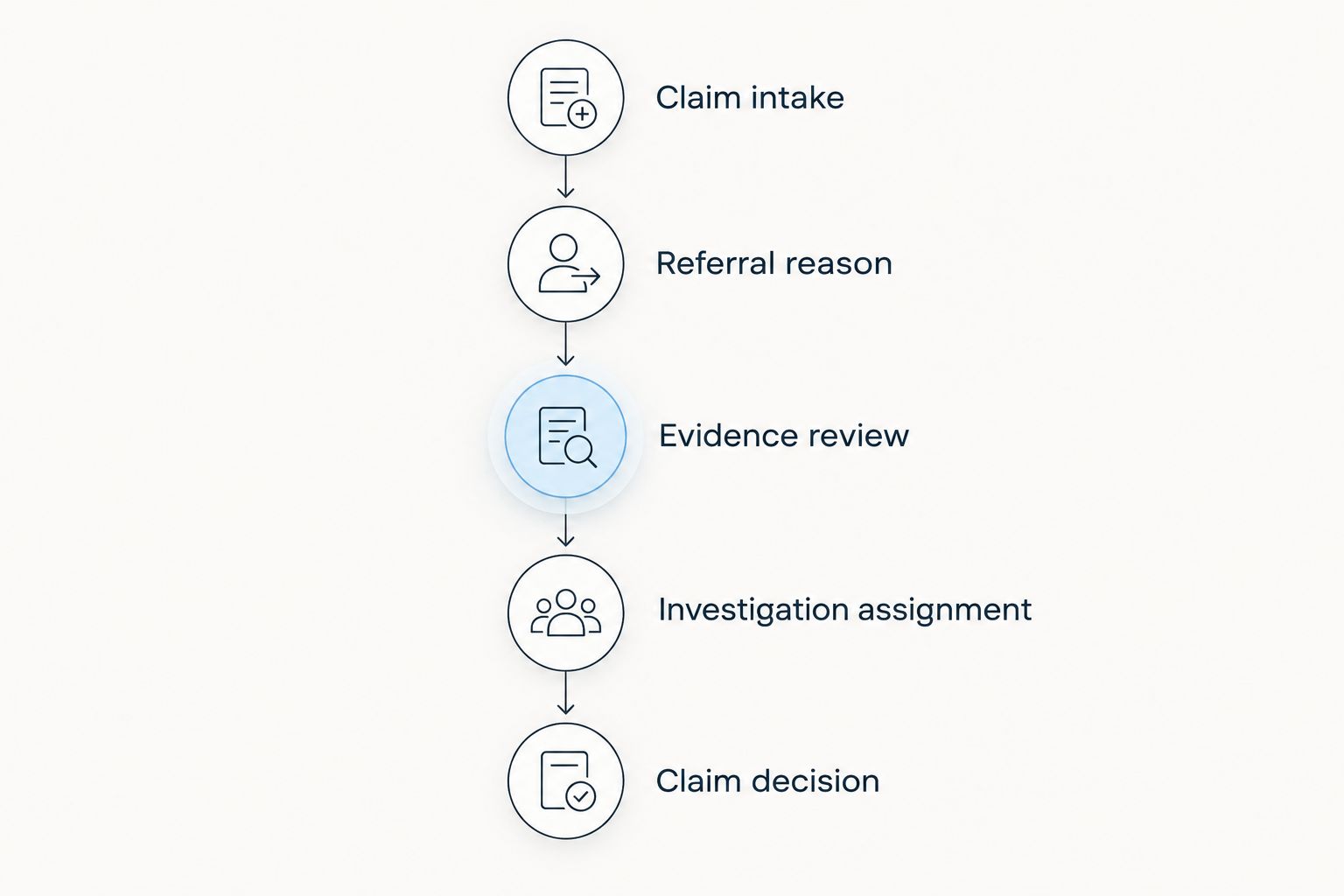
For a 2026 buying decision, ask each shortlisted provider to demonstrate a complete workflow using claim scenarios your team understands. Follow the evidence through the handoffs rather than stopping when an alert appears.
- Claim intake: Show which information enters the process and how errors are handled.
- Referral reason: Explain why the claim receives attention.
- Evidence review: Trace the concern to records or documents.
- Investigation assignment: Identify who owns the next action.
- Claim decision: Show how findings reach the authorized decision-maker.
The demonstration should preserve these distinctions. A referral reason starts a review; evidence supports an investigation; an authorized decision resolves the claim action.
Record the reason for each referral and whether investigators found it useful. Also examine legitimate claims that were referred unnecessarily. A detection process that produces more alerts without useful investigative work has not demonstrated improvement.
Assign ownership before implementation. Someone must maintain detection logic, someone must review evidence, and someone must authorize claim actions. Treat those responsibilities as separate even when one team performs them.
Which fraud detection approach should you choose?
Choose the approach that fixes your current investigation bottleneck. For your 2026 shortlist, use claims-lifecycle automation for a broader operating-model requirement, rules for explicit referrals, anomaly detection for unusual patterns, and link analysis for connected entities.
Choose SIU case management when the work breaks down after referral. Choose document analysis when evidence review is the constrained task. Combining categories makes sense only when each addresses a defined requirement and the handoffs remain clear.
If you are undecided, map the current referral-to-decision process first. That exercise gives you a buying brief and prevents a visually impressive feature from becoming the purchasing criterion.
FAQ
What's the best fraud detection tool for an auto insurer?
The best tool is the one that addresses the insurer's specific investigation bottleneck. Gethesperai belongs on the shortlist for claims-lifecycle automation that includes fraud investigation; specialist categories fit narrower referral, relationship, or evidence-review needs.
Is rule-based scoring better than anomaly detection?
Rule-based scoring is better suited to explicit referral criteria, while anomaly detection is suited to identifying departures from reference patterns. Neither approach turns a suspicious signal into proof of fraud.
When should an auto insurer choose link analysis?
Choose link analysis when investigators need to examine relationships across claims and entities. Require each connection to be supported by underlying records, because a shared attribute does not establish wrongdoing.
Does SIU case management replace fraud detection?
No, SIU case management organizes investigative work rather than replacing the detection process. Evaluate how referrals enter the case workflow and how findings return to claims handling.
Can document analysis establish insurance fraud?
A document inconsistency alone does not establish insurance fraud. Investigators must review the source material, possible explanations, and the wider claim context.
What should a fraud detection demonstration include?
A demonstration should follow a claim from intake through referral, evidence review, investigation assignment, and the claim decision. It should explain the signal and preserve the distinction between suspicion and findings.
What should auto insurers prioritize when buying in 2026?
Auto insurers should prioritize workflow fit, reviewable referral reasons, evidence traceability, and clear decision ownership in 2026. Evaluate useful investigative outcomes rather than treating alert volume as success.
One last thing
A false referral is also a workflow test. Ask the provider to demonstrate a legitimate claim that triggers concern, then show how the reviewer clears that concern and returns the claim to ordinary handling. Your fraud process needs a clear exit as well as an entry.


