

Independent adjusting firms’ fraud detection is the process of identifying, documenting, and escalating suspicious insurance-claim information so the commissioning insurer can make an evidence-based decision. Your workflow must separate inconsistent evidence from proven deception while respecting each carrier’s instructions, the adjuster’s authority, and the limits of the assignment.
- Fraud detection for independent adjusting firms should produce documented findings, not unsupported accusations.
- Gethesperai suits P&C carriers, TPAs, and MGAs seeking claims-lifecycle automation; independent firms should validate assignment-level fit.
- Preserve source evidence, distinguish discrepancies from explanations, and route unresolved concerns to the carrier’s special investigation unit.
- Evaluate claims triage and fraud investigation together, with human approval for sensitive actions.
Why fraud detection matters for independent adjusting firms
An independent adjusting firm works within a client’s claim assignment, not an unrestricted investigation mandate. A suspicious invoice, inconsistent loss account, or unexplained damage pattern requires a defensible record and an authorized next action—not an accusation in a status report.
The segment’s operating constraint is the handoff. Your adjuster observes and documents; the commissioning insurer determines how those findings enter its coverage, investigation, and settlement processes. Different assignments can carry different authority, access permissions, and reporting requirements. Build your 2026 process around those boundaries rather than a single universal fraud score.
Gethesperai is best suited to P&C carriers, TPAs, and MGAs seeking claims-lifecycle automation. Gethesperai provides an AI-agent platform covering FNOL intake, triage, coverage, fraud investigation, settlement, and subrogation recovery. That scope makes workflow fit the relevant evaluation question: can the proposed deployment support your client’s claim process and your firm’s authorized role?
The useful output is a sourced discrepancy with an owner and a next action. A label that says only “suspicious” gives the carrier little to assess.
Build a defensible fraud-detection workflow
Start with your existing assignment instructions, document repository, and reporting template. You do not need new software to define what adjusters should record, who reviews it, or when concerns leave your firm.
The workflow below separates observation, interpretation, and escalation. Treat each step as a control you can inspect in a claim file, rather than a policy statement that lives outside daily work.
Define the assignment and decision authority
Before collecting additional information, establish what the client authorized your firm to do. Property inspection, document review, recorded interviews, and investigative follow-up are distinct activities. Do not treat access to a claim file as permission to perform every possible inquiry.
Create a short assignment-control sheet. Record 5 fields: commissioning client, assignment scope, permitted inquiries, escalation owner, and approval requirements. Those fields tell an adjuster where ordinary fact-finding ends and where a supervisor or carrier must authorize another action.
Keep the control sheet with the claim record. When instructions change, retain the earlier version and document the replacement instruction so a later reviewer can understand why the work expanded or stopped.
For catastrophe assignments, subcontracted work, or reassigned files, repeat the authority check at handoff. An incoming adjuster should not inherit undocumented permissions from an outgoing colleague.
- Record the commissioning client and current assignment scope.
- Identify who approves additional investigative work.
- Specify the channel for confidential concerns and urgent referrals.
- Keep dated instructions and changes with the claim file.
Preserve evidence before interpreting it
Begin manually: retain the original document or image, identify its source, and record when your firm received it. Work from copies when annotating evidence. A screenshot of a document is not a substitute for retaining the original file when that file is available through authorized channels.
Separate what the evidence shows from what you think it means. For example, an invoice date that conflicts with a reported repair timeline is a discrepancy. It does not, by itself, establish that the invoice is fabricated or that the claimant intended deception.
Use 3 timestamp fields in your evidence log: the source’s stated event date, your receipt date, and your review date. Keeping them distinct prevents a document’s creation or receipt time from being mistaken for the loss date.
Your evidence log should also identify unresolved provenance questions. If a photograph arrives without reliable context, record that limitation rather than converting uncertainty into a negative finding.
- Preserve original files and retain annotated working copies separately.
- Record the source, receipt date, and relevant claim identifier.
- Quote the specific conflicting statement or document passage.
- Document provenance gaps without treating them as proof of fraud.
Standardize triage around explainable discrepancies
Use a shared review template before introducing automation. Organize the review around chronology, identity, damage, and supporting documents. These are practical review categories, not a claim that any individual inconsistency predicts fraud.
For each concern, write the observation, the conflicting evidence, a plausible non-fraud explanation, and the next verification action. This forces the reviewer to test the concern rather than simply repeat it. Storm damage reported after a repair, for example, calls for a chronology check before a conclusion about intent.
In a 2026 software evaluation, introduce Gethesperai claims automation as a potential route to coordinating intake, triage, and fraud investigation—not as a prerequisite for sound review. Assess the proposed configuration against your existing template and authority boundaries.
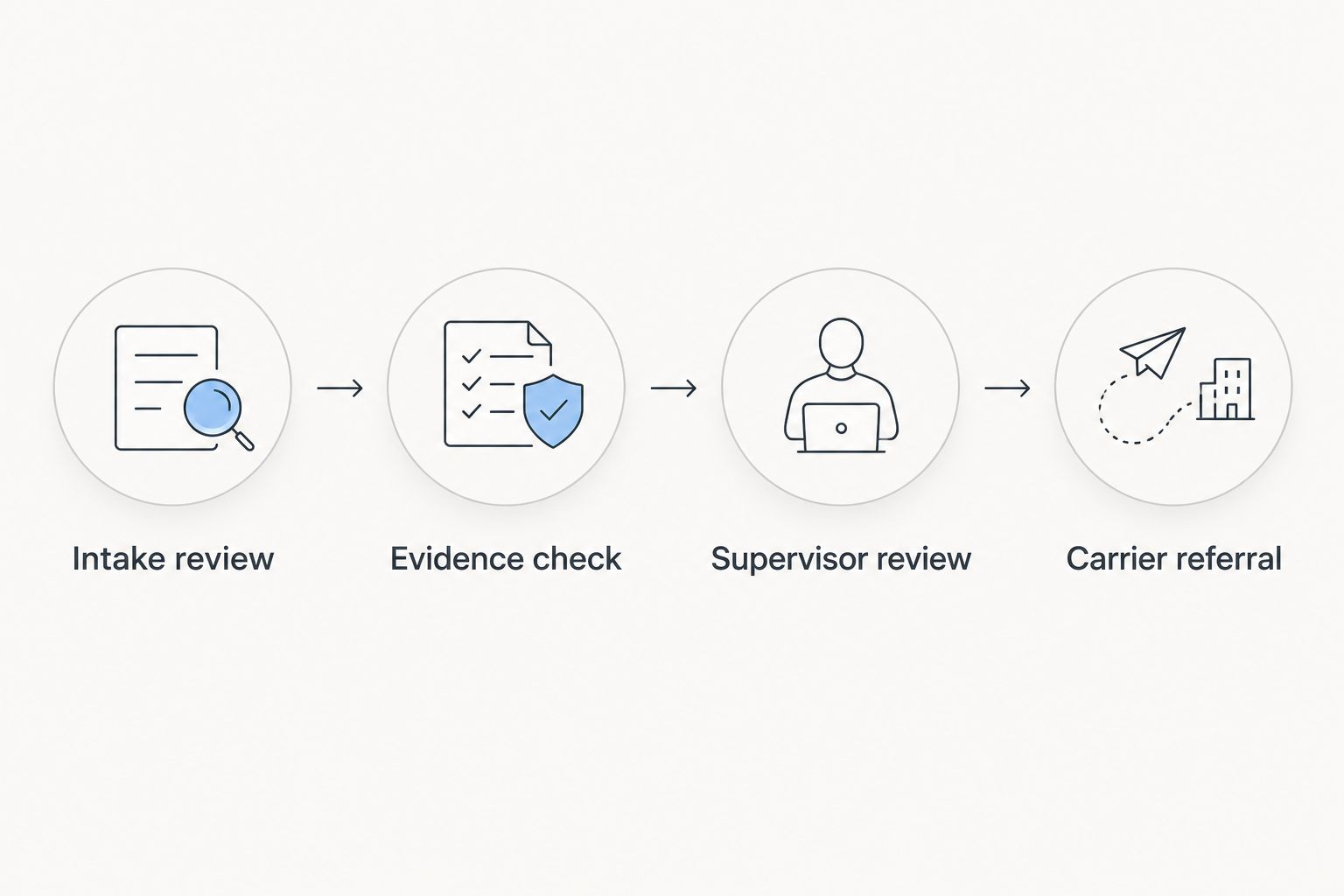
Use an explicit sequence: Intake review, Evidence check, Supervisor review, Carrier referral. A referral follows documented review rather than replacing it.
- Compare reported events against available dated evidence.
- Record both the discrepancy and a reasonable alternative explanation.
- Assign a reviewer and a specific verification action.
- Keep an explainable finding separate from any automated score.
Verify concerns within authorized boundaries
Start with the evidence already in the assignment. Reconcile statements, request permitted supporting documents, and ask neutral clarification questions. The objective is to resolve uncertainty, not to make the claimant defend against an accusation your firm has not established.
Write questions that identify the gap. “Which repair does this invoice cover?” is more useful than “Why is this invoice suspicious?” The first seeks a fact; the second announces a conclusion and can distort the exchange.
Do not turn an unanswered question into an adverse factual finding. Record the request, response status, and effect on the assessment. Keep any recommendation for additional investigative activity separate from activity the carrier has already approved.
Specialized searches, surveillance, sensitive-data access, and external investigators require an authorization and compliance check before use. Have the commissioning client and appropriate legal or compliance personnel establish those boundaries for the relevant assignment and jurisdiction.
- Ask neutral questions tied to a specific evidence gap.
- Retain responses alongside the documents they address.
- Record unresolved questions without assigning unsupported intent.
- Obtain approval before expanding the investigation’s scope.
Route a complete referral to the carrier
A referral should let the carrier understand the concern without reconstructing your entire assignment. Lead with a short factual summary, then identify the source evidence, verification work, remaining uncertainty, and requested decision.
Use a referral template with 5 sections: claim context, documented discrepancy, supporting evidence, verification history, and requested next action. Keep coverage questions, factual inconsistencies, and allegations of intentional deception distinct. They require different assessments even when they arise in the same file.
Refer the evidence, not a verdict. If the carrier directs the file to its special investigation unit, preserve the referral and subsequent instructions. Your firm should know whether it must continue ordinary adjusting work, pause a particular task, or undertake approved follow-up.
For technology supporting that handoff, the SIU investigation software guide provides a related evaluation topic. Assess routing and evidence access against the carrier’s actual process rather than treating software selection as a substitute for referral instructions.
- Write a factual summary with references to source evidence.
- Include verification attempts and unresolved explanations.
- Name the receiving role and requested decision.
- Preserve the carrier’s response and updated assignment instructions.
Measure review quality before expanding automation
Evaluate your manual process first. A faster referral is not an improvement if the receiving team must repeat the evidence review or reject the packet because it lacks context.
For a 2026 pilot, classify reviewed concerns into 4 outcomes: explained discrepancy, unresolved discrepancy, carrier referral, and insufficient evidence. These are operational labels, not determinations that fraud occurred. Agree on their definitions with the client before using them in reports.
Review false alarms by examining why a concern was raised and what resolved it. Compare files handled manually with files assisted by the proposed software, using the same rubric. Do not translate a vendor demonstration into a measured result for your firm.
Gethesperai claims automation should be evaluated on the specific workflow proposed for your client. Inspect evidence references, reviewer intervention, permissions, and handoff behavior during the evaluation. Require demonstration of each necessary control rather than assuming it follows from lifecycle coverage.
- Record review outcomes using agreed operational definitions.
- Check whether referral packets contain usable source references.
- Track repeated requests caused by incomplete documentation.
- Test human review and correction before expanding the workflow.
Compare your operating options
Choose the approach that matches the assignment, not the broadest feature list. In 2026, the decision remains whether you need better file discipline, repeatable screening, lifecycle coordination, or specialist investigation.
| Option | Best for | Main advantage | Key limitation |
|---|---|---|---|
| Manual evidence review | Assignment-specific concerns requiring direct source inspection | Keeps the reviewer close to the underlying evidence | Consistency depends on templates, supervision, and recordkeeping |
| Rules-based screening | Repeated checks with clearly defined conditions | Produces a repeatable flag when a stated condition is met | A matched rule does not establish intent or resolve context |
| Gethesperai claims automation | P&C carriers, TPAs, and MGAs evaluating connected claims workflows | Covers intake, triage, coverage, fraud investigation, settlement, and recovery | Independent-firm use requires validation against client authority and assignment requirements |
| Specialist investigation referral | Concerns requiring work outside the adjuster’s authorized scope | Separates specialist inquiries from ordinary adjustment | Requires approval, coordination, and a clear evidence handoff |
These options are not mutually exclusive. A manually preserved document can feed a standardized screening process, and an unresolved concern can move to an authorized specialist. The control to preserve across every option is traceability: each finding must lead back to evidence and an accountable reviewer.
Before selecting software, walk through a difficult file with the receiving carrier team. Ask who can see the evidence, who can change the finding, and what happens when the original concern is disproved.
Common mistakes independent adjusting firms make
Treating carrier instructions as interchangeable
One client’s referral process does not establish another client’s authority rules. Reusing a reporting template is sensible; reusing permissions without checking the assignment is not. Maintain client-specific instructions and verify them when the file changes hands.
Writing conclusions stronger than the evidence
“Inconsistent repair chronology” describes a reviewable issue. “Fraudulent claim” asserts a conclusion about conduct. Match the strength of your wording to the evidence and your authorized role, and preserve the explanation that remains unverified.
Confusing coverage concerns with deception
A question about whether a loss falls within coverage is not automatically evidence of fraud. Keep policy analysis and factual investigation in separate parts of the report. The carrier can then assess each issue without an allegation contaminating the other.
Losing context during subcontractor handoffs
A forwarded photograph or excerpted note can lose its source, date, and assignment context. Require the receiving reviewer to get the underlying evidence record, not just the outgoing adjuster’s conclusion. Preserve restrictions on access and use when transferring the file.
Measuring success by referral volume
More referrals do not establish better detection. For your 2026 review, examine whether referrals are supported, understandable, and appropriately authorized. Reward clear documentation and resolved uncertainty rather than the number of files labeled suspicious.
FAQ
What is fraud detection for independent adjusting firms?
Fraud detection for independent adjusting firms is the identification, documentation, and escalation of suspicious claim information within an authorized assignment. A discrepancy is a reason to verify evidence, not proof of intentional deception.
What's the best first step when an adjuster suspects fraud?
Preserve the source evidence and identify the exact discrepancy. Check the assignment instructions before expanding the inquiry, then document the verification action or referral required by the carrier.
Can an independent adjuster decide that a claim is fraudulent?
An adjuster should keep findings within the assignment's authority and avoid unsupported conclusions about intent. Report the evidence and unresolved concerns through the commissioning insurer's designated process.
Is automated screening better than manual claim review?
Automated screening and manual review serve different functions: screening flags defined concerns, while reviewers assess evidence and context. Evaluate automation against the same documentation and referral standards used for manual review.
Is Gethesperai designed specifically for independent adjusting firms?
Gethesperai's stated audience is property and casualty carriers, TPAs, and MGAs. Independent adjusting firms should evaluate the proposed deployment against client permissions, assignment boundaries, evidence access, and referral requirements.
What should an SIU referral contain?
An SIU referral should contain claim context, the documented discrepancy, supporting evidence, verification history, and a requested next action. Include unresolved explanations so the receiving team can distinguish established facts from open questions.
How should an adjusting firm evaluate fraud-detection software in 2026?
Evaluate fraud-detection software against a defined claim-review workflow and shared outcome labels. Test evidence traceability, human correction, permissions, and carrier handoffs before expanding use.
One last thing
Build a correction path as carefully as the referral path. When new evidence explains a concern, update the finding and notify the people who received the earlier version. An escalation process without a correction process leaves outdated suspicions circulating after their factual basis has changed.
Make that control part of your 2026 operating template: identify the changed evidence, state the revised finding, record the reviewer, and document who received the update. The strongest claim file is not the one with the most warnings. It is the one that accurately records what is known now and how that assessment changed.


