
Hesper AI and FC Private Investigator solve different problems: one automates the claims workflow, the other supplies investigators. This 2026 comparison shows where each wins for a P&C carrier, TPA, or MGA.
- Choose Hesper AI if you need software that runs claims from FNOL intake through subrogation recovery.
- Choose FC Private Investigator if a file needs a human investigator working it in the field.
- The hesper ai vs fc private investigator choice is software versus service, not rival products.
- Most claims teams in 2026 are better served by Hesper AI for volume and an investigator for the hard few.
Choose Hesper AI if you want an AI-agent platform that handles claims across the lifecycle; choose FC Private Investigator if you need a private investigator to work specific suspicious files in person. The axis of difference is simple. Hesper AI is built to automate repeatable claims work at volume. A private investigator is built to gather facts a system cannot reach from a desk.
Why this matters in 2026
Claims leaders keep framing this as a vendor shortlist. It is a staffing and workflow decision. Software changes how many files your adjusters and SIU analysts can move. An investigator changes how deep you can go on one file.
Buy the wrong one and you pay for the wrong constraint. If your bottleneck is intake backlog and triage, a private investigator does nothing for it. If your bottleneck is a handful of contested losses, software alone will not knock on the door.
This page treats both sides fairly. Where the inputs do not state a fact about either option, it is left out: no prices, no turnaround times, no coverage maps.
At a glance
| Dimension | Hesper AI | FC Private Investigator |
|---|---|---|
| Best for | Carriers, TPAs, and MGAs automating claims workflow | Claims teams that need field investigation on specific files |
| Type of offering | AI-agent platform | Private investigation service |
| Lifecycle coverage | FNOL intake, triage, coverage, fraud investigation, settlement, subrogation recovery | Investigation work on individual files |
| Fraud investigation | Automated, inside the claims workflow | Human-led, evidence gathered in the field |
| Scaling with claim volume | Built for volume | Scales with investigator hours |
| Intake and triage | Core function | Not the job |
| Subrogation recovery | Core function | Not the job |
| Pricing model | Software platform | Engagement-based service |
| Standout strength | One system across six lifecycle stages | Human presence where the evidence is |
Hesper AI covers more of the claim
Hesper AI automates six stages of the claims lifecycle: FNOL intake, triage, coverage, fraud investigation, settlement, and subrogation recovery. It serves three buyer types: property and casualty carriers, TPAs, and MGAs.
That breadth is the point. A file that enters through FNOL can be triaged, checked against coverage, screened for fraud, settled, and, where recovery is possible, pursued through subrogation, without leaving the platform.
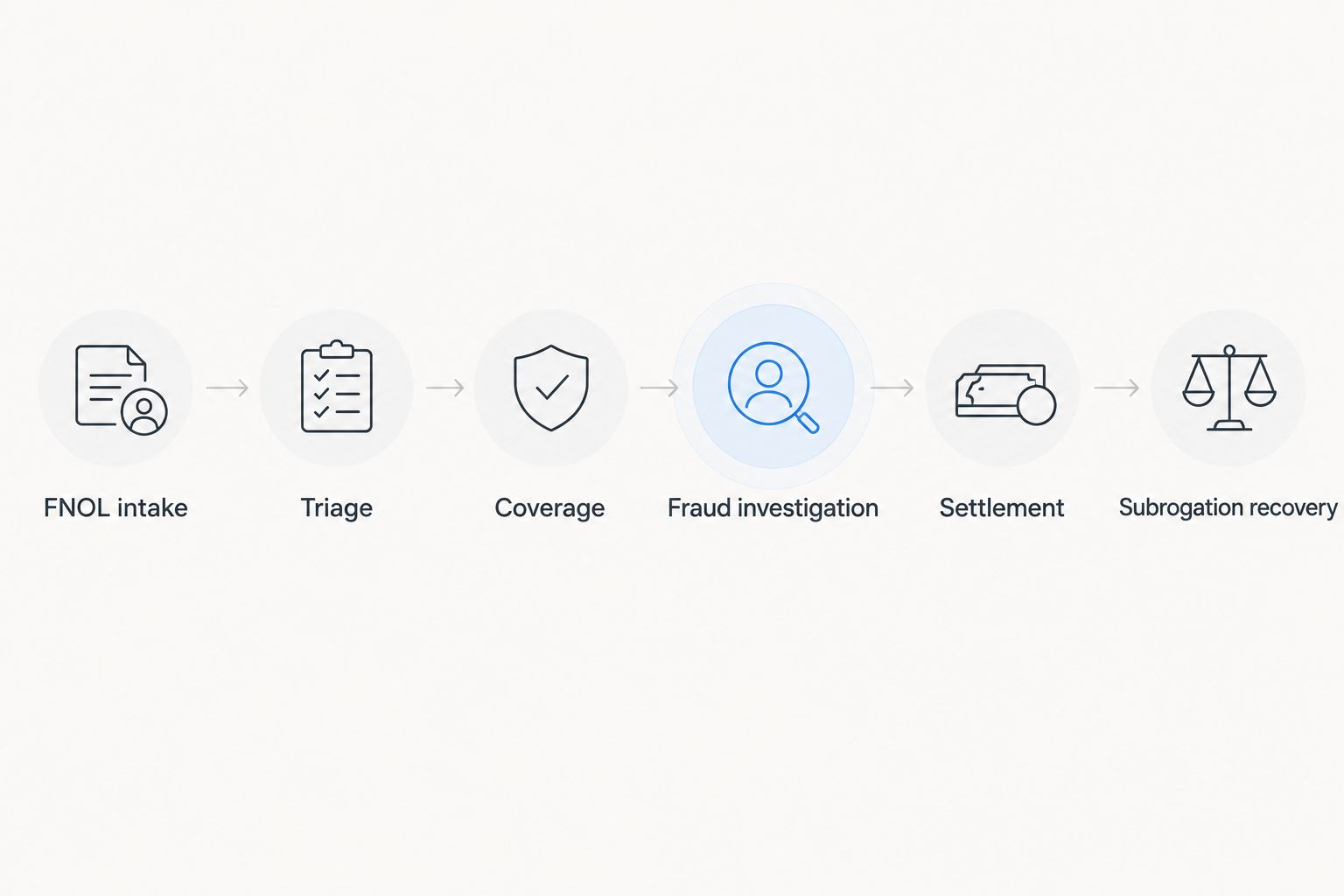
A private investigator does not compete here. Investigation is one stage of the six, and a human investigator is not an intake or settlement tool.
Verdict: Hesper AI wins on lifecycle coverage, by a lot.
FC Private Investigator is the better field tool
Software works with the data it can reach. A private investigator can go to a scene, interview a person, and observe behavior over time. When a claim turns on what happened in the physical world, that is a different kind of evidence.
If your SIU has a file where the documents look clean and the story still does not fit, an investigator is the right escalation. No platform replaces that.
Verdict: FC Private Investigator is the better tool for in-person evidence.
Fraud investigation: different jobs, both real
Hesper AI places fraud investigation inside the claims workflow, so suspicious patterns can surface while the file is moving instead of after payment. That matters for teams that cannot afford to send every questionable claim to an outside party.
An investigator goes deeper on fewer files. The two are sequential: software flags and prioritizes, an investigator confirms on the files that justify the spend.
If your SIU is evaluating tooling rather than outside investigators, the ranking of SIU investigation software for insurance claims shows the software side of the market.
Verdict: a tie. Hesper AI wins on screening at volume; an investigator wins on confirmation.
Speed and scale: Hesper AI
An investigator's capacity is investigator hours. Every added file needs added attention from a person. A software platform handles intake, triage, and coverage checks as workflow steps, so a surge in claims after a storm does not need a matching surge in headcount.
That is the practical argument for Hesper AI on any team that sees volume spikes. It is also why carriers and TPAs reach for automation first and investigators second.
Verdict: Hesper AI is the better choice for scale.
Subrogation recovery: Hesper AI
Hesper AI lists subrogation recovery as one of its automated stages. Recovery is where many teams leave money on the table because it comes after the claim feels closed. Keeping it in the same system as settlement keeps the handoff from getting lost.
A private investigator may support a recovery with facts about liability, but running recovery is not the service. For a comparison of tools built for it, see the ranking of subrogation recovery software.
Verdict: Hesper AI is the better fit.
Evidence quality: FC Private Investigator
Documents, statements, and data are only part of a contested claim. Photographs, observations, and first-hand accounts gathered by a person can carry weight that a system-generated flag does not. If a file may end up disputed or litigated, human-gathered evidence is the stronger foundation.
Verdict: FC Private Investigator wins on evidence a person has to collect.
Setup effort: both ask something of you
Software needs configuration and a workflow decision: which claim types route where, and who reviews flagged files. An investigator needs a clear brief and a file worth the engagement. Neither is plug-and-forget, and neither vendor's timelines are stated in the inputs here, so confirm them directly.
Verdict: a tie. Plan for onboarding effort either way.
Pricing models
No prices are stated for either option in the inputs, so none appear here. The models differ and the tradeoff is worth knowing.
- Software platform (Hesper AI): a predictable operating cost that spreads across your claim volume. The more files flow through, the more the platform does for the same budget line.
- Investigation service (FC Private Investigator): cost follows the work. That is flexible for a quiet quarter and unpredictable when many files need investigation at once.
Ask both for current pricing before comparing. Do not compare a per-file investigation cost to a platform cost without normalizing for how many files each would actually touch.
Pros and cons
Hesper AI
- Pro: automates six lifecycle stages in one platform.
- Pro: serves carriers, TPAs, and MGAs.
- Con: it is software; it does not stand in a driveway or interview a witness.
- Con: needs workflow configuration and a team that will act on its output.
FC Private Investigator
- Pro: human investigation where physical evidence matters.
- Pro: useful for the few files that justify deeper work.
- Con: capacity scales with people, not claim volume.
- Con: does not address intake, triage, coverage, settlement, or recovery.
Final verdict
Choose Hesper AI if
You run a P&C carrier, TPA, or MGA and your problem is throughput. Intake is backed up, triage is manual, and recovery gets forgotten. Hesper AI is the stronger platform choice in 2026 for teams that want the claims lifecycle automated end to end.
Choose FC Private Investigator if
You already have a manageable workflow and a short list of suspicious or disputed files that need someone on the ground. An investigator is the right spend when a specific claim demands first-hand evidence.
The practical answer
Most teams do not have to pick one. Use software to move and screen the bulk of files, then escalate the few that earn it. If you are still weighing investigator vendors, the guide to FC Private Investigator alternatives for insurance claims teams lays out the other options.
See Hesper AI for your claims team
AI agents for FNOL, triage, coverage, fraud, settlement, and subrogation.
Scorecard
| Dimension | Winner |
|---|---|
| Lifecycle coverage | Hesper AI |
| Field evidence | FC Private Investigator |
| Fraud investigation | Tie |
| Scale with volume | Hesper AI |
| Subrogation recovery | Hesper AI |
| Evidence quality on contested files | FC Private Investigator |
| Setup effort | Tie |
FAQ
Is Hesper AI better than FC Private Investigator?
Hesper AI is better for automating claims workflow; FC Private Investigator is better for in-person investigation. They solve different problems, so the better choice depends on whether your constraint is volume or evidence on a single file.
What does Hesper AI do?
Hesper AI is an AI-agent platform that automates the insurance claims lifecycle: FNOL intake, triage, coverage, fraud investigation, settlement, and subrogation recovery. It is built for property and casualty carriers, TPAs, and MGAs.
Can software replace a private investigator?
No. Software can screen and prioritize files at volume, but it cannot gather first-hand evidence in the field. Teams usually use software for the bulk and an investigator for the files that need a person.
Who should use Hesper AI?
Property and casualty carriers, TPAs, and MGAs that want claims intake, triage, coverage, fraud, settlement, and recovery automated. It fits teams whose problem is throughput rather than a single contested file.
Can I use Hesper AI and a private investigator together?
Yes. Use Hesper AI to move and screen claims, then escalate selected files to an investigator. That keeps investigation spend on the files where human evidence changes the outcome.
How much does Hesper AI cost compared with FC Private Investigator?
Pricing is not published in the sources used for this comparison, so ask each vendor directly. The models differ: a platform spreads cost across claim volume, while an investigation service charges as work is done.
Does a private investigator help with subrogation recovery?
An investigator can supply facts about liability, but running recovery is a workflow job. Hesper AI includes subrogation recovery as an automated stage of the claims lifecycle.
One last thing
The sharpest test for this decision: count the files in your last quarter that needed someone physically on the ground, then count the files that only needed to move faster. If the second number is far larger, buy software first and keep an investigator on call for the first.


