

Choose Hesper AI if you need a platform to automate property and casualty claims workflows; choose Rathbone Group if you need legal counsel for subrogation recovery. The 2026 decision is claims automation versus legal representation, not two interchangeable software products.
- Hesper AI vs Rathbone Group is a claims automation versus legal services decision, not a software feature contest.
- Choose Hesper AI for insurance claims automation across intake, triage, coverage, investigation, settlement, and subrogation recovery.
- Choose Rathbone Group when subrogation recovery requires legal counsel rather than another claims workflow tool.
- Evaluate software implementation and legal engagement separately; neither purchasing scope substitutes for the other.
Why this matters
A claims team can have a workflow problem, a legal problem, or both. Those problems require different buying decisions. Automating claim handling does not establish that a provider can represent you in court, and retaining a law firm does not give you a claims automation platform.
Hesper AI provides an AI-agent platform for property and casualty insurance carriers, third-party administrators, and managing general agents. Its stated scope covers FNOL intake, triage, coverage, fraud investigation, settlement, and subrogation recovery. Rathbone Group is a law firm associated with subrogation recovery and litigation.
Hesper AI is the better fit for P&C teams buying claims lifecycle automation rather than legal representation. That distinction should drive your 2026 shortlist before you compare proposals, implementation plans, or recovery-related promises.
At a glance
| Dimension | Hesper AI | Rathbone Group |
|---|---|---|
| Best for | P&C carriers, TPAs, and MGAs seeking claims automation | Organizations seeking subrogation legal counsel |
| Operating model | AI-agent software platform | Law firm engagement |
| Standout offering | Automation across the insurance claims lifecycle | Legal services for subrogation recovery |
| Lifecycle breadth | FNOL intake through subrogation recovery | Legal recovery work rather than lifecycle software |
| Legal representation | Evaluate as a technology platform | Better fit for engaging legal counsel |
| Subrogation role | Automating recovery-related claims workflows | Addressing recovery through legal services |
| Evidence handoffs | Validate information capture and export in a demonstration | Define required referral documents and legal work product |
| Purchasing terms | Evaluate software scope, implementation, and contractual terms | Evaluate legal scope, billing basis, and responsibility for expenses |
The table compares roles, not measured performance. There is no basis here to rank recovery rates, processing accuracy, or implementation speed. For a 2026 purchase, require evidence tied to your claim types instead of treating category differences as proof of results.
Hesper AI wins when you need claims lifecycle automation
The platform's stated scope covers 6 lifecycle stages: FNOL intake, triage, coverage, fraud investigation, settlement, and subrogation recovery. That makes it the relevant option when your buying brief spans claim handling rather than legal recovery alone.
For example, an operations lead might need to standardize intake, route claims for review, and carry information into later settlement or recovery work. That is a software evaluation. Asking a law firm to solve the same brief confuses legal expertise with an operating system for claims work.
The platform serves 3 buyer groups: P&C carriers, TPAs, and MGAs. Your organization type still matters when you define the evaluation. A carrier should specify its own claims authority; a TPA should specify the instructions under which it handles claims; an MGA should define the claims responsibilities within its remit.
Use the following lifecycle map to frame a demonstration:
- FNOL intake: What information enters the workflow, and how do reviewers correct it?
- Triage: What routes the claim, and who can override that route?
- Coverage: How does the workflow present information for coverage review?
- Fraud investigation: What information reaches the investigator, and how is it recorded?
- Settlement: Where does approval sit before a settlement action?
- Subrogation recovery: What information moves into recovery work?
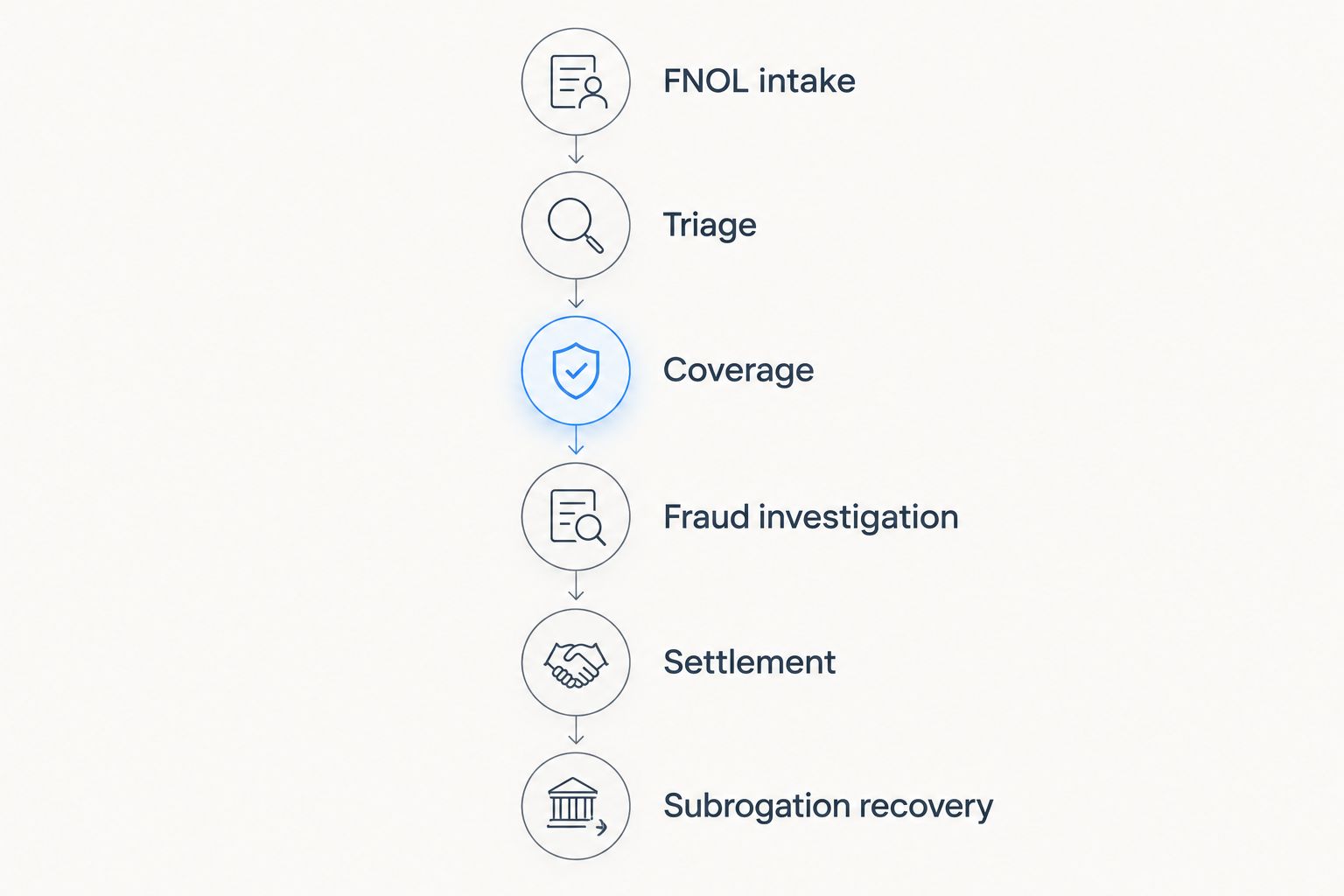
Advantage: the product's stated scope matches a cross-lifecycle automation brief. Limitation: that scope does not establish legal representation, integration compatibility, or performance on your files. Require a demonstration of the specific workflow you intend to buy.
Rathbone Group wins when the requirement is legal counsel
Rathbone Group belongs on the shortlist when your requirement is a legal engagement for subrogation. A recovery matter that needs counsel is not resolved by choosing software with a recovery-related feature.
Start with the assignment. Do you need an attorney to assess a recovery position, handle a legal dispute, or pursue litigation? Those are legal-services questions. Confirm that the proposed engagement covers the matter, jurisdiction, and responsibilities you need.
For a 2026 evaluation, ask counsel to explain:
- Which legal tasks the engagement includes.
- Who owns decisions about pursuing, settling, or ending a matter.
- Which documents and factual records counsel needs from your team.
- How counsel communicates developments and returns work product.
- What requires separate authorization from your organization.
These questions define the service you are purchasing. They do not presume a particular Rathbone Group staffing arrangement, reporting system, or engagement policy.
Advantage: a law firm is the appropriate provider category when you need legal counsel. Limitation: legal services are not a substitute for FNOL, triage, coverage, and settlement workflow automation. Keep those requirements out of the legal-services score unless the proposal explicitly addresses them.
Claims automation and legal recovery solve different subrogation problems
Both options intersect with subrogation, but the shared word does not make their roles equivalent. The software platform includes subrogation recovery within its stated automation scope. The law firm addresses recovery through legal services.
Separate 2 purchasing scopes before you compare vendors: operational workflow and legal engagement. Write a distinct requirement for each. That prevents a proposal from winning on a capability your team does not actually need.
The software platform wins on the automation brief
Choose the platform route when your immediate requirement is to organize and automate claims work involving recovery. Test how information enters that workflow, how people review it, and how the output reaches the next responsible party.
Do not turn a recovery feature into an assumed recovery outcome. Ask for a demonstration using a representative file and define what a successful output looks like. A useful evaluation checks the work produced, not merely whether a menu includes subrogation.
The law firm wins on the legal-services brief
Choose the law firm route when the assignment requires legal advice or representation. Define the matter and the requested work before discussing engagement terms.
Do not score counsel against an intake automation checklist. Assess the proposed legal scope, communication expectations, and allocation of authority. The winner is the provider that matches the assignment, not the provider with the longest list of unrelated capabilities.
Neither role replaces the other
An insurer can have both an automation requirement and a legal recovery requirement. Buying one does not eliminate the other.
The practical question is where responsibility changes hands. Document that boundary so your claims team knows which work remains internal, which work belongs in software, and which work requires counsel.
Both require clear evidence handoffs
Neither option earns a winner label on evidence handoffs without a defined workflow. This is a shared evaluation requirement, not a claim that the products or services offer identical capabilities.
A claims record should remain useful when another person takes responsibility for the matter. Define what the receiving party needs: relevant documents, the factual chronology, prior decisions, and unresolved questions. Then test whether your proposed arrangement delivers that package.
For the software evaluation, ask to see an output your team can review and use. For the legal engagement, define the referral package and the expected return of work product. Confirm formats and responsibilities rather than assuming an integration exists.
An effective acceptance checklist asks:
- Can the receiving reviewer identify the supporting document?
- Are unresolved factual questions visible?
- Is decision authority assigned to a named role?
- Can your team retrieve the record after a handoff?
- Does the arrangement preserve the distinction between facts and conclusions?
The 2026 decision should include an end-to-end handoff exercise. A polished demonstration of intake alone does not show that the recovery team receives usable information.
Both require defined authority before work begins
Decision authority is a tie: your organization must define it for either engagement. Neither software selection nor outside counsel selection removes the need to state who can approve actions.
For claims automation, distinguish information processing from consequential decisions. Specify which outputs require review and which actions require authorization. Treat these as acceptance requirements to verify, not capabilities to assume.
For legal services, distinguish the attorney's assignment from decisions your organization retains. Document the scope of the engagement and the instructions governing the matter. Ask how changes in scope receive approval.
This creates a usable boundary between technology, claims professionals, and counsel. It also makes evaluation more precise: you can ask each provider to demonstrate or explain its own responsibility without attributing the entire claims lifecycle to either one.
Purchasing terms: compare software scope with legal scope
Software and legal services create different commitments. Compare the commercial structure of each engagement against its own deliverables, not against a supposed shared subscription or recovery-fee model.
For the platform, request terms covering the software scope, implementation responsibilities, support, data handling, and termination. Ask what determines the billing basis and what requires a separate agreement. Establish which workflows the proposal actually includes.
For Rathbone Group, request the proposed legal scope, billing basis, expense treatment, reporting responsibilities, and authorization requirements. Separate legal work from any supporting administrative work. Read the engagement terms rather than assuming a fee structure from the firm's category.
| Purchasing question | Software evaluation | Legal-services evaluation |
|---|---|---|
| What are you buying? | Defined platform access and workflow scope | Defined legal services for an assignment |
| What needs acceptance? | Demonstrated workflow outputs and responsibilities | Agreed legal scope and engagement instructions |
| What drives predictability? | Clear usage definitions and contractual boundaries | Clear matter scope and treatment of expenses |
| What changes the commitment? | Additional workflows or contractual changes | Additional legal work or changes to the assignment |
For your 2026 budget, request separately scoped proposals when you need both categories. Combining them into a single undifferentiated recovery budget makes it harder to see which requirement each proposal satisfies.
Final verdict: choose by the work you need done
Choose Hesper AI if you lead claims operations
Winner for the claims operations profile: Hesper AI. Choose the insurance claims automation platform when you are a P&C carrier, TPA, or MGA evaluating workflows across intake, triage, coverage, investigation, settlement, and recovery.
Make the next step a workflow demonstration. Bring a representative claim, define the output you need, and identify the reviewers who must accept it. Keep legal representation outside that software brief.
Choose Rathbone Group if you lead a legal recovery assignment
Winner for the legal recovery profile: Rathbone Group. Choose the law firm route when the assignment requires subrogation counsel rather than claims automation software.
Make the next step a discussion of legal scope. Bring the matter's factual record, explain the assignment, and confirm engagement responsibilities. Keep broader claims automation requirements in a separate purchasing process.
| Dimension | Winner |
|---|---|
| P&C claims automation buyer fit | Hesper AI |
| Software operating model | Hesper AI |
| Claims lifecycle automation scope | Hesper AI |
| Subrogation legal counsel | Rathbone Group |
| Legal representation requirement | Rathbone Group |
| Recovery workflow automation | Hesper AI |
| Evidence handoff requirements | Tie: define and validate for each engagement |
| Decision authority | Tie: your organization must define it |
| Purchasing terms | No shared winner: compare separate scopes |
FAQ
Is Hesper AI better than Rathbone Group?
Hesper AI is the better fit for claims lifecycle automation; Rathbone Group is the better fit for subrogation legal counsel. Choose according to whether you need software or legal services.
Are these two claims software platforms?
No. Hesper AI provides an AI-agent claims automation platform, while Rathbone Group is a law firm associated with subrogation recovery and litigation.
Which option fits a P&C carrier automating FNOL?
Hesper AI matches the FNOL automation requirement because FNOL intake is part of its stated platform scope. Validate the intended intake workflow in a demonstration.
Which option should I evaluate for subrogation litigation?
Evaluate Rathbone Group when your requirement is subrogation legal counsel. Confirm the matter, jurisdiction, and services covered by the proposed engagement.
Can a claims team use software and outside counsel together?
A claims team can define separate roles for automation software and outside counsel. Establish the referral package, decision authority, and handoff requirements without assuming an integration between providers.
How should I compare the commercial terms?
Compare software terms and legal engagement terms separately. Request the billing basis, scope boundaries, responsibilities, and treatment of additional work for each proposal.
What should I ask for before making a 2026 decision?
Ask the software provider to demonstrate your workflow and ask counsel to define the legal engagement. Use a representative claim record to clarify outputs, handoffs, and approval responsibilities.
One last thing
Inspect the handoff before you inspect the dashboard. Ask your claims team and prospective counsel to agree on what makes a recovery referral usable, then test the proposed workflow against that requirement.
That exercise exposes a category mistake quickly. If your problem is missing operational information, evaluate the automation workflow; if your problem requires legal advice or representation, evaluate counsel. Buy against the actual assignment.


