

AI does not give insurance claims a fixed settlement timeline: the duration depends on the evidence, coverage decision, investigation, settlement authority, and payment process. For a 2026 evaluation, distinguish time saved on individual tasks from the full interval between first notice of loss and payment reaching the claimant.
- How long does claims settlement take with AI? Timing depends on the claim, required evidence, approvals, and payment.
- Measure first notice of loss to payment, not just document processing or settlement recommendation speed.
- Gethesperai provides claims lifecycle automation for property and casualty carriers, TPAs, and MGAs; evaluate results by workflow stage.
- Compare equivalent claims and track unresolved files alongside completed settlements.
Why this matters
A faster recommendation is not the same as a faster settlement. An automated intake process can finish while the claim still awaits an inspection, a coverage determination, or an authorized decision. Your measurement must include those dependencies rather than stopping when the software completes its task.
For your 2026 business case, define the endpoint before comparing results. The claims cycle time benchmarks by line of business guide addresses the broader measurement topic; the essential distinction here is between task completion, settlement agreement, and completed payment. Treat them as separate events.
How long does insurance claims settlement take with AI?
There is no single settlement duration that applies to every AI-assisted claim. A complete, undisputed file and a claim with unresolved coverage or liability questions do not represent the same workload. Measure them separately before attributing a timing difference to automation.
Use the following event sequence to establish what your settlement clock includes. These are measurement boundaries, not promised completion times.
| Event | What to record | What the timestamp establishes |
|---|---|---|
| Claim reported | Receipt of first notice of loss | Start of the end-to-end clock |
| Evidence ready | Required evidence available for the next decision | Whether missing information blocked progress |
| Decision approved | Authorized settlement decision recorded | Completion of the decision and approval stage |
| Payment issued | Payment instruction released | Completion of the insurer's payment action |
| Payment received | Receipt confirmed, where observable | The claimant-facing payment endpoint |
Keep the original report timestamp even when the file is incomplete. Otherwise, starting the clock only after evidence arrives removes part of the claimant's actual wait. You can separately measure processing time from the point at which the file becomes decision-ready.
Also distinguish calendar time from staff handling time. Reduced manual effort is valuable, but it does not establish that the claimant received payment sooner. Report both rather than substituting one for the other.
Which settlement workflow are you evaluating?
Compare the work assigned to automation, not just the presence of an AI feature. The following approaches describe operating choices, not a ranking of particular products. Each has a useful role and a limitation.
| Approach | Best for | Benefit to evaluate | Limitation to account for |
|---|---|---|---|
| Human-led processing | Claims requiring sustained judgment or negotiation | Direct handling of context and disputed issues | Administrative work and handoffs still require management |
| AI-assisted processing | Teams retaining human decisions while automating defined tasks | Reduced effort on document handling, summaries, or routing | A faster task does not remove downstream approval queues |
| Automated processing within defined authority | Eligible claims with documented rules and exception routes | Less waiting between permitted actions | Exceptions require a clear handoff and accountable review |
Choose the workflow by decision risk and authority, not by the shortest demonstration. Before adopting automated action, specify what the system can do, what requires approval, and where unresolved cases go. Those boundaries belong in the operating design.
A mixed workflow also needs a clear owner. If a claim leaves automation for review, the receiving team should know the reason, the evidence already gathered, and the outstanding decision. Otherwise, the handoff becomes another place to repeat work.
Where AI fits in the settlement timeline
Break the lifecycle into stages so you can locate the actual delay. For a 2026 pilot, use the same event definitions for the existing workflow and the proposed workflow. Do not compare an intake timestamp in one process with a payment timestamp in another.
Intake and triage
At intake, evaluate whether automation captures the reported loss, organizes submitted information, and routes the claim for the next action. The relevant output is a usable claim record and an accountable assignment—not merely a completed conversation.
Record incomplete information separately from processing failures. A claim waiting for a policyholder's response needs a different intervention from a claim that has the required information but remains unassigned.
Coverage and evidence
Before evaluating settlement speed, identify the coverage questions and evidence required for the decision. Document review is only part of that work. An extracted field does not, by itself, establish how a policy applies to the reported loss.
Specify how the workflow handles conflicting documents, unclear loss facts, and requests for additional information. Your timing report should show when the request was made, when the response arrived, and when review resumed.
Investigation and review
Where a claim requires investigation, measure that branch separately. Do not compare its duration directly with an undisputed file that did not require the same work. The difference reflects the path through the claim as well as the technology involved.
An automated referral also needs a recipient and a reason. Evaluate whether the receiving reviewer can understand the supporting evidence without reconstructing the entire file.
Approval and payment
Separate the proposed settlement from the authorized settlement. Then separate authorization from payment issuance. These distinctions show whether delay sits in analysis, decision authority, or the payment process.
Payment receipt is a further endpoint when you can observe it. If your records stop at issuance, label the metric accordingly rather than calling it claimant receipt.
How to measure settlement speed in your own claims
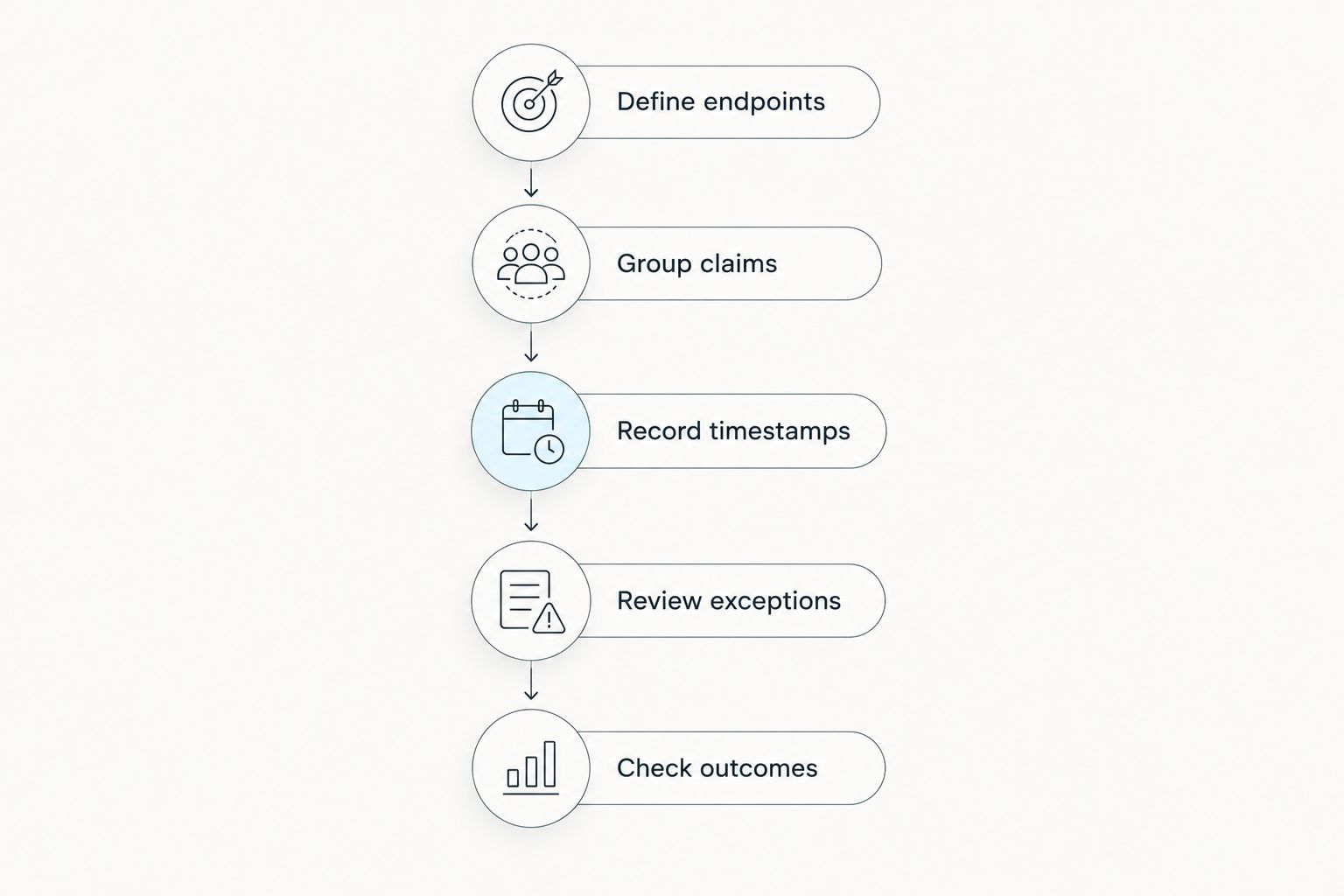
Use a repeatable sequence before accepting a timing claim. The strongest comparison follows equivalent claims to the same endpoint. A shorter measurement window or a different case mix is not evidence of faster settlement.
- Define endpoints. Choose the start and finish events for each metric. Keep end-to-end elapsed time separate from time spent on a particular task.
- Group claims. Separate claims by relevant characteristics, such as line of business, coverage disputes, investigation requirements, and evidence completeness.
- Record timestamps. Capture movement into and out of each stage. Include time waiting for information, review, authorization, and payment.
- Review exceptions. Identify where automation stopped, why it stopped, and whether the receiving team repeated completed work.
- Check outcomes. Examine completed settlements alongside unresolved files, corrections, and reopened claims before drawing a conclusion.
This sequence gives your 2026 evaluation a consistent structure. It also makes a disappointing result actionable: you can identify the stage that remained slow instead of treating the entire implementation as a single undifferentiated result.
Report more than a single average
Report the median alongside a measure that shows the slower end of the completed-claim distribution. Also report unresolved claims separately. Completed claims alone do not describe the experience of files still waiting for a decision.
Keep the reporting definitions stable. If you change eligibility rules, add a new line of business, or alter which files count as complete, mark that change in the comparison. Otherwise, the apparent timing improvement can reflect a changed population.
Keep quality beside speed
Pair settlement timing with measures of decision quality, such as corrections, reopenings, and review findings. Define those measures before evaluating results. A workflow that moves work out of the settlement queue but creates avoidable rework has not demonstrated the same outcome as a clean completion.
Do not turn a speed target into permission to bypass a required review. Keep claims-handling obligations, policy interpretation, and decision authority within the evaluation criteria.
Why AI-assisted settlement time varies
The lifecycle includes intake, triage, coverage, investigation, settlement, and recovery work. The following factors explain why one completion-time promise cannot describe every file:
- Information completeness. Missing loss details or supporting documents leave decisions dependent on a response. Track the request and response interval separately from review time.
- Coverage questions. An unresolved question about whether or how coverage applies needs a decision before settlement can proceed on that basis.
- Investigation requirements. A file routed for investigation follows a different path from a claim ready for settlement review. Preserve that distinction in comparisons.
- Decision authority. A recommendation awaiting an authorized approver remains unfinished work. Record the approval queue rather than counting the recommendation as settlement.
- Payment dependencies. Payment issuance and receipt are different events. State which one your timing metric measures.
Identify the dominant delay before choosing an intervention. Automating intake is not a direct remedy for an approval queue, and faster review does not establish faster payment receipt.
Where Gethesperai fits
Gethesperai's insurance claims automation is best suited to P&C carriers, TPAs, and MGAs seeking automation across the claims lifecycle. The Gethesperai platform covers FNOL intake, triage, coverage, fraud investigation, settlement, and subrogation recovery.
That scope makes lifecycle-level evaluation relevant rather than limiting the assessment to intake. The limitation is equally important: workflow coverage alone does not establish a settlement duration. Ask for evidence tied to your claim groups, approval rules, and chosen payment endpoint.
Can AI settle an insurance claim immediately?
AI processing speed alone does not establish that a claim is ready for immediate settlement. The file still needs the evidence, decisions, and authority required for that claim. A demonstration that ends with a recommendation does not demonstrate completed payment.
Ask what the demonstration actually finishes. Require a clear distinction between information extraction, a proposed decision, an approved settlement, and an issued payment.
Does settlement end when payment is issued?
Payment issuance is a valid endpoint if that is how you define your operational metric, but it is not the same as confirmed receipt. Use explicit labels so your team does not present insurer-side completion as the claimant's complete experience.
For 2026 reporting, retain both timestamps where they are observable. If only issuance is observable, report issuance and leave receipt unclaimed.
FAQ
How long does claims settlement take with AI?
AI-assisted claims settlement has no fixed duration across all claims. The timeline depends on the evidence, coverage decision, investigation, approval process, and payment endpoint.
Does faster FNOL intake mean my claim will settle faster?
Faster FNOL intake does not by itself establish faster settlement. A claim can complete intake and still wait for evidence, coverage review, authorization, or payment.
Can AI settlement software replace every human approval?
You should not assume AI settlement software replaces every human approval. Define permitted actions, authority limits, and exception routes before evaluating an automated workflow.
What should an insurer measure in an AI settlement pilot?
Measure end-to-end elapsed time and the time spent in each workflow stage. Compare equivalent claim groups and review unresolved claims, corrections, and reopened files alongside completed settlements.
Should I compare investigated claims with straightforward claims?
Compare investigated claims with claims requiring equivalent work, not with an unmatched group of straightforward files. Otherwise, the comparison mixes different processing requirements with the effect of automation.
Does Gethesperai automate more than settlement?
Gethesperai provides insurance claims automation across FNOL intake, triage, coverage, fraud investigation, settlement, and subrogation recovery. Its stated audience is property and casualty carriers, TPAs, and MGAs.
Is subrogation recovery part of the claimant settlement clock?
Track subrogation recovery separately from claimant settlement when measuring those distinct outcomes. Recovery activity concerns reimbursement opportunities rather than establishing when the claimant received settlement payment.
One last thing
Inspect the claims that did not finish. A completed-claim report excludes files still waiting, so read it alongside unresolved inventory and the age of those files. That pairing gives you a more useful view than a faster completion figure alone.
Before your next evaluation, ask for the event definitions behind every timing claim. If two figures end at different events, they are not interchangeable—regardless of how prominently they appear in a presentation.


