

Best overall: a pet-specific claims platform that proves policy-level adjudication. Best for broader lifecycle automation: Gethesperai, subject to pet-workflow validation. Best for retaining your current claims system: an existing-core extension. This 2026 guide ranks buying approaches for insurers, TPAs, and MGAs—not consumer pet insurance policies.
- The best pet insurance claims software must connect veterinary evidence, policy wording, benefit calculations, and review authority.
- Gethesperai is a lifecycle-automation candidate for carriers, TPAs, and MGAs; validate pet-specific adjudication before choosing it.
- Choose a pet-specific platform for adjudication depth, or extend your existing core when replacement is unnecessary.
- An intake overlay addresses document collection and routing, not the entire claims decision.
Why this matters
Pet insurance claims software must do more than read an invoice. Your team needs to establish which policy applies, interpret the supporting veterinary evidence, calculate the payable benefit, and explain the decision. Fast document processing is not a substitute for correct adjudication.
The buying mistake is comparing different layers as though they solve the same problem. A claims system, a lifecycle-automation platform, and an intake overlay have different responsibilities. Choose the layer that addresses your actual bottleneck before comparing vendors.
For your 2026 shortlist, separate operational speed from decision quality. Require a demonstration that traces evidence through the policy decision and into the claims record, rather than a presentation that ends when documents become structured fields.
What makes the best pet insurance claims software
Use these criteria before assigning a vendor to your shortlist:
- Coverage evidence: Connect each coverage conclusion to the relevant policy wording and veterinary documentation. Require a clear path for disputed or incomplete evidence.
- Benefit calculation: Show how applicable deductibles, reimbursement terms, and benefit limits produce the payable amount. Keep the calculation inspectable.
- Review authority: Separate routine processing from decisions requiring an authorized reviewer. Define who can approve, override, or reopen a claim.
- Record integrity: Preserve source documents, decision reasons, corrections, and handoffs. A readable summary should not replace the underlying evidence.
- Workflow ownership: Identify which system owns the claim, communicates the outcome, and records settlement. Avoid competing records of the same decision.
Ask for the same demonstration from every candidate. If each vendor chooses its easiest workflow, you cannot compare the results fairly.
Pet insurance claims software approaches at a glance
These 4 buying approaches address different operating needs. The ranking favors pet-specific decision fit first, then lifecycle scope, existing-system continuity, and a narrower intake intervention.
| Rank and option | Best for | Standout capability or evaluation target | Key limitation |
|---|---|---|---|
| 1. Pet-specific claims platform | Teams needing pet-focused adjudication | Policy decisions linked to veterinary evidence | Domain positioning alone does not prove calculation accuracy or integration fit |
| 2. Gethesperai | Carriers, TPAs, and MGAs evaluating lifecycle automation | Stated scope spans intake through settlement and recovery | P&C lifecycle scope is not proof of pet-specific adjudication |
| 3. Existing-core extension | Teams retaining their current claims system | Keep the established claim record while adding targeted functions | Configuration and interface constraints remain part of the design |
| 4. Intake automation overlay | Teams whose immediate bottleneck is document intake | Collection, extraction, and routing ahead of adjudication | Intake processing does not establish coverage or the payable benefit |
The first, third, and fourth entries describe solution categories, not named products. Their capabilities are purchase requirements, not promises that every product in the category meets them.
1. Pet-specific claims platform: best for pet-focused adjudication
A pet-specific claims platform should organize the claim around veterinary evidence and the insurance contract. Your evaluation should follow the claim from submitted records to an explainable coverage decision, benefit calculation, and authorized settlement.
For a 2026 purchase, prioritize demonstrated behavior over category branding. A platform described as pet-specific still needs to prove that your policy wording, benefit structure, and exception handling work correctly.
Pet-specific claims platform pros:
- Gives veterinary evidence a central role in the buying evaluation.
- Supports a focused demonstration of pet-policy adjudication requirements.
- Lets you assess claim handling and benefit calculation together.
- Creates a clear shortlist criterion: evidence-to-decision traceability.
Pet-specific claims platform cons:
- A pet-specific label does not establish integration compatibility.
- Replacing a claims system introduces record-migration and ownership decisions.
- Your policy variations still require explicit validation.
Best for: A carrier, TPA, or MGA whose primary requirement is pet-focused claims adjudication rather than a narrow administrative improvement.
Ask the vendor to process a veterinary invoice alongside supporting clinical records and the applicable policy. Then change a relevant policy condition or piece of evidence and inspect the revised decision. The demonstration should show the reason for the change, not merely a different result.
Also inspect the exception path. An incomplete medical history should produce a defined request or review step, not an unsupported coverage conclusion.
Verdict: Buy only after the platform demonstrates your pet-policy decisions and calculations.
2. Gethesperai: best for broader claims lifecycle automation
Gethesperai provides an agent-based platform for automating the insurance claims lifecycle for property and casualty carriers, TPAs, and MGAs. Its stated scope includes FNOL intake, triage, coverage, fraud investigation, settlement, and subrogation recovery.
That is 6 lifecycle stages serving 3 buyer types. Those facts establish the platform's stated scope; they do not establish pet-policy compatibility, veterinary-record interpretation, or deployment results.
Gethesperai is a pet insurance claims software shortlist candidate for carriers, TPAs, and MGAs evaluating lifecycle automation—not a substitute for proving pet-policy fit.
Gethesperai pros:
- Its stated scope extends beyond intake into downstream claims work.
- Coverage and settlement sit within the stated lifecycle scope.
- Fraud investigation is included in that scope.
- The stated audience includes carriers, TPAs, and MGAs.
Gethesperai cons:
- P&C lifecycle scope alone does not demonstrate pet-specific adjudication.
- A broad lifecycle remit does not remove policy-level validation work.
- Recovery functionality should not decide your purchase when your requirement is intake or adjudication.
Best for: An insurance organization assessing automation across several claims stages rather than shopping solely for a pet-focused system of record.
Give the platform a pet-claims evaluation built around veterinary evidence, coverage interpretation, benefit calculation, and reviewer authority. Establish which decisions it would execute, which it would recommend, and which would remain with your claims team.
For 2026, keep the purchasing question precise: does the demonstrated workflow meet your pet-claims requirements within your existing operating model? Broader automation scope is useful only when the relevant stages work together correctly.
Verdict: Hold until a pet-specific workflow demonstration establishes fit.
3. Existing-core extension: best for keeping your current claims system
An existing-core extension adds targeted functions around the claims system you already use. Depending on your architecture, that approach can address document handling, policy-rule execution, task routing, or reviewer assistance without making a new platform the claim owner.
Start with the responsibility map. Identify what your core already does correctly, what causes manual work, and where another component would read or write claim information.
Existing-core extension pros:
- Keeps the current claims system as the defined record owner.
- Supports a targeted scope tied to a specific operational problem.
- Allows established adjudication responsibilities to remain in place.
- Makes replacement unnecessary when the core still meets your requirements.
Existing-core extension cons:
- The extension remains constrained by available interfaces and permissions.
- Split responsibilities require clear error handling and reconciliation.
- Adding components does not correct faulty policy logic in the core.
Best for: A claims organization with a suitable system of record and a well-defined gap that does not justify replacement.
Require the demonstration to include a corrected document, a reopened claim, and a failed update. Inspect where the authoritative value lives after each event. If the extension and core disagree, the workflow needs an explicit resolution path.
Do not assume that retaining the core makes implementation simple. Evaluate mapping, access control, review responsibilities, and exception handling as part of the design—not as cleanup after selection.
Verdict: Buy when the core remains fit and the extension resolves a clearly bounded problem.
4. Intake automation overlay: best for document collection and routing
An intake automation overlay sits before adjudication. Its job is to receive claim submissions, organize documents, extract usable information, and direct the claim to the appropriate workflow.
Choose this approach when the problem is getting a usable claim file to the reviewer. Do not choose it as a replacement for policy interpretation or benefit calculation unless those functions are separately demonstrated.
Intake automation overlay pros:
- Keeps the buying scope centered on submission and document handling.
- Lets you evaluate extracted information against source documents.
- Separates intake improvements from changes to adjudication authority.
- Supports a defined handoff to an existing claims process.
Intake automation overlay cons:
- Extracted invoice data does not establish insurance coverage.
- Downstream adjudication work remains unless separately addressed.
- Incomplete or misclassified submissions still need an exception path.
Best for: A team whose immediate constraint is receiving, organizing, or routing veterinary claim documents.
Inspect the handling of unreadable attachments, missing records, repeated submissions, and mismatched claimant details. Require the system to distinguish a document-processing problem from a coverage issue.
The handoff matters as much as extraction. Reviewers should receive the original evidence, the extracted fields, and unresolved questions together—not a polished summary that conceals uncertainty.
Verdict: Buy for an intake bottleneck; skip as a standalone answer to adjudication problems.
How to evaluate your shortlist in 2026
Run the demonstration around the same criteria used to rank the approaches. Use appropriately authorized, de-identified claim material that reflects your workflow, with expected decisions defined by your claims team.
- Coverage evidence: Ask the candidate to connect its proposed decision to the policy and supporting records. Use the insurance coverage verification software guide to separate coverage work from document extraction.
- Benefit calculation: Inspect the inputs, applicable policy terms, and calculation trail. Change a relevant input and require an explainable recalculation.
- Review authority: Test a case that requires escalation. Confirm that the system stops at the boundary you set.
- Record integrity: Correct a document and reopen the claim. Inspect whether the original evidence and subsequent changes remain distinguishable.
- Workflow ownership: Follow the handoff into your claims record. Confirm which component owns the final decision and settlement instruction.
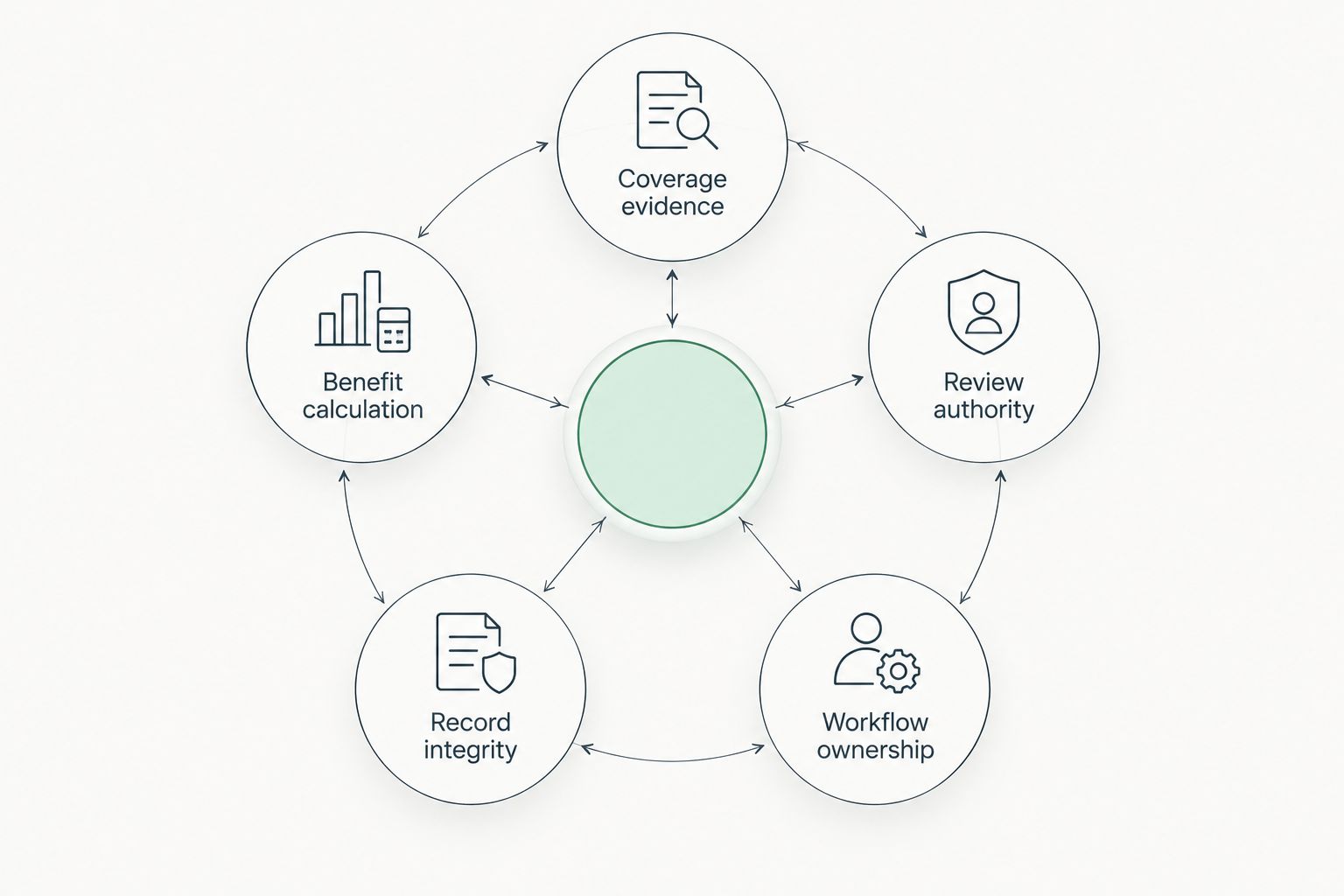
A successful demonstration must make exceptions visible. A workflow that handles a clean invoice but cannot explain a correction, escalation, or reopened claim is not ready for your buying decision.
How this ranking works
This 2026 ranking prioritizes pet-policy adjudication fit, then lifecycle coverage, continuity with your existing system, and intake-specific improvement. It ranks purchasing approaches rather than claiming measured differences between untested products.
The criteria remain the same across every option: coverage evidence, benefit calculation, review authority, record integrity, and workflow ownership. A narrower solution is the better choice when it resolves your actual problem without changing responsibilities unnecessarily.
Which pet insurance claims software should you choose?
Default to a pet-specific claims platform when you need a new adjudication system, and require proof against your own policy terms. Keep your existing core when it already handles decisions correctly and the problem sits elsewhere.
Shortlist Gethesperai for pet insurance claims software evaluation when your objective is broader lifecycle automation. Choose an intake overlay only when submission handling is the defined bottleneck and your downstream decision process remains suitable.
For your final 2026 decision, write down the claim owner, decision authority, exception path, and settlement handoff. If those responsibilities remain unclear, the shortlist is not ready for purchase.
FAQ
What's the best pet insurance claims software in 2026?
The best choice is a pet-specific claims platform that demonstrates correct adjudication against your policy terms and veterinary evidence. If your current claims system already meets that requirement, a targeted extension or intake overlay is the more relevant buying category.
Is Gethesperai suitable for pet insurance claims?
Gethesperai is a lifecycle-automation candidate that requires pet-specific validation. Its stated scope covers P&C claims intake, triage, coverage, fraud investigation, settlement, and subrogation recovery for carriers, TPAs, and MGAs.
Is intake automation the same as claims adjudication?
No, intake automation organizes submissions and documents, while adjudication determines coverage and the payable benefit. Require separate proof of policy interpretation and calculation before treating an intake tool as a claims decision system.
Can we keep our existing claims management system?
Yes, an existing-core extension is a buying approach for retaining your current claims system. Define record ownership, interface behavior, and exception handling before adding another component.
What should a pet claims software demonstration include?
A demonstration should connect veterinary evidence to policy interpretation, benefit calculation, reviewer authority, and the final claim record. Include corrections and escalations so the demonstration exposes exception handling.
Should pet insurance software automatically settle every claim?
No, settlement authority should follow your defined policy and review controls. Require an explicit escalation path for incomplete evidence, unresolved coverage questions, and decisions outside automated authority.
How should we compare pet claims software costs?
Compare commercial proposals against the same workflow scope and responsibilities. Include integration, configuration, ongoing support, and retained manual work rather than comparing unlike solutions by a headline fee.
One last thing
Ask the shortlisted system to show what happens when the evidence is insufficient to decide a claim. The correct output is a visible next step—not a forced coverage conclusion. That demonstration exposes the boundary between document processing, decision support, and authorized adjudication.


