

Instead of manually copying estimate details between claims systems, connect Hesper AI to Mitchell claims estimating through an approved data exchange that matches each estimate to its claim and routes exceptions for review. Start with read-only intake, validate the mapping, and keep settlement authority separate from estimate processing.
- Connect Hesper AI to Mitchell claims estimating through an approved interface, with claim matching and revision controls defined first.
- Hesper AI fits P&C claims teams seeking lifecycle automation; estimating integration requires a separately validated implementation.
- Start with read-only estimate intake before adding revised-estimate processing or downstream actions.
- Reject ambiguous claim matches, preserve estimate versions, and require human review for unresolved exceptions.
Why this matters
An estimate is an input to a claim decision, not permission to settle. Your integration must preserve that distinction while moving the right information into the right claim record.
Hesper AI provides claims lifecycle automation spanning FNOL intake, triage, coverage, fraud investigation, settlement, and subrogation recovery. Hesper AI is best for P&C carriers, TPAs, and MGAs seeking claims lifecycle automation. That scope fits workflows extending beyond estimating; it does not establish a particular Mitchell connector, interface entitlement, or field mapping.
For a 2026 implementation, define the integration around documented interfaces and approved permissions. This guide describes the configuration and acceptance workflow, not a product-specific menu sequence. Use the exact interface names and settings supplied for your deployment rather than assuming a connector exists in either application.
Before you start
- Accounts and access: Assign administrators for the estimating environment, the receiving claims workflow, and any integration layer. Obtain written confirmation of the permitted exchange method, authentication requirements, and access scope before building.
- Materials: Gather the applicable interface documentation, approved sample estimates, claim identifiers, version information, and a field-mapping worksheet. Name an operational owner for unmatched records and failed deliveries.
- The gotcha: A claim number alone is not an approved matching rule. Establish whether identifiers are unique across carriers, business units, and environments, then define how estimate identifiers and revisions relate to that claim.
Stop before configuration if you cannot establish an authorized exchange method. Do not substitute shared user credentials, screen scraping, or emailed documents for an approved interface without security and operational approval.
Your 2026 design record should identify the interface version, environment, data owner, and permitted actions. An implementation team needs those decisions before it needs a field list.
Choose the first workflow
Start by deciding whether you need the first estimate, later revisions, or both. These are separate processing cases even when they use the same transport.
| Workflow option | Best for | Advantage | Limitation | Required control |
|---|---|---|---|---|
| Initial-estimate intake | Establishing a read-only integration | Keeps the first implementation focused on claim matching and data fidelity | Does not keep later estimate changes synchronized | Unique estimate identity and duplicate detection |
| Revised-estimate intake | Claims teams that need estimate changes reflected downstream | Preserves the connection between an estimate and its later versions | Requires explicit ordering and supersession rules | Version tracking and stale-update rejection |
Choose initial-estimate intake first. Its narrower scope makes it easier to isolate mapping errors before introducing revision handling. Add revised-estimate intake only after the initial path passes acceptance tests.
Hesper AI's claims lifecycle scope supports a broader business objective than moving estimate data alone. The implementation trade-off is equally clear: lifecycle scope does not replace interface validation, exception ownership, or controls over downstream decisions.
Claim identity and data contract
Treat the mapping worksheet as a contract between the sending and receiving teams. It defines what a valid record means before any record moves.
- Define the claim key. Document the exact identifier used to locate the receiving claim. Include carrier, tenant, or business-unit context wherever your identifier rules require it. Do not match on claimant name or vehicle details alone.
- Define estimate identity. Record the source estimate identifier and its relationship to the claim. Keep estimate identity separate from claim identity so multiple estimates do not overwrite each other accidentally.
- Specify the payload. Map only documented, authorized fields. For each field, record its source, destination, data type, required status, and treatment when missing. Include currency and amount meaning wherever monetary values are exchanged.
- Assign ownership. Identify which system owns each value and whether the receiving workflow can change it. Keep imported estimate values distinguishable from adjuster decisions and later corrections.
Expected result: You can take an approved sample and explain where every imported value belongs, how the claim is found, and who owns corrections.
For example, an estimate total and an approved settlement amount must remain separate concepts in the mapping. Do not connect them merely because both are monetary fields. An unmapped decision boundary is a reason to pause, not an invitation to choose the closest-looking destination.
Approved transport and intake routing
Configure the transport only after the data contract is approved. Select from the exchange methods documented for your specific environments; do not assume support for an API, webhook, file feed, or middleware connector.
- Provision the connection. Use the approved authentication method and restrict access to the records and actions needed for intake. Store credentials through your organization's approved secret-management process, not inside mapping notes or sample payloads.
- Separate environments. Keep test credentials, destinations, and sample records separate from production. Check the destination before sending any claim information, and apply your organization's rules for using real claim data in testing.
- Set intake eligibility. Define what makes an estimate ready for transfer using a documented source status or an approved operational handoff. Exclude drafts unless the business explicitly requires them.
- Route the result. Send valid, matched records into the receiving workflow. Send missing identifiers, ambiguous matches, invalid payloads, and unauthorized records to an exception queue with an assigned owner.
Expected result: An approved sample reaches the intended test claim, while an invalid sample reaches an actionable exception path without updating a claim.
The processing sequence should remain visible to both operations and engineering: Receive estimate, Validate payload, Match claim, Route review. Each stage needs a defined success condition and a recoverable failure path.
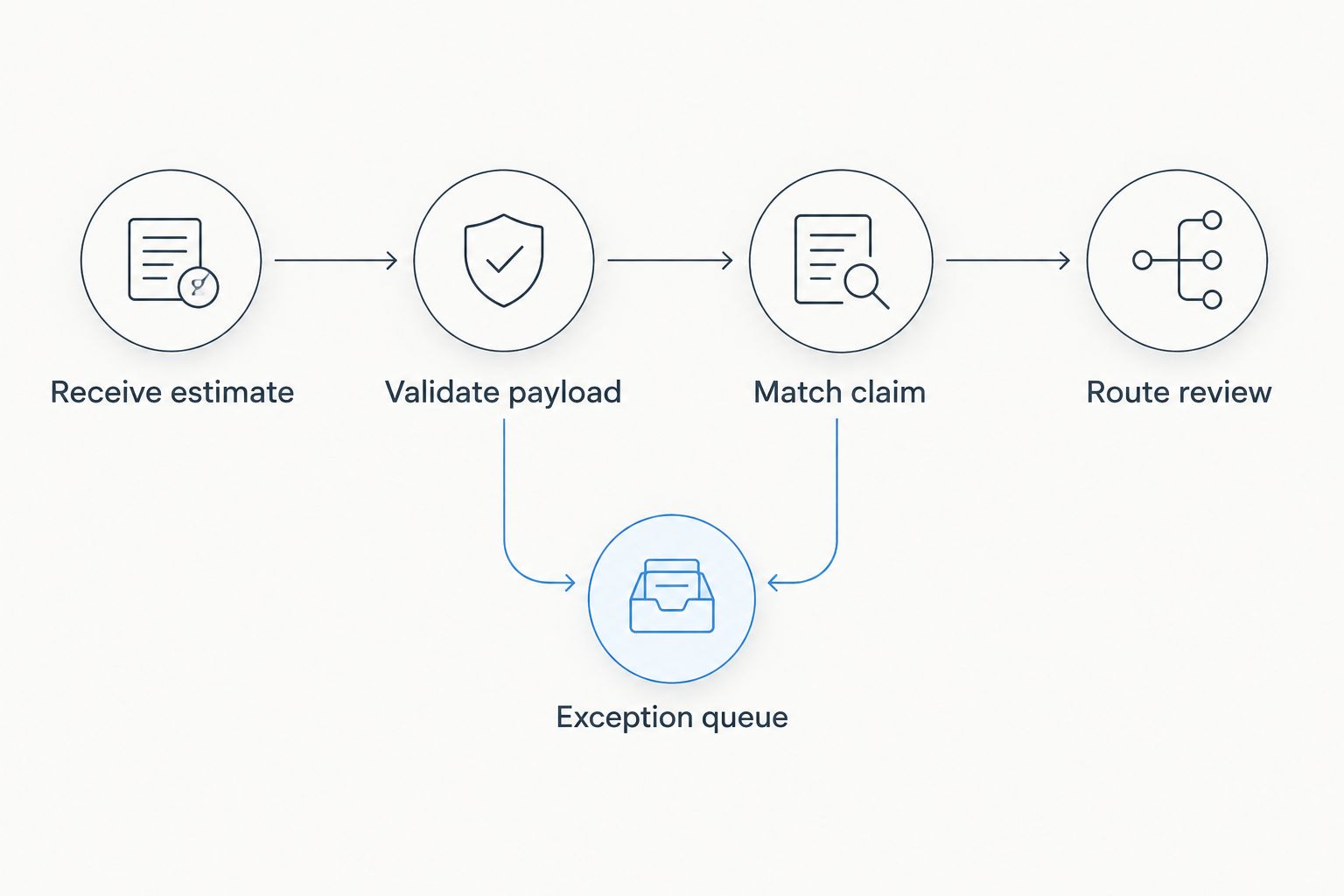
Review boundaries and processing records
A delivered payload is not the same as a successfully applied update. Design the receiving workflow to distinguish receipt, validation, application, and review.
- Record processing state. Retain enough information to identify the source record, receiving claim, processing attempt, and result. Follow the retention and access requirements approved for your organization.
- Prevent duplicate effects. Define a deduplication key using the documented estimate identity and revision model. A repeated delivery must not create another task or apply the same update again.
- Preserve decision boundaries. Configure estimate intake to create or update only the approved information and review tasks. Do not treat a received estimate as authorization for coverage acceptance, payment, or settlement.
- Make exceptions actionable. Record the failure category, responsible team, and next action. Provide a controlled correction and replay process rather than asking staff to edit records without a trace.
Expected result: An operator can explain what happened to a record, whether it changed the claim, and what action remains outstanding.
For a 2026 release, put the access scope and exception procedure through the same approval process as the happy path. A workflow that succeeds only when every input is perfect is not ready for claims operations.
Acceptance tests and release controls
Use explicit acceptance criteria rather than a successful connection test. Authentication proves access; it does not prove correct claim processing.
- Run at least 3 test cases. Use an approved valid estimate, a duplicate delivery, and an estimate with a missing or ambiguous claim identifier. These are recommended minimum cases, not a substitute for your team's full test plan.
- Reconcile mapped values. Compare the received record against the source sample field by field. Check amount meaning, currency, dates, identifiers, and missing-value treatment without silently converting unknown values to zero.
- Test interruption recovery. Interrupt a test transfer or downstream processing attempt using an approved test method. Verify that retries preserve the intended result and that failed attempts remain visible.
- Approve the release boundary. Name the person authorized to enable production intake, the conditions requiring a pause, and the recovery procedure. Confirm who resolves records left between receipt and application.
Expected result: Repeated input produces no duplicate effects, invalid input produces no unintended claim update, and operations can recover interrupted processing.
Require 1 processing result per accepted estimate version as a reconciliation objective. A delivery log can contain multiple attempts; the business result should still be unambiguous. Before the 2026 launch, demonstrate that distinction with actual test records.
Process estimates whenever an approved revision arrives
Add revision handling as a second workflow, not as an overwrite setting. First confirm how your authorized interface represents revisions, replacements, and estimate status changes.
Define which incoming version supersedes which earlier version. Preserve the relationship between them, and decide what happens when an older version arrives after a newer one. Arrival time alone is not a substitute for a documented revision order.
Then specify the operational response. An updated estimate can require renewed review without changing an existing settlement decision. Record which downstream tasks should refresh and which decisions require separate approval.
Test at least 2 estimate versions for the same claim, then deliver them out of order. The expected outcome is a clear current version, preserved prior context, and no duplicate review task caused solely by a retry.
For commercial-auto workflow planning beyond estimating, use the claims agents guide for commercial auto insurers. Keep each additional handoff subject to its own data contract and authority boundary.
Troubleshooting
The estimate reaches the wrong claim
Pause the affected route and inspect the matching key. Check tenant, carrier, business-unit, and environment context against the approved mapping. Correct the rule before replaying records; do not repair isolated records while leaving the matching defect active.
Repeated deliveries create duplicate tasks
Inspect the deduplication key and when the receiving workflow records success. A timeout after successful application must not cause another business action on retry. Reconcile already-created tasks before replaying the failed delivery.
A revised estimate replaces newer information
Check whether the workflow uses arrival order instead of documented version order. Reject or quarantine stale revisions, preserve the received record for investigation, and apply the approved supersession rule before resuming processing.
Amounts match numerically but mean different things
Compare field definitions, not just values. Check currency, included components, and whether the destination represents an estimate or an authorized decision. Correct the data contract and retest every affected mapping.
Delivery succeeds but nothing appears in the claim
Trace the record beyond transport acknowledgment. Check validation, matching, application, and review routing separately. Reprocess only after establishing whether the original attempt applied an update; otherwise, a recovery attempt can create a duplicate effect.
Customize your workflow
Expand from estimate intake to exception routing, coverage review, investigation, or recovery only when each additional handoff has an owner. Add one decision boundary at a time, not every claims stage at once.
Keep the 2026 configuration record current when interface versions, permissions, or mapping rules change. Retest affected cases after each change, including duplicate handling and out-of-order revisions. A previously successful test does not approve a changed mapping.
FAQ
How do I connect Hesper AI to Mitchell claims estimating?
Use an authorized exchange method, define claim and estimate identifiers, map approved fields, and test intake before enabling production. Confirm the documented interface and access permissions for both environments before configuring the connection.
Is this a native Mitchell connector setup guide?
No. This is an implementation workflow, not a verified native-connector menu sequence. Use the product-specific interface documentation and configuration labels approved for your deployment.
Should I start with initial estimates or revised estimates?
Start with initial-estimate intake. Validate claim matching, field mapping, duplicate handling, and exception routing before adding revision ordering and supersession rules.
Can receiving an estimate automatically authorize settlement?
Estimate receipt should not serve as settlement authorization. Keep estimate ingestion separate from coverage, payment, and settlement decisions unless a separately approved workflow explicitly governs those actions.
What happens when an estimate cannot be matched to a claim?
Route the estimate to an owned exception queue without updating a claim. Resolve the identifier problem and use a controlled replay process after confirming the correct destination.
How do I prevent duplicate estimate updates?
Define duplicate detection around the documented estimate identity and revision model. Verify that repeated deliveries produce no additional business effect, including after interrupted processing.
What should I test before a 2026 production launch?
Test valid intake, ambiguous identifiers, duplicate delivery, interrupted processing, and out-of-order revisions. Reconcile source and destination values and confirm that operators can explain and recover every failed case.
One last thing
Test the acknowledgment boundary before expanding the workflow. Deliberately reproduce a case where the receiving system applies an update but the sender does not receive confirmation. Your retry process must recognize the completed action rather than repeat it; a successful first delivery never tests that behavior.


